
Drawing is More Than Just a Hobby: The Surprising Benefits Many People Don't Know
This article dives deep into the unexpected psychological, cognitive, and physical benefits of drawing, proving that picking up a pencil is not just a creative hobby, but a powerful tool for brain health and emotional well-being.

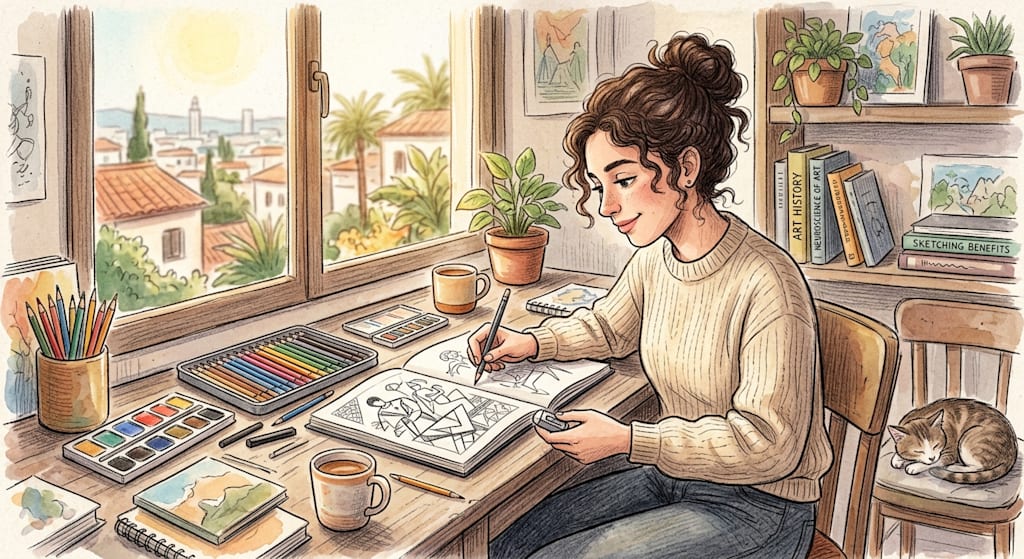
When we think of drawing, we often picture professional artists in quiet studios or children doodling with crayons on scrap paper. For most people, drawing is categorized strictly as a hobby—a pleasant pastime to kill boredom if you happen to possess natural talent. However, viewing drawing through such a narrow lens misses its true value. Scientific research and psychological studies have shown that the act of putting pencil to paper is a transformative practice. It offers a wide array of surprising benefits for the brain, mind, and body that go far beyond creating a pretty picture. A Powerful Weapon Against Stress and Anxiety In our modern, fast-paced world, stress has become a chronic condition. Many people turn to meditation or exercise to cope, but drawing offers a uniquely effective alternative. When you draw, you enter a psychological state known as "flow." This is a state of deep absorption where your worries, anxieties, and the chaotic noise of daily life simply fade away. The repetitive motion of sketching and shading regulates your nervous system, slowing down your heart rate and lowering cortisol levels. Unlike passive activities like scrolling through social media, which can actually increase anxiety, drawing actively engages your brain in a calming, rhythmic task. It serves as an emotional escape valve, allowing you to process heavy emotions without needing to find the right words to speak them. Enhancing Memory and Cognitive Function One of the most surprising benefits of drawing is its profound impact on memory and cognitive longevity. A study conducted by researchers at the University of Waterloo discovered that drawing information is one of the most effective ways to retain it. In fact, drawing was found to boost memory retention far better than writing notes, visualization, or simply looking at images. This happens because drawing forces the brain to process information in multiple ways simultaneously: visually, spatially, and kinesthetically. It creates a robust "memory trace" in the mind. Because of this powerful neurological engagement, engaging in drawing regularly is increasingly recommended as a preventative practice to keep the brain sharp and delay cognitive decline in older adults. Rewiring the Brain Through Neuroplasticity Every time you pick up a pencil to sketch, you are essentially giving your brain a rigorous workout. Drawing requires intense coordination between the eyes, hands, and various regions of the brain responsible for spatial awareness, geometry, and pattern recognition. This complex coordination stimulates neuroplasticity—the brain's ability to reorganize itself by forming new neural connections. As you analyze shapes, calculate proportions, and decide how light falls on an object, you are sharpening your problem-solving skills and enhancing your visual literacy. People who practice drawing regularly often find that they become much more observant in their daily lives, noticing fine details, textures, and subtle changes in their environment that others completely overlook. The Rise of Fine Motor Skills and Focus We live in a digital age dominated by typing, tapping, and swiping on smooth screens. This reliance on technology has led to a gradual decline in fine motor skills and hand-eye coordination for many individuals. Drawing acts as an antidote to this digital numbness. Controlling a pencil requires a high degree of precision, strengthening the small muscles in the hands and wrists while refining neural pathways. Furthermore, drawing is an exercise in sustained attention. In an era where human attention spans are shrinking due to short-form digital content, sitting down to complete a drawing forces you to practice patience and prolonged focus. It trains your mind to resist distractions, a skill that directly translates into improved productivity and concentration in your professional and academic life. Conclusion: A Universal Tool for Well-being The greatest misconception about drawing is that you need to be "good at it" to reap its rewards. The psychological and neurological benefits of drawing do not care if your final sketch looks like a masterpiece or a childlike doodle. The magic lies entirely within the process of creation, not the final product. Drawing is a universal, low-cost, and deeply accessible tool for self-care, brain health, and personal growth. It is a language of the subconscious, a gym for the brain, and a sanctuary for the stressed mind. So, the next time you feel overwhelmed, forgetful, or mentally fatigued, do not hesitate. Pick up a pencil, find a blank piece of paper, and start drawing—your brain and body will thank you for it.
About the Creator
Yasmine Yessou
I’m Yasmine, a writer of diverse stories and articles. I share mystery, suspense, supernatural tales, and reflections that inspire, engage, and leave a lasting impression.
Enjoyed the story? Support the Creator.
Subscribe for free to receive all their stories in your feed.
Comments
There are no comments for this story
Be the first to respond and start the conversation.