
Zhipu Had the Best Model and the Worst Timing
A 429 error, a 194-million-user gap, and three profit models that explain why the best technology doesn't always win the public.
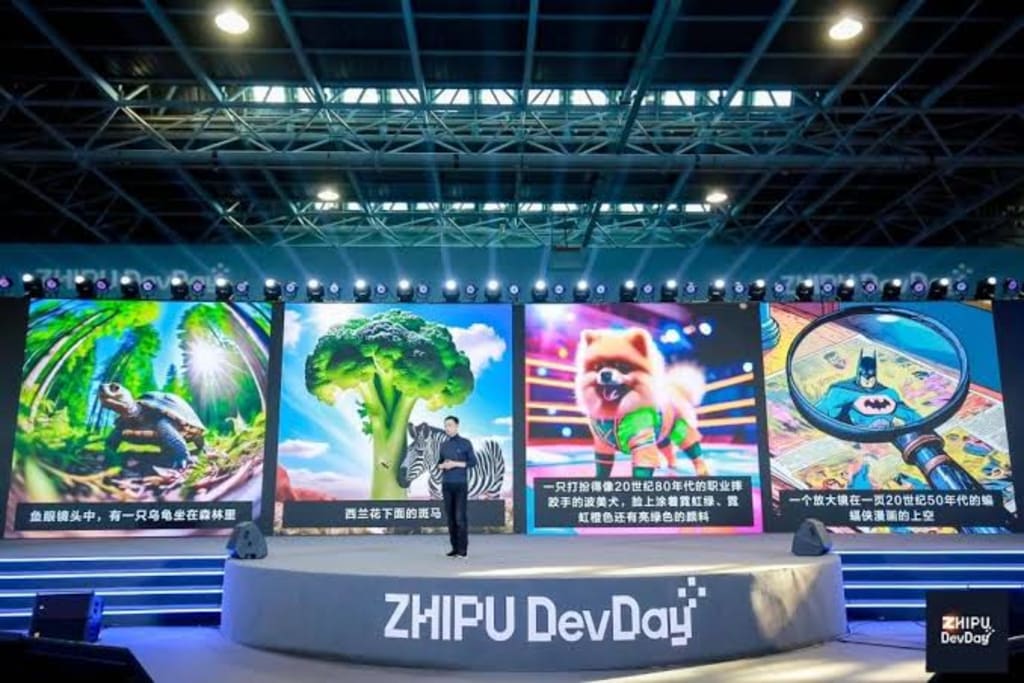
In July 2026, Zhipu Qingyan's monthly active users stood at 1.94 million. Over the same period, Doubao had 338 million, and DeepSeek had 94.17 million. Put those three numbers together and you have a gap that does not require much explanation. But something more interesting was happening on another axis: GLM-5 scored 77.8% on SWE-bench Verified, first among open-source models; GLM-4.7 topped the Hugging Face trending list; GLM-5.2 triggered nearly a thousand points of discussion on Hacker News. The way overseas developer communities evaluate Zhipu and the way the domestic public perceives it are almost descriptions of two different companies.
The starting point of this rift is not a failed marketing campaign, nor is it a case of technology going unseen. It lies in one specific product moment, in three separately viable profit curves, and in three different understandings of the phrase "application scenarios."
1. 429: A Crack That Closed the Window to Public Awareness
Around 2025, GLM subscriptions were, for a time, snapped up within developer circles. A secondary market emerged on Xianyu, where people who managed to get a subscription could resell it at a markup. That scarcity could have settled into reputational capital. Instead, repeated 429 errors during peak hours turned it into something else.
Zhejiang TV reported one case. An entrepreneur in Hangzhou who builds AI websites bought Zhipu's Pro plan for 149 yuan per month. His backend showed that only 7% of his quota had been used when the service was throttled. He tried running multiple accounts in parallel to get around the limit and was blocked anyway. Throttling itself is normal. Any company serving inference has capacity ceilings. The problem was that the rules of throttling were opaque. Users did not know how the "complexity coefficient" was calculated or where the threshold lay. They only knew that after paying, at some moment they could not predict, the service would stop.
An even more glaring example came from a higher-paying user. One user bought the Max plan at 2,400 yuan per year, left a comment in the community saying "it's completely unusable," and then switched to DeepSeek's API. The experience of your product colleague next door is almost a replica of this narrative: he got a GLM subscription, used it for a few days, asked for a refund, and switched to DeepSeek to top up API credits. He did not leave because Zhipu's model was bad. He left because it was not there when he needed it.
The damage this did to Zhipu's public perception was not primarily about how many C-end paying users it lost. The problem is that in one of the places where things should never go wrong, basic service stability after payment, it left an impression that is hard to erase. Developers can vote with their feet and switch APIs to keep working. But once the broader public market settles on "Zhipu = laggy" as a stereotype, the window for awareness is basically closed.
Doubao's fame comes from Douyin's traffic irrigation and its national-level reach on the app side. Someone who has never cared about model parameters may download Doubao after scrolling past a short video, find it "not bad," and stay. DeepSeek's fame comes from the brand momentum it built in open-source communities after R1 as a category of its own. Developers quote it over and over on Hacker News, on GitHub, and in every technical group chat, and that quoting is itself advertising. Zhipu Qingyan lacks an entry point that can speak to the public continuously and reliably. The 429 incident did not create this structural weakness; it simply cut another opening into it.
2. Three Profit Curves: Who Pays for "Intelligence," and What Are They Paying For?
The differences among the three companies' profit models essentially come down to different answers to the same question: who is willing to pay for "intelligence," and in what form.
Zhipu chose institutions and governments. In 2025, Zhipu's full-year revenue was 724 million yuan, with local deployment contributing 534 million yuan, or 73.7%. Local deployment means installing the GLM model into the own servers of governments, central state-owned enterprises, and financial institutions, delivering an AI system whose data does not leave the domain and which is auditable and controllable. This is a project-based business: large single contracts, high barriers to entry, strong renewal inertia once signed. But the cost is written in the gross margin. Local deployment gross margin slid from 66.0% in 2024 to 48.8% in 2025, which the company explained as "investing more delivery resources to meet customer needs." Scale was expanding, but marginal costs did not come down as expected. At the same time, R&D expenses in 2025 were 3.180 billion yuan, 4.4 times full-year revenue; net loss was 4.718 billion yuan, widening 59.5% year over year. Government and enterprise project work provided the revenue base, but the base itself cannot support the R&D consumption of a foundation-model company.
Doubao chose national-level traffic, then monetized inside ByteDance's platform. Monthly active users once reached 345 million, average daily token calls hit 180 trillion, and API prices were pressed down to one-tenth of the industry average. Core C-end features are free, and revenue comes from two places: paid subscriptions ranging from 68 to 500 yuan, and commissions embedded in ByteDance's transaction network (about 12% comprehensive fee on hotel orders, with ride-hailing in gray-box testing). In the first half of 2026, Doubao's daily revenue was less than 1 million yuan, almost all from e-commerce commissions, while daily compute costs alone ran into tens of millions of yuan. AI itself is not the revenue source here. The entry point captures consumer intent and channels that intent into a transaction loop ByteDance has already proven. Its precondition is that ByteDance simultaneously holds C-end traffic, a B-end delivery channel, and a compute base. All three are indispensable. Another company trying to copy this playbook cannot.
DeepSeek chose developers and enterprises, turning an extremely cost-effective API into infrastructure. In the first seven months of 2026, DeepSeek's revenue was 475 million yuan, already about ten times its full-year 2025 revenue; API business gross margin was 82.9%, and overall gross margin was 44.6%. That margin did not come from raising prices. It came from extreme optimization of inference efficiency. Running models on fewer chips, pressing unit costs down, and then selling at a price still far below closed-source flagships. DeepSeek V4-Pro's peak output price was raised to $3.96, but it remained below Kimi K3's $15 and Claude Opus 5's $25. It chases becoming the layer that as many developers and enterprises as possible "call by default." C-end monthly active user scale is not the metric it optimizes for. Open-source weights further reinforce that position: when cloud providers can deploy DeepSeek directly with native frameworks and get performance and cost close to official levels, it becomes a reasoning base that the entire industry can share.
3. The Mismatch of Scenarios: Who Serves Decisions, Who Serves Execution, Who Serves Organizational Loops
The split in profit models, projected onto application scenarios, produces a very clear set of mismatches.
Doubao occupies the broadest daily decision-making scenarios. Chatting, retrieval, creation, image and video generation. It reaches the micro-decisions a person encounters every day. Much of Doubao's brand awareness comes from this broad-spectrum positioning: an ordinary person opens Doubao without needing to know what an Agent is or what a long-horizon task is, and still gets perceptible value. But the other side of broad spectrum is a depth ceiling. ByteDance's Seed team has produced Seedance, a first-tier global video generation model, but in text and coding tasks, Doubao is not the first choice for programmers and researchers. This imbalance does not affect Doubao's public perception, because the mass market never used coding ability as its first yardstick.
DeepSeek occupies deep productivity execution scenarios. Code generation, mathematical reasoning, long-text processing, scientific research tasks. Its user profile is narrower, but loyalty is higher. Once a developer embeds DeepSeek into their workflow, switching cost does not come from interface habits but from rational calculation of output quality and call cost. In early 2025, DeepSeek once held nearly 80% of the open-source model market, later falling back to around 40% as models such as Qwen rose, but its position as "a brand in a class of its own among open-source weights" has not been shaken. Developers cite and recommend it again and again in technical communities. That, not advertising, is where its fame comes from.
Zhipu occupies organizational-level long-horizon task loops. Industry knowledge bases, enterprise Agents, and locally deployed autonomous and controllable AI systems in government, finance, and energy scenarios. GLM-5's capability in long-horizon Agent tasks is a technical highlight, but the delivery target for such scenarios is institutions, not individuals. Delivery cycles are long, customization is high, and the acceptance standard is project documentation, not monthly active user numbers. Overseas developers can "perceive" Zhipu by downloading weights, running benchmarks, and arguing on Hacker News. The domestic public has no such touchpoint. Zhipu's invisibility in public perception is, to a large extent, determined by its scenario choice: it serves organizations, while the yardstick of public awareness measures individuals.
4. Between Two Evaluation Systems
Zhipu's predicament is not a simple mismatch between technical strength and market perception. It is a company that chose to serve organizations and developers, placed in a market where public awareness is defined by traffic scale and daily experience, and measured by that market's yardstick. The 429 incident exhausted its trust among C-end paying users, the traffic structure gap made its voice hard to penetrate to the public level, and the government-enterprise project-based profit model and application scenarios naturally left it without a touchpoint that hundreds of millions of users would open every day.
Doubao wins on breadth of reach, DeepSeek wins on irreplaceability within technical workflows, and Zhipu wins on barriers and gross margin space in the government-enterprise market. Each has its own business logic. Overseas developers evaluate Zhipu by paper quality, degree of open source, and API stability. The domestic public evaluates it by open rates and topic heat. What lies between the two evaluation systems is not a difference in technical level, but the distance between the product and people.
The product colleague who canceled his GLM subscription and went off to top up DeepSeek's API later said one thing in the group chat: "Zhipu's model is actually pretty good. It's just that when I need it, it's often not there." That sentence could probably be posted at the entrance to Zhipu's domestic awareness dilemma, as a footnote.
About the Creator
Jin
Writer of reamstories
https://reamstories.com/jin
Enjoyed the story? Support the Creator.
Subscribe for free to receive all their stories in your feed. You could also become a paid subscriber, letting them know you appreciate their work.
Comments
There are no comments for this story
Be the first to respond and start the conversation.