
You've Got Mail, Fayetteville
A screeching modem, a screen name called Grunt66 and the night an Army town got a lot smaller

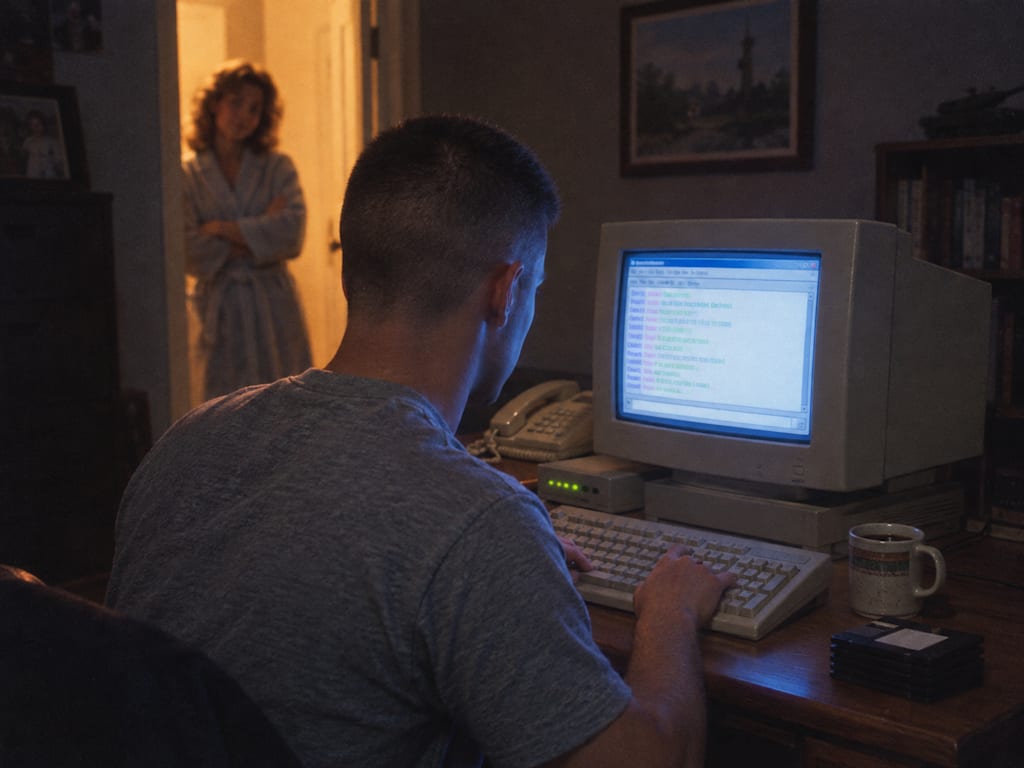
The first thing I remember about the internet is the noise.
If you were there, you already hear it. If you weren't, I'm not sure I can do it justice. It started with a dial tone, then a quick run of beeps as the modem dialed a local number. Then came a shriek, a hiss, a sound like a fax machine arguing with a tea kettle, and a long burst of static that seemed to go on forever. For about thirty seconds, every time, I was sure I had broken something.
Then the noise stopped, and a cheerful voice came out of the speakers and said, "Welcome."
That was America Online. That was Fayetteville, North Carolina. And that was the night a soldier who had spent his whole adult life learning to read terrain, maps and people sat down in front of a beige computer and realized he had no idea where he was.
The Disk on the Counter
Anyone who lived in America in the 1990s remembers the AOL disks. They showed up everywhere. They came in the mail. They were stacked at the checkout at the grocery store. They fell out of magazines. They were taped to cereal boxes, or at least it felt that way. You could have shingled a roof in Fayetteville with the free trial disks that came through our mailbox.
For a while, ours sat on the kitchen counter next to the phone bills. My wife, Frances, would move it out of the way to set something down, and I would move it back. Neither of us threw it away. I think we both knew that one day curiosity was going to win.
Fayetteville was an Army town through and through, sitting right outside Fort Bragg. Life there ran on formations, field time and the training calendar. Computers were starting to show up at work, but for most of us they were tools for typing up evaluations and counseling statements, not windows to anywhere. The internet was something you heard about on the news. It was for college kids, scientists and people who used words like "information superhighway" with a straight face.
Then one evening, after the kids were in bed, I picked up that disk, slid it into the drive and decided to find out what all the noise was about.
Choosing a Name
Before AOL would let me go anywhere, it wanted to know who I was.
This turned out to be harder than I expected. The Army had given me a name, a rank, a service number and a job title. I had never once in my life been asked to invent a name for myself. Now a little box on the screen was blinking at me, waiting.
I want to say I gave it a lot of thought. I did not. I typed the most honest thing I could think of about myself at that moment in my life:
Grunt66
Infantryman, born in 1966. Short, simple, accurate. AOL didn't give you many letters to work with in those days, and I wasn't about to waste them on anything clever. I remember sitting back and feeling oddly proud of it, as if I had just been issued a call sign.
Frances, who had wandered in to see what the screeching was about, read it over my shoulder and said, "That's what you went with?"
I told her it was tactical. She told me it was the least surprising thing she had ever seen. We were both right.
Into the Chat Rooms
I'd like to tell you I spent my first night online doing something useful. Reading the news. Checking the weather. Learning something.
Instead, I found the chat rooms.
If you never used AOL chat, picture a room full of strangers all talking at once, except nobody can see anybody, and everybody is typing. Lines of text scrolled up the screen faster than I could read them. Screen names I didn't recognize popped in and out. Someone would say hello, someone else would ask where everyone was from, and three conversations would tangle into one. It was loud without making a sound.
I typed my first message with two fingers. I believe it was "Hello from North Carolina." It vanished up the screen almost instantly, buried under a dozen other lines. Nobody answered. I typed it again. Still nothing.
That was my first lesson about the internet. It doesn't care who you are. Rank doesn't follow you in there. Nobody stands up when you walk into the room.
Eventually, I found a room for military folks, and that is where things changed.
The Stranger from Ohio
Somebody in that room had a screen name I've long since forgotten, something with "Vet" in it and a string of numbers after. He noticed my name and asked if I was really a grunt or just playing one on the computer. I told him I was the real thing and where I was. He told me he had been an infantryman too, a long time before me. Vietnam. He lived in Ohio now and had a grandson who had just enlisted.
We talked for well over an hour.
We compared notes on things that hadn't changed in thirty years, like bad boots, long road marches and sergeants who could find you no matter where you hid. We talked about things that had changed a great deal, like night vision, radios and the way the Army trained. He asked me questions his grandson wouldn't know to ask yet. I answered as honestly as I could, and he told me a few things he said he hadn't talked about in years.
At one point he typed something I've never forgotten. It went something like this: "Funny. I've got neighbors I've never said ten words to, and I'm telling you this."
I didn't really understand it then. I do now.
There was something about that glowing screen, in a quiet house, late at night, that made it easier for two men to talk. No faces. No posture. No need to look tough or squared away. Just words, going back and forth across a few hundred miles of phone line.
The Phone Bill
Around midnight, Frances came back to the doorway and said, "You know nobody can call this house, right?"
I had not known that. It had never occurred to me that when the modem was connected, the phone line was busy. If anyone had tried to reach us that night, including my unit, they would have gotten a busy signal for hours. For a soldier, that was not a small thing. I signed off in a hurry.
Then there was the bill. In those days, AOL charged by the hour once you went past your free time. I had used up a good chunk of my trial in one sitting, and I had no idea how much I had spent. I spent the next few days waiting for an envelope that would explain to me, in dollars, exactly how much an evening of chatting with strangers was worth.
When it came, it wasn't ruinous, but it was enough to get my attention. Frances and I had a short and very productive discussion about operational limits. After that, I set a timer.
I'd love to tell you I stuck to it.
What It Meant
It's easy to laugh at those early days. The screeching modem. The tiny screen. The screen name with numbers on the end. The way we all thought a few hundred people in a chat room was the biggest crowd in the world.
But looking back now, after nearly thirty years in uniform and the years that followed, I can see what that first night really gave me.
It showed me that distance was changing. All my life, being a soldier meant being far away. Letters took weeks. Phone calls home were expensive and rare. When you left, you were gone. That night in Fayetteville, I talked in real time with a stranger hundreds of miles away as easily as if he were sitting across the table.
Years later, that idea stopped being a novelty and became a lifeline. On deployments, email became the thread that held families together. A short message from home at the end of a long day could carry a soldier for a week. I watched young troops line up for computers the way earlier generations had lined up for mail call. Every time I saw it, I thought back to that beige computer on the desk in Fayetteville and the noise it made.
It also taught me something about people. That old infantryman from Ohio didn't need a ceremony or a reunion to say what was on his mind. He just needed someone on the other end who understood, and a little bit of distance to make it feel safe. I've thought about that many times since, as a leader and as a writer. Sometimes the right setting matters more than the right words.
And honestly, it opened the door to the life I have now. Today I write articles, books and songs, and almost all of it finds its readers and listeners online. Every time I hit "publish," some small part of me still expects to hear a screech and a hiss, and then that cheerful voice saying, "Welcome."
Signing Off
I don't remember exactly when I let Grunt66 go. At some point, AOL gave way to other services, the disks stopped coming in the mail, and the modem went quiet for good. The screen name faded out the way old call signs do, without a ceremony.
But I still think about that first night. A soldier in an Army town, a stack of free disks, a wife shaking her head in the doorway, and a stranger in Ohio who typed the words he couldn't say out loud.
The internet is a very different place now. It is faster, louder and a lot less innocent. But every now and then, I still find what I found that first night: someone on the other side of the screen who gets it.
That was worth the phone bill.
Grunt66, signing off.
About the Creator
Charles V Sasser Jr
Retired U.S. Army CSM, SOFREP defense analyst, and author of the thriller Led by Love of Country. I translate military doctrine into strategic insights on global conflicts, defense technology, and executive leadership.
Enjoyed the story? Support the Creator.
Subscribe for free to receive all their stories in your feed. You could also become a paid subscriber, letting them know you appreciate their work.
Comments
There are no comments for this story
Be the first to respond and start the conversation.