
Your AI Rules Are Now Your Biggest Problem – Here's Why GPT‑6 Astra Demands You Delete Them
As models get smarter, the instructions you wrote for older versions become liabilities. Learn how to move from command‑stacking to context‑routing – and finally unshackle your AI.
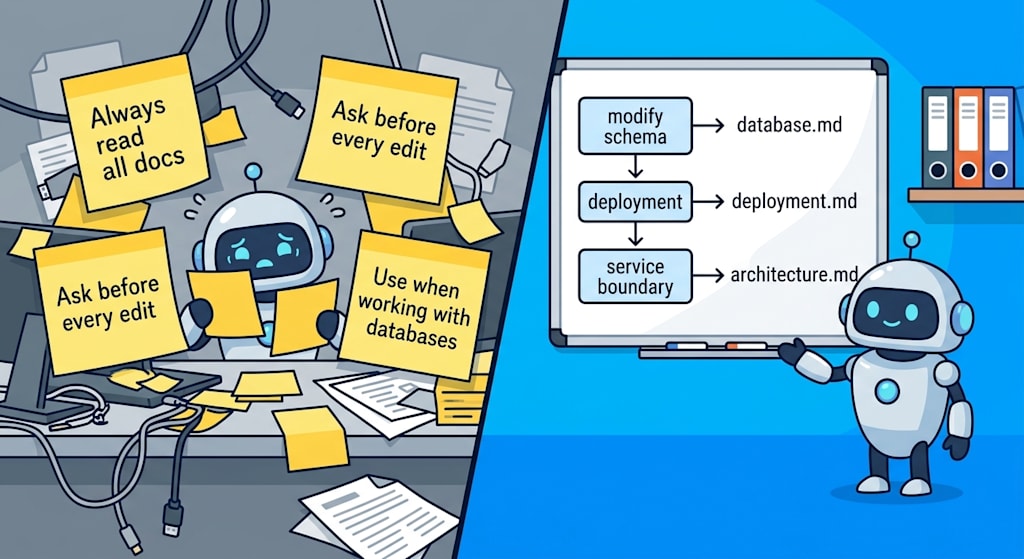
You open your project. Your AI coding assistant reads AGENTS.md, loads every Skill description, and stops. "This rule says read all documentation before every edit. That rule says load only on demand. Which should I follow?" It's not being difficult. It's doing exactly what you asked.
In early 2026, OpenAI published Rethinking Skills and Prompts for GPT‑6 Astra. The central argument: as models improve, more rules can mean worse results.
From GPT‑5.6 Sol to GPT‑6 Astra, the shift in model capability changes the logic of prompt engineering. The "best practices" accumulated over the past two years may work against you. This article explains why, and how to fix it.
I. Why Instructions Get Heavier
Two changes in Astra explain why old rules fail.
Instruction Sensitivity. Astra reads every instruction in Skills, AGENTS.md, and system prompts with literal precision. Earlier models ignored vague or contradictory rules. Astra executes them.
Picture a desk covered in sticky notes. One says "Check daily." Another says "Process deprecated." A third says "Ignore deprecation notices." Your old assistant ignored the mess. Astra reads all three and asks which to follow.
This is what developers are seeing.
Autonomous Decision‑Making. OpenAI's direction from GPT‑5.4 to GPT‑6 Astra is clear: let the model choose its own task path.
Earlier models needed instructions like a map for someone who doesn't know the way. Astra already knows the way. Hand it an old map covered in annotations, and it gets lost. Should it follow the map or its own judgment?
We used to write prompts to teach. Now we write them to let go.
II. Deconstruction: Two Checklists
Before rewriting, extract anchors from both sides.
From Astra Architectural Logic (Primary Skill):
Context routing over instruction stacking—tell the model what to load under what conditions, not what to do every time. Skill triggers must be task‑specific—describe when to load, not what it's related to. Rules need conditional boundaries—replace unconditional commands with conditional indices. Preserve autonomous space—set guardrails only for high‑risk operations. Load on demand—avoid pre‑loading context.
From Legacy Issues (Constraint Skill):
Forbidden prefixes include "Always," "Never," "Every time," and "Ask before" as unconditional commands. Avoid "Use when working with [broad category]" patterns. Avoid a single all‑purpose AGENTS.md that lists everything. Use routing tables—task to document mappings. Test every rule: if deleting it leaves the model doing the right thing, the rule is redundant.
III. Conflict Resolution
Anticipate clashes before writing.
Anticipated Conflicts:
How to describe a database Skill without using "database" or "model" when precision is required? How to keep safeguards for production operations while preserving autonomous space? How to make the model read documentation only when needed, not pre‑load everything?
Resolution Rules:
Position sets the anchor; form sets the tone. When Astra demands a routing rule and the constraint forbids broad phrasing, keep both. The primary skill decides that a rule must exist. The constraint decides it must not say "related to X." Find the task‑specific formulation.
If you cannot find a formulation that satisfies both, translation is not done. Go back to the task. Define exactly when the Skill should load. This is not a failure—it means the fusion process is incomplete.
When conflict involves the model's baseline capability, the constraint yields. If a rule truly needs a pre‑check every time—such as production deployments—keep it. But rephrase it. Say "Load deployment.md when preparing a deployment," not "Before every deployment, run these ten checks."
IV. Translation: From Architecture to Configuration
Turn each architectural requirement into a concrete configuration.
Mapping:
When the primary skill says "establish context routing here," do not say "use when working with databases." Say "use when adding or changing a migration, or reviewing its rollout."
When the primary skill says "Skills must have precise triggers," do not use broad tags. Use action verbs—adding, changing, reviewing—to define scope. Let the model judge; do not judge for it.
When the primary skill says "rules need conditional boundaries," do not say "before every edit." Build a routing table. Modify service boundary? Load architecture.md. Modify schema? Load database.md. Prepare deployment? Load deployment.md.
When the primary skill says "preserve autonomous space," do not say "ask before modifying additional files." Narrow confirmations: "When a command would modify production data, output a plan and wait for confirmation."
When the primary skill says "load on demand," load only Skill name and description at startup. Load the full Skill only when triggered.
Key Translations:
A Skill description that reads "Use when working with databases, queries, models, or persistence" becomes "Use when adding or changing a migration, or reviewing its rollout."
An AGENTS.md entry that reads "Before every edit, read architecture.md, database.md, and deployment.md" becomes "Use architecture.md for service boundaries, database.md for schema changes, and deployment.md when preparing a deployment."
A confirmation rule that reads "Ask before modifying additional files. Ask before making architectural decisions" becomes "Before modifying production data or deleting resources, output a plan and wait for confirmation."
V. Self‑Check While Writing
Check after finishing each functional module.
Decision Tree:
Is the skeleton there? Delete this rule. Would the model behave differently? If no, rewrite. If yes, pass.
Is the flesh unique? Replace the task name—say, change "migration" to "deployment." Does the rule still make sense? If yes, it is too broad. Replace with a more precise description. If no, pass.
Is it honest? Does this rule tell the model what to do, or under what conditions to load what? If the latter, pass. If the former—imperative—go back to routing‑table thinking.
Pattern Scan:
After passing the tree, scan for "Always," "Never," and "Every time." Replace each with conditional indexing. Scan for "Ask before." Verify it is a high‑risk operation. If not, delete it. Scan for "working with," "related to," and "pertaining to." Each indicates a description that is still too broad. Narrow it to a concrete task.
VI. Final Validation
Check against the primary skill. All Skill descriptions changed from "relevance" to "task"? AGENTS.md changed from command list to routing table? Confirmations reduced to high‑risk operations only? On‑demand loading achieved for every module? Autonomous space preserved?
Check against the constraint skill. Forbidden prefixes—Always, Never, Every time, Ask before—are zero‑occurrence? Any rule that could be dropped into another project's configuration? That indicates a reused pattern—are confirmations repeated across modules? Any pseudo‑precision—surface specificity that is still broad underneath? Information conveyed via task to document mappings, not "the model should do X" commands?
VII. A Case Study: Superpowers
Superpowers is the project least suited to Astra.
Its philosophy: if any Skill might apply, invoke it. The using‑superpowers Skill calls a Skill if there is even one percent chance it applies. It runs the Skill check before every response, question, file inspection, or code review.
This discipline helped GPT‑4. In Astra, it forces the model off its natural trajectory onto a prescribed one. The results are over‑triggering—ordinary tasks load irrelevant Skills. Decision interference—the model cannot judge and follow process at the same time. Context bloat—each judgment loads extra information.
The author has adjusted the process. But the core philosophy—constraint as discipline—is no longer necessary.
What many AGENTS.md files record is the defect of the previous model. As the model improves, those patches become shackles.
VIII. The Capability Gap
This is not new. At GPT‑5.6 Sol, the community noticed. Anthropic said of Fable 5: "Superpower has become a negative optimisation—it wastes tokens and does nothing useful."
Why is Astra different? Because Astra's instruction‑following exceeds Sol's. The better the model follows instructions, the more fully legacy rules execute their side effects.
Capability rises. Prompt updates lag. The gap is where negative optimisation lives.
That AGENTS.md you wrote a year ago may now be a burden.
IX. Prompt Engineering Is Now Context Architecture
Astra‑era prompt design is Context Architecture, not Prompt Engineering.
Prompt Engineering means telling the model how to do something. Context Architecture means helping the model find the right information.
Astra already knows how. It does not need more instructions. It needs precise context indices.
OpenAI calls this Harness Engineering: a precise set of context indices and constraints that let the model load on demand and decide autonomously.
X. Every Model Upgrade Is a Debt Settlement
"If you learn slowly enough, you do not have to learn at all."
This applies to prompt engineering. Use GPT‑4 era "best practices" for GPT‑6 Astra, and your technical debt may break the model.
Prompt maintenance is part of model migration. Every upgrade requires a re‑evaluation of the prompt system.
In the GPT‑6 Astra era, the best prompt engineering may be writing fewer rules.
Or: writing the right rules, not more rules.
About the Creator
Jin
Writer of reamstories
https://reamstories.com/jin
Enjoyed the story? Support the Creator.
Subscribe for free to receive all their stories in your feed. You could also become a paid subscriber, letting them know you appreciate their work.
Comments
There are no comments for this story
Be the first to respond and start the conversation.