
Your AI Knows Everything Except Your Business
Building a product has never been cheaper. Getting customers has never been harder. Inside the system more than 100 founders use to make AI actually market their business.
Building a product has never been cheaper. A quarter of Y Combinator's Winter 2025 batch shipped with codebases that were 95% AI-generated, and by early 2026, 92% of US developers were coding with AI. A solo founder can now build in a weekend what used to take a funded team a quarter.
Marketing that product has never been harder. When anyone can ship, everyone does, and attention becomes the bottleneck. 80% of marketers now use AI for content creation, which means every inbox, feed, and search result is flooded with output from the same handful of models. HubSpot's 2026 State of Marketing report puts it bluntly: more content is now generated by AI than by humans, most of it is average, and brands without a clear point of view are getting lost in it.
Founders feel this every day. They ship a product, open ChatGPT or Claude, ask for a launch post or a cold email, and get back something that sounds like every other startup on the internet. They are not imagining it. When Brafton surveyed 132 marketers using AI in their workflows, the number one concern by a wide margin was that the output sounds thin and generic. The tool is powerful. The output is interchangeable. And interchangeable does not convert.
The math of startups has inverted. Distribution used to be the easy part and product the hard part. Now the product takes a weekend and distribution decides who survives.
Nik Vassev saw this pattern more than fifty times before he decided to fix it. Today, over 100 early-stage companies use what he built.
From door-to-door sales to a seven-figure exit
Vassev's path into startups started in commission-only, door-to-door sales, where rejection was the daily baseline and outworking everyone was the only strategy available. The grind worked. He put himself through school, moved into tech sales, hit President's Club, and closed enterprise deals with organizations like the NFL and Volkswagen. On paper, he had made it. He left to build his own companies anyway.
His first startup, an e-commerce business, collapsed. The failure took more than money. Burnout set in, then depression, and Vassev found himself back in a cubicle selling software while privately navigating mental health challenges the conventional system was not built to solve. That experience turned him into a proponent of emerging treatments, and it gave him the thesis behind everything he built next.
His second startup, Mindleap Health, gave people structured support through psychedelic care, an approach he believed in because he had needed it himself. The platform grew to 30,000 users and was acquired within 24 months by Mydecine Innovations Group, a clinical-stage biotech developing a second-generation psilocin molecule for addiction treatment in partnership with Johns Hopkins. He went on to co-found Novobeing, where he raised over $1.5 million and built a clinically validated therapeutic virtual reality technology co-developed and validated with Harvard. Novobeing is now used in hospitals and cancer centers across the US, transporting patients from a hospital bed to calming natural places around the world while giving them on-demand mental health support, with proven reductions in stress, anxiety, and pain.
He has also worked with later-stage companies and helped lead a turnaround of Digimax, a Canadian Blockchain company he served on the board of. There, he helped raise $20 million and acquire several artificial intelligence technologies, helping the company reach a $100 million valuation.
The pattern across his work is deliberate. The companies Vassev founds, invests in, and advises cluster in health technology: biotech companies, healthcare marketplaces, therapy platforms, anti-aging clinics, and psychedelic clinics. Founders building treatments the world has not caught up to yet, in categories with no marketing playbook.
Across his career, Vassev has raised $22 million, generated $6 million in revenue, exited a company, and advised more than 50 startup founders, including as a mentor with Futurpreneur Canada. Ask him why, and the answer has nothing to do with exits. It is about making founders' dreams real and getting their stories told.
Guide IQ did not come out of theory. It came from the work itself. Vassev spent years taking startups from zero to one in categories with no established playbook, marketing psychedelic care through Mindleap and therapeutic VR through Novobeing, nascent technologies most buyers had never encountered. When the category does not exist yet, positioning and brand strategy carry the entire go-to-market. He learned to tell stories the market had no reference point for, and win. After those wins, startup founders began reaching out to Vassev for advice on marketing their own companies, and the same gap kept appearing.
The problem nobody was solving
The founders reaching out to Vassev were capable builders. They could ship products, write code, and use AI tools daily. What they could not do was market what they built, and the AI tools they leaned on were not helping.
The reason is structural. ChatGPT, Claude, and Gemini know almost everything about the world and almost nothing about your business. They have no idea who your customers are, what makes your product different, what your voice sounds like, or what your strategy is. So they guess. The result is marketing that reads like a template because, functionally, it is one.
Founders were spending hours re-explaining their business in every session, rewriting outputs that missed the mark, and abandoning AI marketing entirely when the results stayed flat. The tools were fine. The foundation was missing.
What Guide IQ does
Guide IQ is a brand and go-to-market strategy builder that gives founders marketing clarity without hiring or guesswork. It captures a company's positioning, voice, audience, and strategy, then structures all of it into what Vassev calls a Brand Brain: a reusable brand intelligence system built on four pillars.
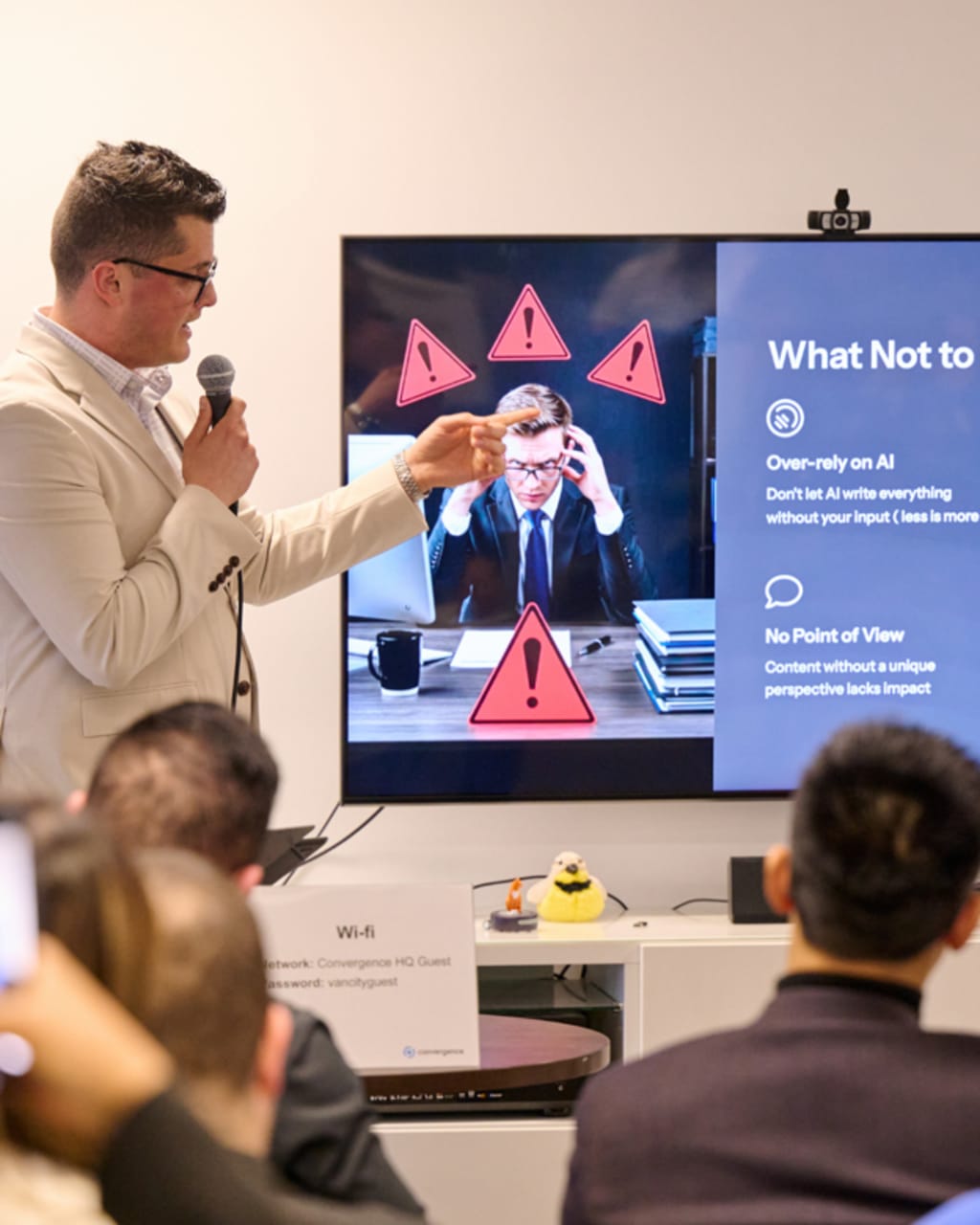
Nik Vassev giving a talk on AI Branding and Marketing
Brand DNA defines who the company is: positioning, voice, visual identity, and messaging rules. Brand Soul captures the deeper story and beliefs behind the business. Brand Strategy lays out the audience, offers, and go-to-market plan. AI Marketing Skills are expert frameworks covering 8 marketing disciplines, from copywriting to campaigns.
The founder loads this system into the AI they already use. From that point on, ChatGPT, Claude, Gemini, or any other assistant produces on-brand content and campaigns using the AI you already use, in the company's exact voice, aligned to its actual strategy. Setup takes about 15 minutes, and the system updates as the business evolves.
Early results
More than 100 early-stage companies have already used Guide IQ, including Nucleus4D, Hub Healthcare, TLT Talent, Selfrun AI, and Climatedoor, reporting significant time savings on content and improved conversions across their marketing.
"My cold email reply rate doubled after I set up Guide IQ on my ChatGPT," says Vlad Djordjevski, founder of TLT Talent. "You can really tell it got smarter at marketing my company."
The pricing model reflects Vassev's ownership philosophy: $149 once, you own it. No subscription, no platform lock-in. The system exports to any AI, so founders are never renting their own brand strategy back from a software company. Lifetime pricing ends at 200 founders, after which the model changes.
Systems over hustle
Guide IQ is also a product of Vassev's own reinvention. After years of 10-hour days and repeated burnout cycles, he rebuilt his companies around systems that operate without his constant presence, moved from Vancouver to Mexico, and now builds from the beach in the Caribbean. His operating philosophy, "systems over hustle," runs through everything he ships.
Guide IQ is that philosophy applied to marketing. Instead of a founder grinding through prompts every day, the strategic work happens once and every piece of content compounds from it.
For the thousands of founders who can build a product but cannot sell it, that shift matters. The AI they need is already open in a browser tab. It just needs to know their business.
Guide IQ is available at guideiq.ai. More on Nik Vassev's work and writing at nikvassev.com.
About the Creator
Enjoyed the story? Support the Creator.
Subscribe for free to receive all their stories in your feed.
Comments
There are no comments for this story
Be the first to respond and start the conversation.