
Wrist-Worn Scribe: Apple Watch’s Siri Recap and the Privacy Paradox of Ambient AI
With the introduction of always-on meeting transcription and sound recognition, Apple is transforming the Watch into a proactive intelligence hub, but the utility comes with inevitable questions about data security in intimate spaces.

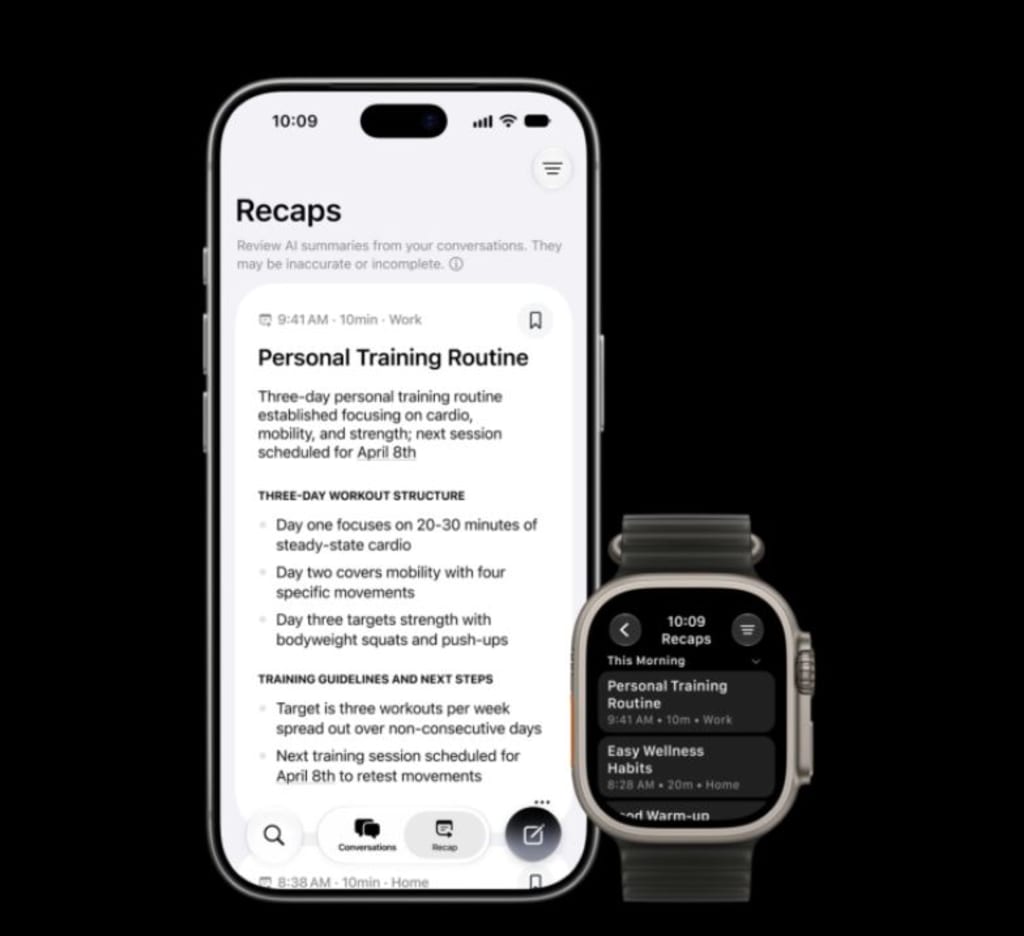
At its "Surprise and Shine" event on Wednesday, Apple launched a meeting notetaker for the Apple Watch Series 12 and Ultra 4, marking a significant expansion of the device’s role from passive health tracker to active cognitive assistant. This new capability, part of a broader suite of audio intelligence features, allows the wearable to listen to sounds through its built-in microphone and process them locally. The feature, called Siri Recap, uses ambient listening to take high-level notes of your conversations, according to the company. Rather than creating a verbatim transcript, Apple Intelligence will automatically generate a title, summary, and key points from the conversation, which can then be reviewed in the dedicated Siri app. This abstraction layer is designed to capture the essence of a discussion without the clutter of filler words or tangential remarks, making it ideal for quick recaps of team syncs, parent-teacher conferences, or medical consultations.
Apple said that you can choose to keep this feature always on, set up a schedule, or turn it off completely. This flexibility acknowledges that not every moment requires documentation. Users might enable it during work hours but disable it during personal time, maintaining a boundary between professional productivity and private life. However, the mere existence of an always-on listening mode on a wrist-worn device represents a fundamental shift in user expectations. Unlike a phone that sits in a pocket or a laptop that can be closed, a watch is a constant companion, making its auditory awareness feel more pervasive and intimate.
The notetaker wasn’t the only audio-focused feature introduced for the Watch during the event. Apple’s new audio intelligence features also include Shazam integration, which can identify songs instantly. This means Apple has finally caught up to Google’s Now Playing feature, closing a long-standing gap in ambient media recognition. Additionally, the Watch can recognize loud sounds like sirens, alarms, doorbells, or a baby crying and notify users via haptic feedback. This accessibility-focused capability ensures that critical environmental cues are not missed by those with hearing impairments or in noisy environments, further cementing the Watch’s role as a sensory extension of the user.
Apple also introduced a feature called Live Rewind, which lets users recap the last 15 seconds of conversation when they double-press the Digital Crown. This acts as a short-term memory buffer, perfect for moments when attention drifts or a crucial detail is missed. Combined with Siri Recap’s longer-form summarization, these tools create a comprehensive safety net for auditory information, reducing the cognitive load of trying to remember everything in real-time.
Despite these innovations, privacy remains the elephant in the room. Apple emphasized that the features don’t store raw audio recordings and that the original sound files are inaccessible after processing. The Siri Recap feature doesn’t identify speakers either, adding a layer of anonymity to the summaries. Users can access Live Rewind recaps, which are end-to-end encrypted, ensuring that even Apple cannot view the content. These guardrails are technically robust and align with Apple’s longstanding privacy-first branding. Yet, despite these protections, an always-listening feature will likely raise privacy concerns because Siri Recap may still capture sensitive information in its summaries. A summary of a confidential HR discussion or a private medical consultation, even without speaker labels, could contain personally identifiable details or proprietary business strategies. The risk is not necessarily malicious hacking, but accidental exposure, leaving a watch unlocked, sharing a screen showing the Siri app, or syncing summaries to a compromised device.
Besides some of the privacy features, Siri Recap sounds similar to other notetakers like Granola and Circleback, which also have Apple Watch apps. This raises questions about differentiation. Why would users trust Apple over specialized third-party tools? The answer lies in integration. Siri Recap isn’t just an app; it’s woven into the OS, leveraging the Neural Engine for on-device processing and syncing seamlessly across the Apple ecosystem. Third-party apps often rely on cloud APIs and require separate permissions, whereas Apple’s solution offers a unified, system-level experience that feels native and secure.
Ultimately, Siri Recap represents a bet that users value convenience enough to accept a new level of ambient surveillance. If Apple can maintain trust through transparent controls and ironclad encryption, the Apple Watch could become the most personal secretary ever invented. But if a single breach or misuse occurs, the backlash could undo years of privacy goodwill. For now, the technology is impressive; the social contract around it is still being written.
About the Creator
Mark Lim
Hi I am mark an automotive student and a car, tech and food enthusiast ! Im gonna try and post daily & hope you enjoy what I write and do share my page with people you know. I would gladly appreciate it! Cheers
Enjoyed the story? Support the Creator.
Subscribe for free to receive all their stories in your feed.
Comments
There are no comments for this story
Be the first to respond and start the conversation.