
Wires and Cables Market Surges as Global Infrastructure and Digital Connectivity Investments Accelerate
Growing demand for electricity, renewable energy expansion, and rapid digital transformation are driving strong growth across the global wires and cables industry.

In today's increasingly connected world, few industries play a more fundamental role than the wires and cables sector. Whether powering homes, enabling high-speed internet, connecting renewable energy projects, or supporting the rise of electric vehicles, wires and cables form the invisible network that keeps modern economies running.
As nations continue investing in infrastructure modernization, digital transformation, and clean energy initiatives, demand for advanced wiring solutions is growing at an unprecedented pace. Industry analysts believe the sector is entering a period of sustained expansion fueled by technological innovation and large-scale infrastructure projects worldwide.
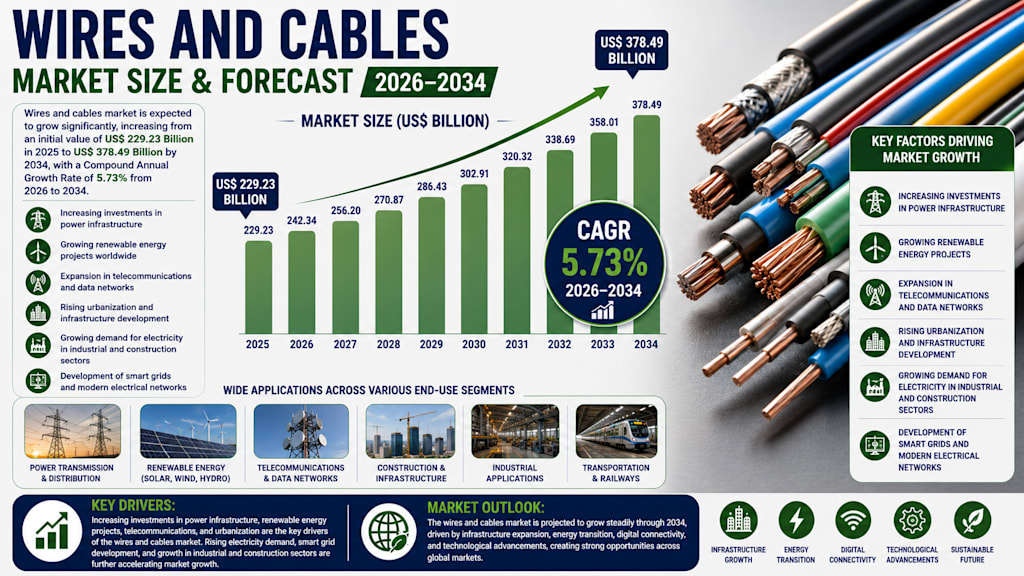
According to Renub Research, the global wires and cables market is projected to increase from US$ 229.23 Billion in 2025 to US$ 378.49 Billion by 2034, growing at a compound annual growth rate (CAGR) of 5.73% between 2026 and 2034. This forecast highlights the industry's importance as countries focus on improving energy security, expanding telecommunications networks, and building smarter cities.
Why Wires and Cables Matter More Than Ever
At first glance, wires and cables may seem like simple industrial products. However, they are essential components of nearly every modern system.
A wire typically consists of a single conductor made from materials such as copper or aluminum. A cable, on the other hand, usually contains multiple insulated conductors bundled together and protected by an outer sheath. These products facilitate the transmission of electricity, data, and communication signals across residential, commercial, industrial, and governmental applications.
From the electrical wiring inside a home to the submarine cables connecting continents, the world relies heavily on these systems. As technology advances and energy demands increase, the importance of reliable and efficient cable infrastructure continues to grow.
The market's expansion reflects broader global trends including urbanization, industrialization, digital connectivity, renewable energy adoption, and transportation electrification.
Infrastructure Development Driving Demand
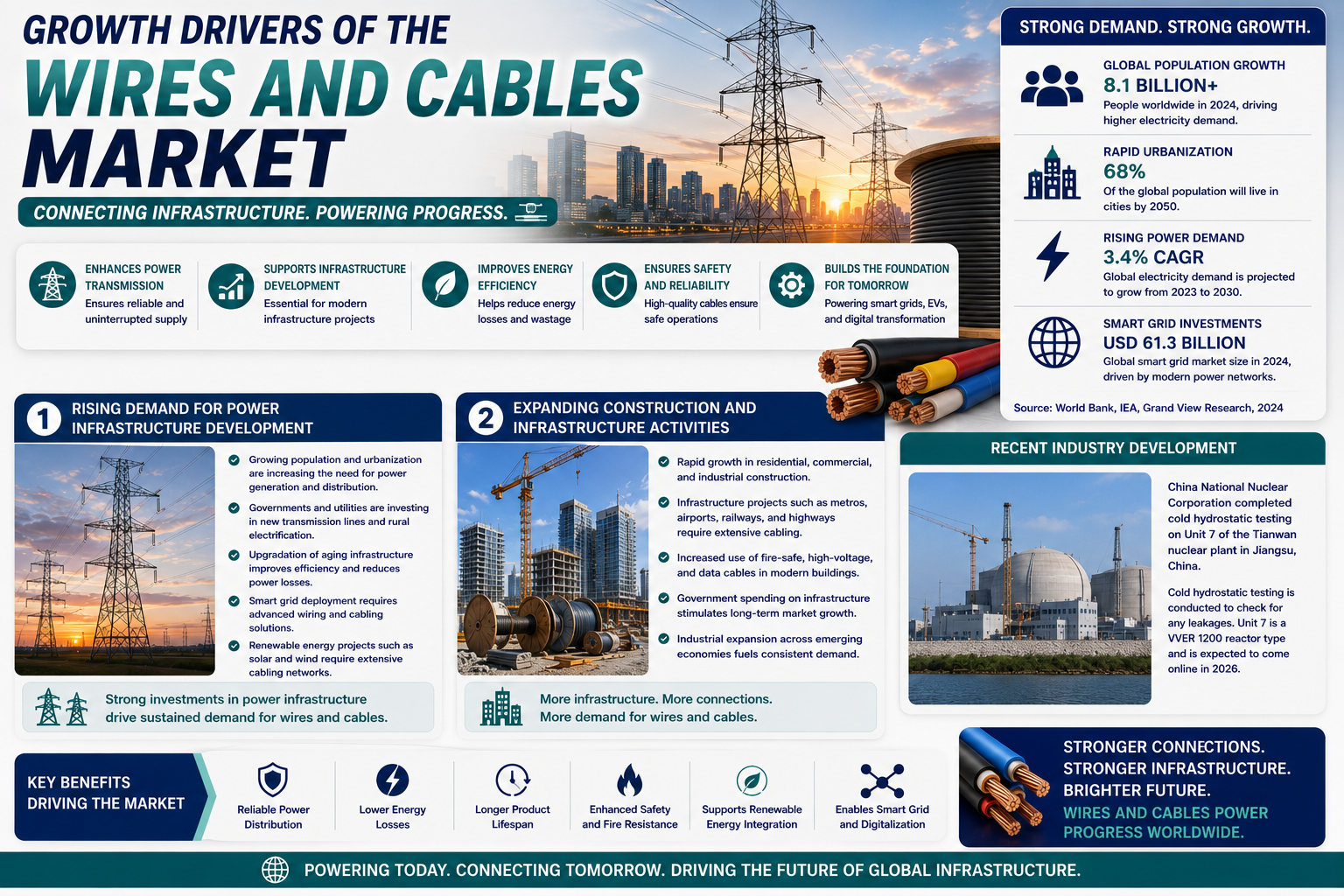
One of the strongest growth drivers for the wires and cables industry is the increasing investment in power infrastructure.
Across both developed and developing economies, governments are upgrading aging electricity networks while expanding access to underserved regions. Rapid urbanization has created greater demand for reliable power transmission and distribution systems capable of supporting growing populations and industrial activities.
Modern electrical grids require extensive cable networks to ensure safe and efficient energy delivery. New transmission lines, substations, and distribution systems all depend on advanced wiring solutions.
Many countries are also investing heavily in smart grid technology. Unlike traditional power systems, smart grids use digital communications to monitor energy consumption, improve efficiency, and reduce outages. These sophisticated systems require large volumes of specialized cables capable of supporting both electrical and data transmission.
As energy consumption continues to rise globally, infrastructure investment is expected to remain one of the most significant contributors to long-term market growth.
Renewable Energy Creates New Opportunities
The global transition toward renewable energy is reshaping the wires and cables industry.
Solar farms, wind power installations, hydroelectric facilities, and emerging renewable technologies all require extensive cabling systems to connect generation assets with transmission networks. Without high-performance cables, renewable energy cannot be efficiently integrated into national grids.
Offshore wind farms present particularly significant opportunities. These projects often require submarine cables capable of transmitting electricity across long distances under challenging environmental conditions.
Solar energy projects similarly depend on durable cable systems that can withstand extreme temperatures and continuous outdoor exposure.
Governments worldwide are implementing ambitious carbon reduction targets and encouraging investment in renewable energy infrastructure. As these initiatives expand, demand for advanced cable technologies is expected to rise alongside them.
The clean energy revolution is no longer a future trend—it is already influencing purchasing decisions, research investments, and product innovation throughout the wires and cables sector.
Telecommunications Expansion Fuels Market Growth
Another major factor contributing to market expansion is the rapid growth of digital connectivity.
The modern economy relies heavily on internet access, cloud computing, data centers, and mobile communications. Behind these services lies a vast network of fiber optic cables that enable high-speed data transmission.
Fiber optics have become increasingly important because they can transmit enormous amounts of information over long distances with minimal signal loss. As demand for faster internet speeds continues to rise, governments and telecommunications providers are investing heavily in network upgrades.
The rollout of 5G technology represents another major opportunity for cable manufacturers. Fifth-generation mobile networks require significant infrastructure development, including fiber backhaul systems and advanced communication cables.
Meanwhile, the growth of smart homes, connected devices, and the Internet of Things (IoT) continues to create additional demand for reliable data transmission infrastructure.
In a digital-first world, communication networks are becoming just as essential as roads and power lines. This reality positions the wires and cables industry at the center of future connectivity initiatives.
Fiber Optic Cables Leading the Digital Revolution
Among all market segments, fiber optic cables are attracting substantial attention.
Consumers increasingly rely on streaming platforms, remote work solutions, cloud applications, online education, and digital commerce. These activities require fast, stable internet connections that traditional infrastructure often struggles to provide.
Fiber optic technology addresses these challenges by delivering significantly higher bandwidth and faster transmission speeds.
Telecommunications companies across North America, Europe, Asia-Pacific, and the Middle East are expanding fiber deployments to meet growing consumer expectations.
As artificial intelligence, cloud computing, and data-intensive applications become more common, the importance of fiber infrastructure is expected to increase even further.
This segment remains one of the most promising areas for long-term industry growth.
The Rising Importance of Power Cables
Power cables remain a cornerstone of the global wires and cables market.
These cables are responsible for transmitting electricity from generation facilities to end users, making them essential to everyday life and economic activity.
The increasing adoption of renewable energy sources has further elevated the role of high-voltage and extra-high-voltage power cables. Long-distance energy transmission requires specialized systems capable of minimizing losses while maintaining operational reliability.
Growing industrial activity, urban expansion, and rising electricity consumption are creating sustained demand for power transmission infrastructure.
As countries pursue electrification strategies and energy modernization initiatives, power cables will continue to represent one of the industry's most critical segments.
Underground Cabling Gains Popularity
Urban planners and governments are increasingly turning toward underground cable systems.
Unlike overhead lines, underground cables are protected from severe weather conditions, falling trees, and accidental damage. This makes them a preferred option in densely populated urban environments where reliability and aesthetics are important considerations.
Although underground installations generally require higher upfront investment, they often provide long-term benefits through reduced maintenance requirements and improved service reliability.
Modern cities seeking resilient infrastructure solutions are increasingly incorporating underground wiring into transportation systems, commercial developments, and public utility projects.
As urban populations continue to expand, underground cable networks are expected to play a larger role in future infrastructure planning.
Construction Sector Continues to Support Demand
The building and construction industry remains another significant market contributor.
Every residential development, office complex, shopping center, healthcare facility, and industrial plant requires extensive wiring systems for power distribution, lighting, security, and communications.
Rapid urbanization across emerging economies is creating substantial demand for electrical infrastructure within new construction projects.
At the same time, modern buildings are becoming increasingly technology-driven. Smart lighting systems, automation platforms, surveillance networks, and energy management solutions all depend on advanced cable installations.
Fire-resistant and energy-efficient wiring products are also gaining popularity as regulatory standards evolve and sustainability concerns grow.
These trends ensure continued demand from the construction sector for years to come.
Automotive Innovation Opens New Growth Avenues
The automotive industry is undergoing one of the most significant transformations in its history.
Modern vehicles contain sophisticated electronic systems that require extensive wiring networks. Advanced driver assistance systems, infotainment platforms, navigation technologies, and digital displays all depend on reliable electrical connectivity.
The rise of electric vehicles (EVs) is creating even greater opportunities for cable manufacturers.
EVs require specialized high-voltage cables capable of supporting battery systems, charging infrastructure, and power management technologies. Manufacturers are increasingly focused on developing lighter, more efficient cable solutions that enhance vehicle performance while improving energy efficiency.
As global EV adoption accelerates, the automotive wires and cables segment is expected to experience strong growth.
Challenges Facing the Industry
Despite positive growth prospects, the market is not without challenges.
One of the most significant concerns involves fluctuations in raw material prices. Copper and aluminum remain the primary materials used in cable manufacturing, and their prices are heavily influenced by global supply chain conditions, geopolitical developments, and commodity market volatility.
Price instability can affect manufacturing costs and profit margins, creating uncertainty for both producers and customers.
Installation complexity presents another challenge. Large-scale cable projects often require specialized equipment, technical expertise, and extensive planning. Underground and submarine installations can be particularly expensive and technically demanding.
Maintaining large transmission and communication networks also requires ongoing investment and skilled labor.
Companies that successfully manage these challenges while improving efficiency and innovation are likely to gain a competitive advantage in the years ahead.
Regional Markets Show Strong Potential
Several regions are contributing significantly to market growth.
The United States continues investing in power infrastructure modernization, renewable energy projects, data centers, and 5G expansion.
The United Kingdom is seeing increased demand driven by renewable energy developments, particularly offshore wind projects and fiber network expansion.
India remains one of the fastest-growing markets due to rapid urbanization, industrialization, infrastructure development, and government electrification initiatives.
Saudi Arabia is investing heavily in energy infrastructure, smart city projects, and economic diversification programs, creating additional demand for advanced cable systems.
These regional trends demonstrate the truly global nature of the industry's growth story.
Looking Ahead
The future of the wires and cables market appears highly promising.
As societies become more connected, electrified, and technologically advanced, the need for reliable transmission infrastructure will only increase. Whether supporting renewable energy projects, expanding telecommunications networks, enabling smart cities, or powering electric vehicles, wires and cables remain essential components of progress.
Innovation will continue to shape the industry's future, with manufacturers focusing on smarter, more durable, and more sustainable solutions. Companies that invest in advanced technologies and adapt to changing market demands will be well-positioned for success.
Final Thoughts
While they often remain hidden behind walls, beneath streets, and under oceans, wires and cables are among the most important building blocks of modern civilization. They connect people, power economies, and enable technological advancement.
With Renub Research forecasting the global market to grow from US$ 229.23 Billion in 2025 to US$ 378.49 Billion by 2034, the industry is poised for a decade of meaningful expansion. Infrastructure modernization, renewable energy investments, digital transformation, and transportation electrification are creating powerful opportunities that will shape the market's future.
About the Creator
Enjoyed the story? Support the Creator.
Subscribe for free to receive all their stories in your feed.
Comments
There are no comments for this story
Be the first to respond and start the conversation.