
Will the Global Agricultural Tractors Market Reach US$ 111.67 Billion by 2034 as Precision Farming and Mechanization Transform Agriculture?
Rising labor shortages, increasing farm automation, government subsidies, and advanced precision farming technologies are driving global tractor demand.

Agriculture is undergoing a technological revolution unlike anything seen in previous generations. As the global population continues to expand and food demand rises, farmers are increasingly turning to advanced machinery to improve productivity, reduce labor dependency, and optimize farming operations. Among the most important pieces of equipment driving this transformation are agricultural tractors.
Modern agricultural tractors have evolved far beyond simple machines used for pulling implements. Today's tractors incorporate GPS systems, telematics, sensors, automation technologies, and precision farming capabilities that enable farmers to maximize efficiency while minimizing resource consumption.
Whether used for plowing, seed sowing, irrigation, spraying, transportation, or harvesting, tractors remain at the heart of modern agricultural operations. As governments promote mechanization and farmers seek higher productivity, demand for technologically advanced tractors continues to rise worldwide.
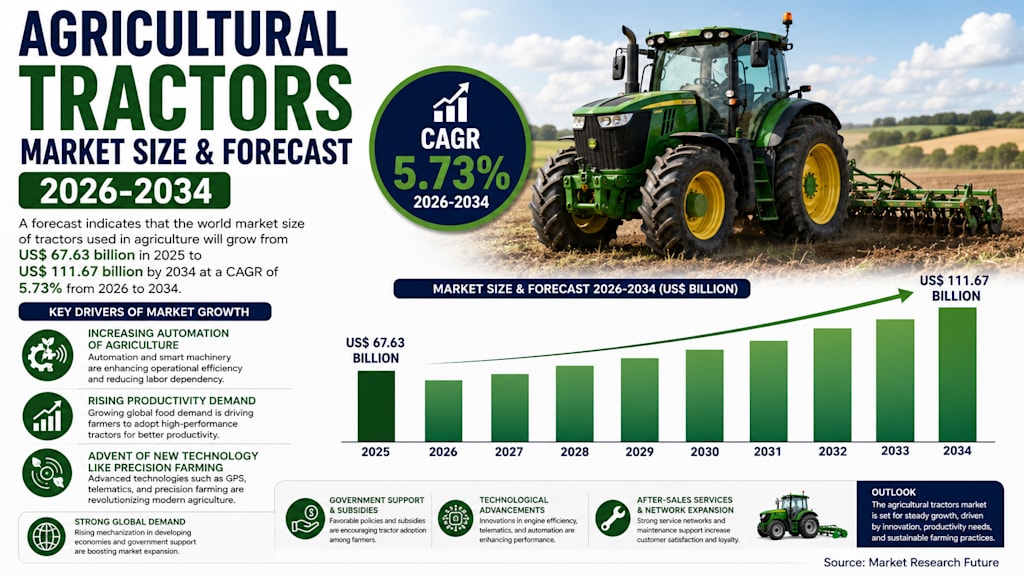
According to Renub Research, the global Agricultural Tractors Market is expected to grow from US$ 67.63 billion in 2025 to US$ 111.67 billion by 2034, registering a CAGR of 5.73% between 2026 and 2034. The market's expansion is being driven by increasing mechanization, labor shortages, precision farming adoption, and continuous technological innovation.
Farm Mechanization Is Reshaping Global Agriculture
One of the strongest factors fueling demand for agricultural tractors is the rapid adoption of farm mechanization across both developed and developing economies.
Traditional farming methods often depend heavily on manual labor, which can be time-consuming, costly, and less efficient. However, as agricultural operations become increasingly commercialized, farmers are seeking equipment that enables them to cultivate larger areas of land while maintaining productivity.
Agricultural tractors significantly improve operational efficiency by performing multiple tasks including soil preparation, cultivation, transportation, irrigation, and harvesting support.
Mechanization also enables farmers to complete critical agricultural activities within shorter timeframes, helping maximize crop yields and improve profitability.
Governments around the world increasingly recognize the importance of mechanization in achieving food security goals, further supporting tractor adoption through subsidies and financial assistance programs.
As agriculture continues to modernize, mechanization will remain one of the most important drivers of market growth.
Labor Shortages Are Accelerating Tractor Adoption
Labor shortages have become a growing challenge for agricultural sectors worldwide.
In many regions, younger generations are migrating from rural communities to urban centers in search of alternative employment opportunities. This demographic shift has reduced the availability of agricultural labor, creating significant operational challenges for farmers.
Agricultural tractors provide an effective solution by reducing dependence on manual labor while increasing efficiency.
Tasks that once required large numbers of workers can now be completed using advanced machinery operated by a small workforce.
This trend is particularly important in countries facing aging farming populations and declining rural labor availability.
As labor shortages continue to affect agricultural productivity, demand for tractors and mechanized equipment is expected to increase significantly.
Precision Farming Is Transforming Tractor Technology
Precision agriculture represents one of the most significant technological advancements influencing the agricultural tractors market.
Modern tractors increasingly incorporate sophisticated technologies such as GPS guidance systems, telematics, sensors, automation platforms, and real-time data analytics.
These technologies enable farmers to make data-driven decisions that improve efficiency and resource utilization.
Precision farming technologies help optimize planting, fertilization, irrigation, spraying, and harvesting activities while reducing waste and environmental impact.
Auto-steering systems allow tractors to operate with exceptional accuracy, reducing overlap and minimizing fuel consumption. Variable-rate technology enables precise application of seeds, fertilizers, and pesticides based on field-specific conditions.
These innovations improve crop yields while lowering operating costs.
As awareness regarding precision farming benefits continues to grow, adoption of technologically advanced tractors is expected to accelerate across global agricultural markets.
Automation Is Defining the Future of Farming
Automation is becoming an increasingly important feature within modern agricultural machinery.
Manufacturers are investing heavily in autonomous and semi-autonomous tractor technologies designed to reduce operator workload while improving operational efficiency.
Automated systems can perform repetitive farming tasks with greater precision than traditional methods. Advanced sensors and artificial intelligence technologies enable tractors to analyze field conditions and adjust operations accordingly.
The emergence of electric and autonomous tractors also reflects growing interest in sustainable agriculture and environmental responsibility.
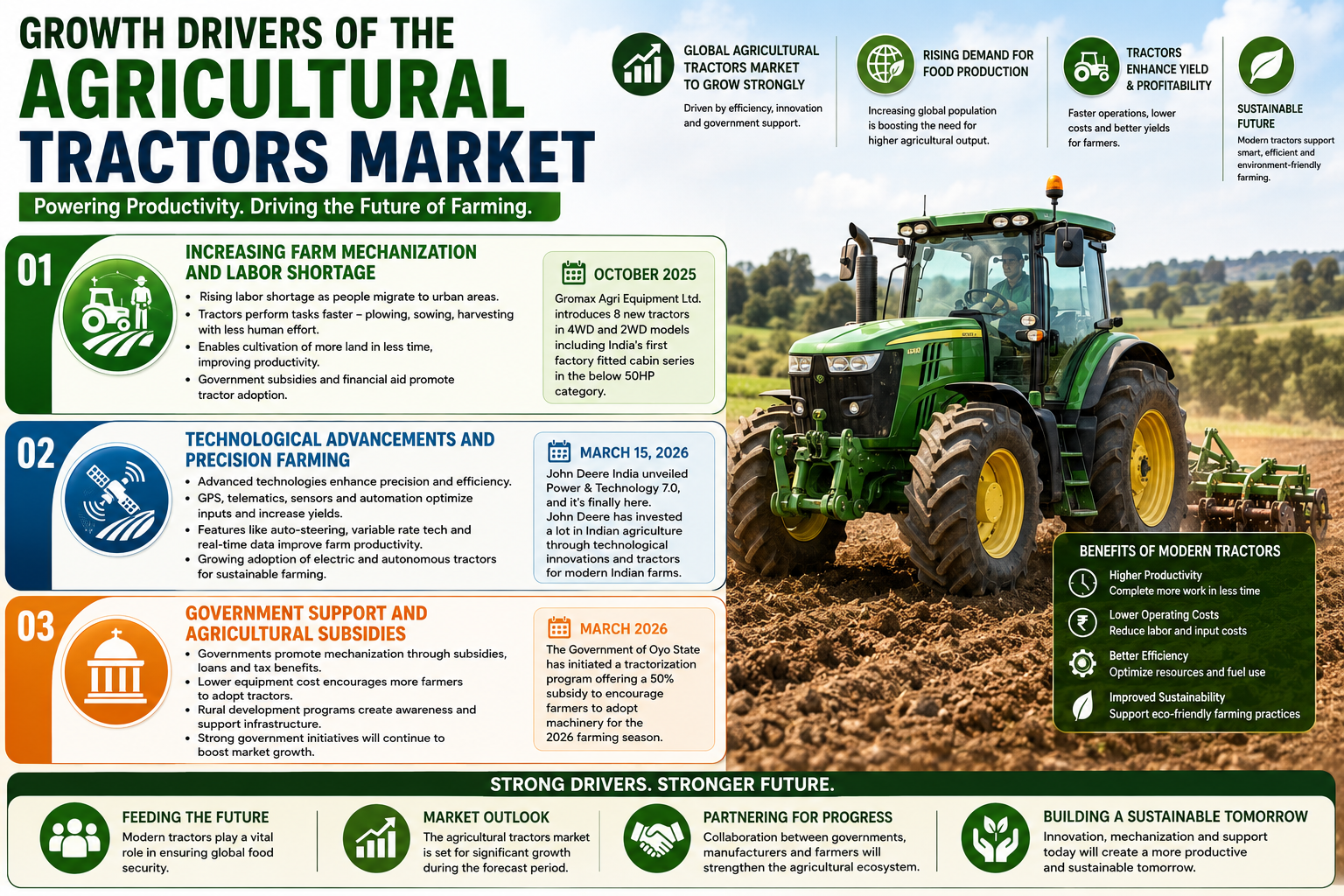
On March 15, 2026, John Deere India introduced Power & Technology 7.0, highlighting the company's continued commitment to technological innovation within modern farming operations.
As automation technologies continue to mature, they are expected to play a central role in shaping the future of agriculture.
Government Support Is Encouraging Mechanization
Government initiatives remain one of the most influential factors supporting agricultural tractor adoption worldwide.
Many countries have implemented subsidy programs, affordable financing options, tax incentives, and rural development initiatives designed to encourage farmers to invest in modern agricultural machinery.
These programs help reduce financial barriers associated with equipment purchases while promoting agricultural productivity and food security.
Governments also conduct educational programs that raise awareness regarding the benefits of mechanization and modern farming practices.
For example, in March 2026, the Government of Oyo State in Nigeria launched a tractorization program offering a 50 percent subsidy to encourage greater adoption of agricultural machinery.
Such initiatives are expected to continue supporting market expansion throughout the forecast period.
Technological Advancements Are Improving Tractor Performance
Manufacturers continue investing heavily in research and development to improve tractor capabilities.
Modern tractors feature fuel-efficient engines, advanced hydraulic systems, ergonomic operator cabins, enhanced connectivity solutions, and integrated precision agriculture technologies.
These improvements help farmers achieve greater productivity while reducing operational costs.
Comfort has also become an important consideration. New tractor designs prioritize operator safety, reduced fatigue, climate control, and user-friendly interfaces.
Technological advancements are particularly important in competitive agricultural markets where efficiency gains directly influence profitability.
As innovation continues, farmers are increasingly upgrading older equipment to benefit from improved performance and functionality.
Mid-Power Tractors Remain Highly Popular
Among various horsepower categories, tractors ranging from 40 HP to 99 HP continue to represent one of the most widely adopted segments globally.
These tractors offer an effective balance between affordability, versatility, and performance, making them ideal for medium-sized farming operations.
Farmers use these machines for plowing, cultivation, transportation, irrigation support, and numerous other agricultural activities.
Manufacturers continue enhancing this segment through improved fuel efficiency, advanced hydraulics, and operator comfort features.
The popularity of mid-power tractors is particularly strong in developing countries where cost-effective solutions remain essential for mechanization efforts.
Row-Crop Tractors Support Precision Agriculture
Row-crop tractors have become increasingly important due to the growing popularity of precision farming.
These tractors are specifically designed for crops planted in rows, including corn, cotton, soybeans, and other high-value agricultural commodities.
Features such as adjustable track widths, advanced steering systems, and high ground clearance allow row-crop tractors to operate efficiently without damaging crops.
The integration of smart technologies further enhances their effectiveness by improving planting accuracy, fertilizer application, and weed management.
As precision farming practices continue expanding globally, demand for row-crop tractors is expected to grow steadily.
Harvesting Tractors Play a Critical Role
Harvesting tractors are essential for ensuring efficient crop collection during critical harvest periods.
These machines work alongside combines, reapers, and other harvesting equipment to improve productivity and minimize crop losses.
Large-scale agricultural operations particularly depend on harvesting tractors to complete harvesting activities within narrow seasonal windows.
Technological advancements continue improving harvesting efficiency through automation, enhanced attachments, and better machine integration.
As global food demand rises, the importance of efficient harvesting solutions will continue increasing.
Seed Sowing and Spraying Applications Drive Equipment Demand
Seed sowing tractors are becoming increasingly important as farmers adopt precision planting techniques.
These machines support the use of advanced seed drills and planters, ensuring seeds are placed at optimal depths and spacing for maximum productivity.
GPS integration and automated guidance systems further improve planting accuracy.
Similarly, agricultural spraying tractors are widely used for fertilizer, pesticide, and herbicide applications. Precision spraying technologies help reduce chemical waste while improving crop protection.
These specialized applications continue driving demand for technologically advanced tractor models across agricultural markets worldwide.
High Equipment Costs Remain a Significant Challenge
Despite strong growth prospects, affordability remains a major obstacle for many farmers.
Advanced tractors equipped with precision technologies, automation systems, and sophisticated electronics often require substantial capital investment.
For small-scale farmers and those operating in developing economies, acquisition costs can be prohibitive even when government support programs are available.
Maintenance expenses, spare parts costs, and repair requirements further increase total ownership costs.
Limited access to financing can also restrict adoption among resource-constrained farmers.
Addressing affordability challenges will remain critical for expanding tractor penetration in emerging markets.
Fragmented Land Holdings Limit Adoption
Another challenge affecting the agricultural tractors market is the prevalence of fragmented land ownership.
In many developing countries, farms are divided into small and irregularly shaped plots that may not justify investment in large machinery.
Small-scale farmers often struggle to achieve sufficient economic returns from tractor ownership due to limited land availability.
Although compact and specialized tractor models help address some of these concerns, land fragmentation continues to constrain broader mechanization efforts.
Innovative business models such as equipment leasing and shared ownership programs may help overcome these limitations.
The United States Leads Global Tractor Innovation
The United States remains one of the most advanced agricultural tractor markets globally.
American farmers utilize sophisticated equipment equipped with GPS systems, automation technologies, telematics, and precision farming solutions.
Large-scale commercial farming operations create strong demand for high-performance tractors capable of managing extensive agricultural acreage efficiently.
Government support programs, strong financing availability, and ongoing technological innovation continue supporting market growth.
In August 2025, AGCO strengthened its agricultural operations through the acquisition of Allegiance Ag & Turf alongside True Ag & Turf operations in Iowa.
The U.S. market is expected to remain a global leader in agricultural machinery innovation.
India Represents a Major Growth Opportunity
India is one of the world's largest agricultural tractor markets due to its extensive agricultural sector and growing mechanization efforts.
Demand is particularly strong for low- and medium-horsepower tractors that are suitable for small and medium-sized farms.
Government subsidies, rural development initiatives, and affordable financing options continue encouraging tractor purchases among farmers.
In September 2025, CNH Industrial announced plans to establish a tractor manufacturing facility in Greater Noida, reflecting confidence in India's long-term growth potential.
As rural incomes rise and awareness of mechanization benefits increases, India is expected to remain a major growth engine for the global market.
Final Thoughts
The global agricultural tractors market is entering a new era driven by automation, precision farming, technological innovation, and increasing demand for agricultural productivity.
Farmers worldwide are embracing advanced machinery to address labor shortages, improve efficiency, and meet growing food production requirements. At the same time, government support programs and technological advancements continue accelerating adoption.
While challenges such as high equipment costs and fragmented land holdings remain, ongoing innovation and expanding mechanization initiatives are creating substantial growth opportunities.
With the market projected to grow from US$ 67.63 billion in 2025 to US$ 111.67 billion by 2034, agricultural tractors will remain at the center of modern farming transformation and global food security efforts for years to come.
About the Creator
Enjoyed the story? Support the Creator.
Subscribe for free to receive all their stories in your feed.
Comments
There are no comments for this story
Be the first to respond and start the conversation.