
Will Malaysia’s Game-Based Learning Market Reach US$ 512.01 Million by 2034 as Digital Education Transforms Learning?
Rising internet penetration, government-backed digital education initiatives, AI-powered learning platforms, and increasing demand for interactive education are driving rapid growth in Malaysia’s game-based learning market.

The education sector is undergoing a profound transformation as technology reshapes how students learn and how organizations train their workforce. Traditional classroom methods are increasingly being complemented by digital tools that improve engagement, personalize learning experiences, and enhance knowledge retention. Among the most impactful innovations driving this change is game-based learning.
Game-based learning (GBL) incorporates game mechanics such as rewards, challenges, simulations, leaderboards, quizzes, and interactive scenarios into educational environments. These elements make learning more engaging while encouraging critical thinking, collaboration, problem-solving, and long-term retention of knowledge.
Malaysia has emerged as one of Southeast Asia's most promising markets for game-based learning due to strong government support for digital education, widespread internet access, increasing smartphone usage, and a tech-savvy population eager to embrace innovative learning methods.
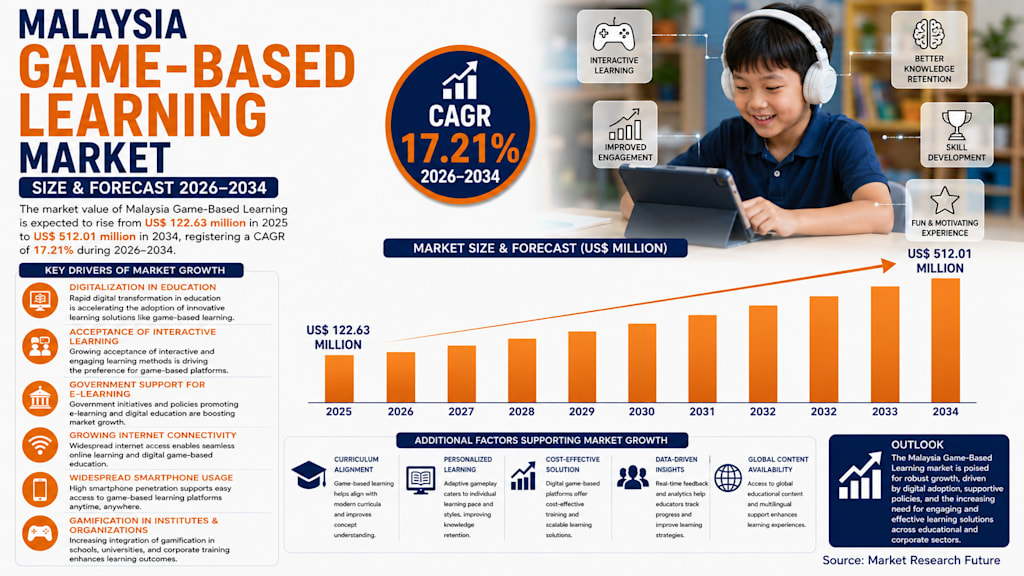
According to Renub Research, the Malaysia Game-Based Learning Market is projected to grow from US$ 122.63 million in 2025 to US$ 512.01 million by 2034, registering an impressive CAGR of 17.21% during 2026–2034. Government-backed digitalization programs, growing demand for personalized learning, and increasing adoption of educational technology continue to fuel market expansion.
Understanding the Growing Importance of Game-Based Learning
Game-based learning refers to the use of structured gaming experiences designed specifically to achieve educational objectives.
Unlike traditional learning methods that often rely heavily on lectures and memorization, game-based learning actively engages participants through interactive experiences that encourage exploration, experimentation, and practical problem-solving.
Students earn rewards, receive instant feedback, complete challenges, and progress through learning pathways that make education more enjoyable and effective.
These techniques can be applied across a wide range of educational environments, including primary schools, universities, vocational training programs, corporate learning initiatives, and professional development courses.
The ability to improve engagement and motivation while supporting measurable learning outcomes has made game-based learning increasingly attractive across Malaysia.
Government Initiatives Are Accelerating Digital Education
One of the strongest drivers behind Malaysia's game-based learning market is government support for educational digitalization.
The Malaysian government has introduced multiple initiatives aimed at transforming education through technology adoption and digital literacy development.
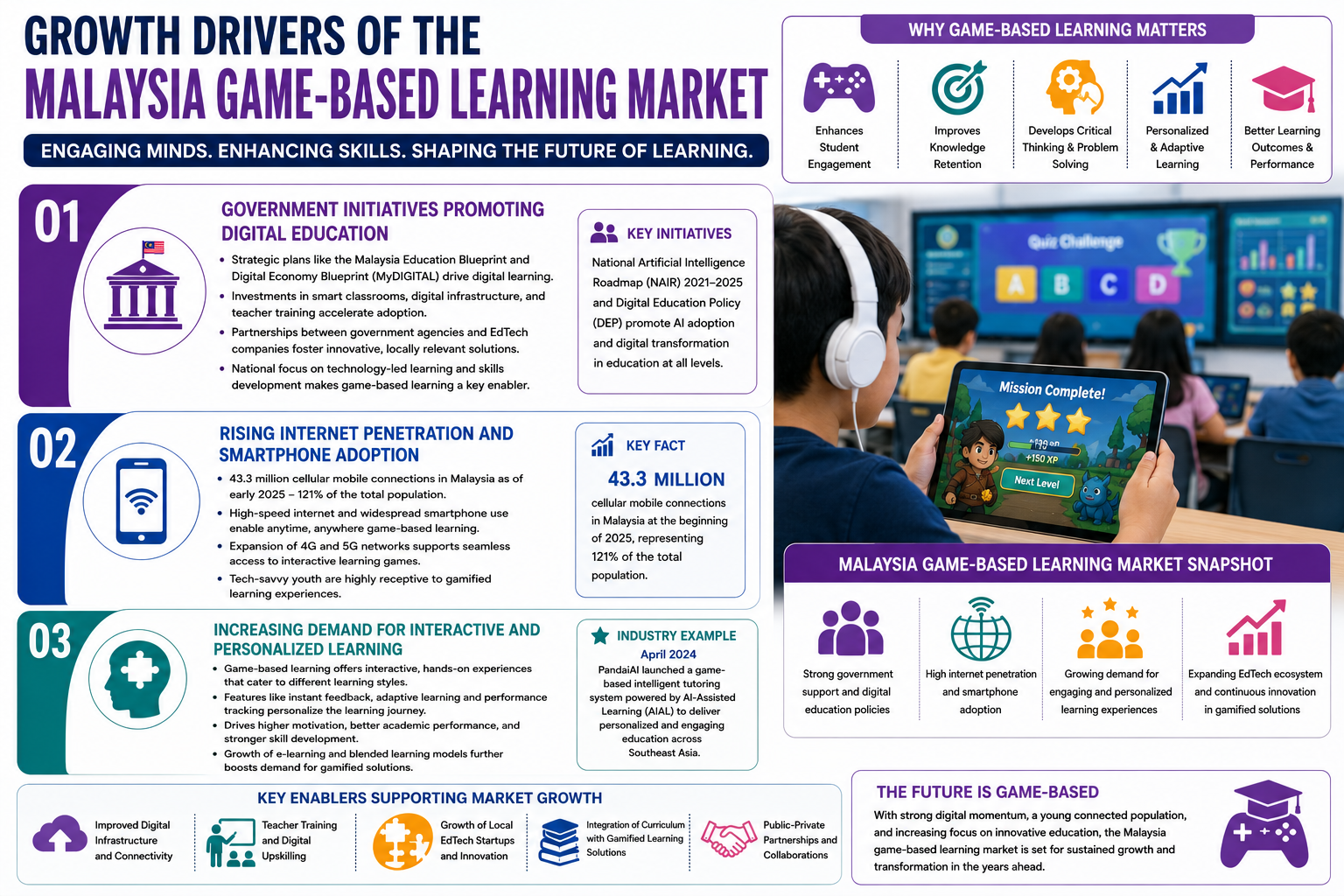
Programs such as the Malaysia Education Blueprint and MyDIGITAL emphasize the integration of digital tools into educational institutions to prepare students for the future economy.
Government investments in smart classrooms, digital infrastructure, teacher training, and technology-enabled learning environments have created favorable conditions for the adoption of game-based learning platforms.
National initiatives promoting artificial intelligence, digital transformation, and educational innovation further strengthen market growth.
The National Artificial Intelligence Roadmap (NAIR) and Digital Education Policy (DEP) are particularly important in supporting the integration of AI-powered educational technologies across Malaysia's learning ecosystem.
As government support continues expanding, game-based learning is expected to become an increasingly important component of Malaysia's education system.
Internet Connectivity and Smartphone Adoption Drive Accessibility
Malaysia's strong digital infrastructure provides a solid foundation for game-based learning adoption.
The widespread availability of high-speed internet and mobile connectivity has made digital learning platforms accessible to millions of students and professionals.
According to industry data, Malaysia had approximately 43.3 million mobile cellular connections at the beginning of 2025, representing more than 121% of the country's population.
The increasing adoption of smartphones and tablets allows learners to access educational content anytime and anywhere.
Mobile-friendly game-based learning applications are particularly attractive because they support flexible learning schedules and improve accessibility beyond traditional classroom environments.
The ongoing rollout of advanced 4G and 5G networks is further enhancing the quality of digital learning experiences by enabling smoother content delivery and real-time interaction.
As connectivity continues improving, access barriers are expected to decline significantly.
Interactive Learning Is Replacing Traditional Teaching Methods
Educational institutions across Malaysia are increasingly embracing interactive teaching approaches that place students at the center of the learning process.
Traditional teaching methods often struggle to maintain student attention and engagement, particularly among younger generations accustomed to digital experiences.
Game-based learning addresses this challenge by transforming lessons into interactive experiences that encourage active participation.
Students are more likely to retain information when they engage directly with educational content rather than passively consuming information.
Interactive learning environments also support different learning styles, helping educators accommodate diverse student needs.
The growing recognition of these benefits is encouraging schools, colleges, universities, and training providers to invest in gamified learning solutions.
Personalized Learning Enhances Educational Outcomes
One of the most significant advantages of game-based learning is its ability to deliver personalized educational experiences.
Modern learning platforms increasingly incorporate adaptive technologies that analyze learner performance and customize content accordingly.
Students receive individualized learning pathways based on their strengths, weaknesses, progress, and preferences.
This personalized approach helps learners advance at their own pace while receiving targeted support where needed.
Game-based systems also provide instant feedback, allowing students to identify mistakes and improve understanding in real time.
As educational institutions place greater emphasis on student-centered learning, personalized game-based solutions are expected to gain widespread adoption.
Artificial Intelligence Is Revolutionizing Educational Games
Artificial intelligence is becoming one of the most transformative technologies within the game-based learning industry.
AI-powered learning platforms can evaluate student behavior, monitor performance, and generate customized educational experiences.
These systems continuously adapt content based on learner progress, ensuring optimal engagement and effectiveness.
Artificial intelligence also enables intelligent tutoring systems that provide personalized guidance and support.
For example, AI-powered educational platforms such as PandaiAI leverage gamification and personalized learning methodologies to improve educational outcomes across Southeast Asia.
As AI capabilities continue advancing, educational games will become increasingly sophisticated and effective.
Corporate Training Creates Significant Growth Opportunities
Game-based learning is no longer limited to schools and universities.
Organizations across various industries are increasingly using gamification techniques to train employees, develop skills, and improve workforce performance.
Interactive learning modules help employees acquire technical knowledge while improving communication, leadership, teamwork, and problem-solving abilities.
Compared with traditional training methods, game-based learning often results in higher engagement levels and improved knowledge retention.
Businesses appreciate the ability to deliver scalable, measurable, and cost-effective training programs.
As Malaysia's economy becomes increasingly knowledge-driven, corporate adoption of game-based learning is expected to accelerate.
Training, Knowledge, and Skill-Based Games Lead Adoption
Training, knowledge, and skill-based games represent one of the largest segments within Malaysia's game-based learning market.
These games focus on developing practical competencies, cognitive abilities, technical expertise, and professional skills.
Educational institutions use them to improve academic performance, while corporations utilize them to support employee development initiatives.
Simulation exercises, quizzes, role-playing scenarios, and interactive challenges are among the most commonly used formats.
The versatility and effectiveness of these tools make them highly attractive across both educational and corporate environments.
As organizations prioritize continuous learning and workforce development, demand for skill-based learning games is expected to remain strong.
Cloud-Based Learning Platforms Gain Momentum
Cloud computing has become a major enabler of game-based learning adoption.
Cloud-based platforms allow users to access educational content from virtually any location using internet-connected devices.
These solutions eliminate the need for expensive hardware infrastructure while providing greater flexibility and scalability.
Educational institutions and businesses can deploy learning programs more efficiently while benefiting from automatic updates and centralized management.
Cloud-based systems also support remote learning, collaborative education, and distance training initiatives.
Malaysia's growing digital infrastructure and increasing adoption of Software-as-a-Service (SaaS) solutions are accelerating the transition toward cloud-based learning environments.
Education Sector Remains the Largest End User
Educational institutions continue to represent the largest end-user segment within the game-based learning market.
Schools, colleges, universities, and vocational training centers increasingly integrate gamified learning tools into their curricula.
Subjects such as mathematics, science, languages, history, and technology benefit significantly from interactive learning approaches.
Game-based methodologies help improve student engagement while making complex concepts easier to understand.
Teachers increasingly recognize the value of educational games as tools for enhancing classroom participation and learning outcomes.
As educational technology adoption continues expanding, schools are expected to remain key contributors to market growth.
Government Sector Embraces Gamified Learning
Government organizations across Malaysia are also adopting game-based learning solutions.
These technologies support public sector training, professional development programs, civic education initiatives, and digital literacy campaigns.
Gamification helps government agencies deliver engaging and effective training experiences while improving knowledge retention.
Partnerships between government bodies, educational institutions, and technology providers are facilitating the development of localized learning content tailored to Malaysian cultural and educational requirements.
Government support will continue playing a central role in market expansion.
IT and Telecom Industries Drive Corporate Adoption
Malaysia's rapidly growing IT and telecommunications sectors are major adopters of game-based learning platforms.
Organizations use gamification to train employees in areas such as coding, cybersecurity, cloud computing, network management, and data analytics.
Interactive simulations allow employees to practice real-world scenarios in controlled environments.
The deployment of 5G technology and increasing digital transformation initiatives are creating ongoing demand for workforce upskilling.
Game-based learning offers an effective solution for delivering continuous professional development within fast-changing industries.
As Malaysia strengthens its position as a regional technology hub, corporate demand for gamified training solutions is expected to rise.
Digital Divide Remains a Challenge
Despite strong market growth, unequal access to technology continues to present challenges.
Students in rural and underserved communities may face difficulties accessing reliable internet connectivity and modern digital devices.
While urban educational institutions often benefit from advanced infrastructure, some rural schools struggle with limited resources.
This digital divide can restrict access to game-based learning opportunities and create disparities in educational outcomes.
Addressing these challenges will require continued investment in infrastructure development and inclusive education initiatives.
High Development Costs Can Limit Innovation
Developing high-quality educational games requires significant investment in technology, content creation, instructional design, and software development.
Small educational technology companies may face financial barriers when attempting to create sophisticated learning platforms.
Additionally, some educators and administrators remain hesitant to adopt gamified learning methods due to concerns regarding screen time, implementation complexity, and curriculum alignment.
Teacher training and awareness programs will be important for overcoming resistance and encouraging broader adoption.
Kuala Lumpur Leads Market Development
Kuala Lumpur remains the most advanced game-based learning market in Malaysia.
As the country's economic, educational, and technological center, the city hosts numerous universities, international schools, technology firms, and innovation hubs.
Educational institutions across Kuala Lumpur actively integrate digital learning platforms and gamified educational tools into teaching practices.
Corporate organizations also utilize game-based learning extensively for employee training and development.
Strong digital infrastructure and supportive government policies continue reinforcing the city's leadership position.
Johor Bahru and Shah Alam Show Strong Growth Potential
Johor Bahru is experiencing rapid growth due to its strategic location, strong economic development, and increasing technology adoption.
Educational institutions and businesses are embracing gamification to improve learning outcomes and workforce capabilities.
Meanwhile, Shah Alam's well-developed educational ecosystem and industrial base are creating favorable conditions for market expansion.
Universities, technical colleges, and research institutions increasingly utilize game-based learning technologies across multiple disciplines.
These cities are expected to become important contributors to future market growth.
Final Thoughts
Malaysia's game-based learning market is entering a period of exceptional growth driven by digital transformation, government support, increasing internet connectivity, and evolving educational preferences.
Interactive learning experiences, artificial intelligence, cloud computing, and personalized education solutions are transforming how knowledge is delivered and acquired.
While challenges related to digital accessibility, development costs, and adoption barriers remain, continued investment in educational technology is creating substantial opportunities.
With the market projected to grow from US$ 122.63 million in 2025 to US$ 512.01 million by 2034, game-based learning is poised to become a cornerstone of Malaysia's future education and workforce development ecosystem.
About the Creator
Enjoyed the story? Support the Creator.
Subscribe for free to receive all their stories in your feed.
Comments
There are no comments for this story
Be the first to respond and start the conversation.