
Why Your Music Video Gets Views But No Subscribers (And What I Did About It)
The frustrating gap between visibility and growth — and the real reasons it happens to almost every independent artist
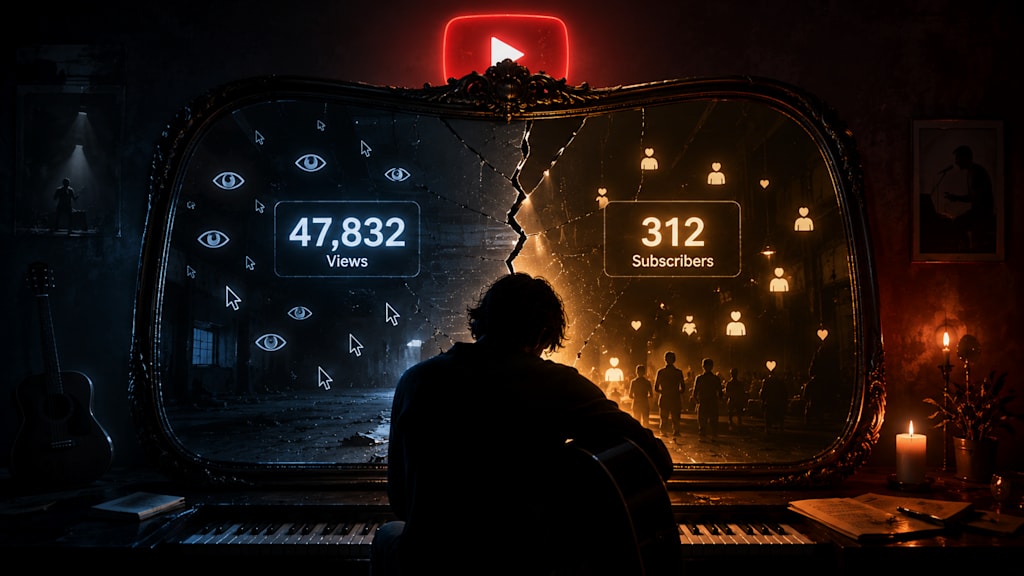
There's a specific kind of frustration that only music artists on YouTube understand. It's not the frustration of uploading something and getting zero views — that one is painful but at least logical. Zero views means nobody found you. That's fixable.
The frustration I'm talking about is subtler and somehow worse. It's uploading a music video, watching the view count climb — genuinely climb, not just from your mum and your three friends — and then opening your subscriber count and seeing it hasn't moved. Not even a little. Thousands of people apparently watched your video and then just... left.
For the longest time I had no idea why this was happening. I assumed it was normal. Maybe that's just how music on YouTube works, I thought. People stream songs without subscribing. They treat YouTube like Spotify. I accepted this explanation for about eight months before I started actually digging into what was going on — and what I found changed how I approach the platform completely.
This is what I learned.
The Number Nobody Talks About: View-to-Subscriber Ratio
When you look at your YouTube Studio analytics, there's a metric buried in there that most artists either don't know about or actively avoid looking at because it's uncomfortable. It's called your subscriber conversion rate — essentially, out of every 100 people who watch your video, how many subscribe?
The typical view-to-subscriber ratio on YouTube sits between 0.5% and 2.5% depending on the channel and content type. That means for every 1,000 views you receive, you'd expect somewhere between 5 and 25 new subscribers if things are working properly.
When I checked mine after eight months of uploading, my ratio was sitting at 0.1%. Out of every 1,000 views, one person was subscribing. Sometimes none.
That's not just below average. That's a signal that something fundamental was wrong — not with the music necessarily, but with how I was presenting it and who was watching it.
Reason 1: The Wrong People Were Finding My Videos
The first thing I had to accept was uncomfortable but important. Not all views are equal.
YouTube surfaces content to different people through different pathways — search results, the browse homepage, suggested videos, and the Shorts feed. When someone finds your music through the browse homepage or suggested videos, they're often casual discoverers — people with no strong intention to find new music to follow. They clicked because something caught their eye, watched for thirty seconds, and moved on.
When someone finds your music because they searched for something specific — a genre, a mood, an artist similar to you — they're genuinely looking. They have intent. Those viewers subscribe at dramatically higher rates because they arrived with a reason to care.
For the first eight months of my channel, the vast majority of my views came from browse and suggested traffic — basically YouTube was surfacing my videos randomly to people who hadn't asked for them. My thumbnails were clickable enough to get the view, but the people clicking had no particular connection to what I was making.
The fix wasn't to make better music. It was to get the right people to find the music that already existed.
Reason 2: My Channel Gave People No Reason to Stay
Here's something I genuinely didn't think about for a long time: when someone watches your video on YouTube, what do they see when they click on your channel name?
I clicked on my own channel the way a stranger would — cold, no context, no prior knowledge of me or my music — and I saw a sparse page with four music videos uploaded over eight months, no channel trailer, a generic banner image I'd made in ten minutes, and a description that said something vague about being a musician based in Manchester.
There was nothing on that page that answered the question a new viewer is unconsciously asking: why should I subscribe to this specific channel?
When a channel has views but no subscribers, that is not the end of the world — but it is a signal. It's time to zoom out and ask: what does a new viewer see when they land on your channel?
I started thinking about what a channel page actually communicates. Every element of it — the banner, the trailer, the playlist organisation, the about section — is either giving someone a reason to subscribe or failing to. My page was failing to in almost every way possible.
So I rebuilt it from scratch. I wrote a proper about section that told a specific story — not "I'm a musician" but what kind of music I make, who it's for, and what someone who subscribes can expect to see. I created a channel trailer that opened with the hook of my strongest song rather than an introduction. I organised my videos into playlists by theme rather than leaving them in an undifferentiated pile.
The change in conversion rate was noticeable within the first month. The same number of people were clicking my channel — but more of them were finding a reason to stay.
Reason 3: I Was Making Music Videos When I Should Have Been Making Content
This is the one that took me longest to accept because it felt like a compromise of something I cared about. I'm a musician. My job, I thought, was to make music and release it. YouTube was just a place to put the music videos.
That mindset, I've come to understand, is why most music channels stop growing after a certain point.
The channels growing fastest in 2026 share a common trait — they treat YouTube as a content platform first and a music hosting service second. Simply uploading official audio tracks and waiting for streams is no longer a viable growth strategy.
What this means in practice is that people don't subscribe to music channels because of a song. They subscribe because of a person — or at least the feeling that there's a person on the other side of the camera they want to follow. A music video, however good, is a finished product. It doesn't create the sense of relationship or ongoing story that makes someone want to come back.
The channels I started studying obsessively when I was trying to fix my own numbers were doing something different. They were uploading music videos, yes — but also studio session footage shot on a phone, short acoustic versions of their songs performed in their living room, occasional vlogs from gigs or recording days, and responses to comments that turned into short videos of their own.
None of this content needed a production budget. Most of it was filmed on a phone in natural light. But it created texture around the music — context and personality that made the artist feel like someone worth following rather than just a body of recorded work.
I started doing the same, slowly and imperfectly. I filmed a rough behind-the-scenes of tracking drums for my next song. I posted an acoustic version of an older track from my sofa. I uploaded a seven-minute video about the experience of playing a gig to twelve people in a venue that holds 200.
That last one became my most-subscribed video. Not my most viewed — but the one that converted viewers into subscribers at the highest rate. Because it was honest and specific and felt like something a real person had made rather than a content deliverable.
Reason 4: I Wasn't Asking People to Subscribe — At the Right Moment
Most creators either never ask for subscriptions or ask at the worst possible moment. The beginning of a video, before a viewer has any idea whether the content is worth their time. A generic "if you like this please subscribe" dropped somewhere in the middle. An end screen CTA delivered in a tone that sounds like a legal disclaimer being read aloud.
The ask has to be earned and it has to be timed.
I started placing my subscription CTA at the moment in my videos when I could feel, even in editing, that something had landed — an emotional beat in a live performance, the moment a studio session came together unexpectedly, the line in a song that I knew was the reason people kept listening. Right after that moment, I'd speak directly: "if that meant something to you, there's a lot more where that came from — subscribing is the best way to make sure you don't miss it."
It sounds simple. It is simple. But timing it to a genuine moment of connection rather than inserting it generically changes the response entirely.
Reason 5: My Thumbnail and Title Were Getting the Wrong Click
Here's something that took me too long to understand about the relationship between thumbnails, clicks, and subscribers.
A thumbnail that generates clicks from people who are mildly curious but not genuinely interested in your music creates what I'd describe as empty views — people who watch for fifteen seconds, decide this isn't what they were looking for, and leave. That view counts in your analytics. It also tanks your audience retention and contributes to a subscriber conversion rate of approximately zero.
A thumbnail that generates clicks from people who are specifically looking for what you're making — people who saw the thumbnail and thought "yes, this is for me" rather than "this looks mildly interesting" — generates engaged views. Those people watch longer, engage more, and subscribe at higher rates.
The difference often comes down to specificity. A thumbnail that signals genre, mood, and energy very precisely attracts the right clicks even if it attracts fewer total clicks. I was optimising for click-through rate without thinking about who was clicking — and a high CTR from the wrong audience is worse than a lower CTR from the right one.
I started thinking about my thumbnails differently. Instead of asking "what will make the most people click this?" I started asking "what will make the right people feel like this video was made for them?" The answer usually involved being more specific — about genre, about emotion, about the specific kind of listener I was trying to reach.
Reason 6: I Was Getting Views From the Wrong Places Entirely
This is where things got more complicated, and where my understanding of YouTube changed significantly.
At some point in my research spiral — the kind you fall into at 1am when your subscriber count has been stuck for three months — I found myself reading about the difference between what YouTube actually counts as a meaningful view and what it essentially ignores. Not in terms of fake views or bots, but in terms of geographic and demographic targeting.
I came across a detailed breakdown comparing Google Ads vs Fake Views: What Kills Your YouTube Channel that helped me understand something I'd been completely ignoring: where your views come from shapes everything. Not just your earnings — though that's significant — but how YouTube's algorithm categorises your channel and who it shows your content to next.
If your early views come primarily from audiences who don't typically subscribe to music channels, or from geographic markets where engagement patterns with music content are different, YouTube builds its understanding of your channel based on that data. It continues showing your content to similar audiences. The algorithm is learning from every view — and if the views aren't from the audience you're trying to build, the algorithm learns the wrong lesson.
This reframed how I thought about promotion entirely. It wasn't just about getting more views. It was about getting views from the right people — people who matched the audience profile I was actually trying to build, in the markets I was actually trying to reach.
What I Changed About Promotion
I'd never thought seriously about promotion in the early days. My assumption was that the algorithm would eventually find my audience if I kept uploading, and that anything involving paying for views was either a scam or cheating.
The scam part I'd already learned about the hard way through a service I'd tried once that delivered numbers with no substance behind them — watch time so low it was statistically impossible for real humans to have generated it. That's a different conversation. What I came to understand later was that there's a significant difference between services that manufacture false metrics and services that run actual advertising — putting your content in front of real people who are genuinely browsing YouTube.
After doing considerable research, I found that using an authentic YouTube promotion service with Google Ads was fundamentally different from anything I'd tried before. The views it generated came from real people browsing YouTube who matched the targeting criteria I'd set — genre interests, geographic location, age range. Those views showed up in YouTube Studio with real watch time data, real retention curves, and real geographic breakdown. They fed the algorithm accurate information about who my music was for.
More importantly, the subscriber conversion rate from those views was dramatically higher than my organic average at the time — because the people watching had been selected specifically because they matched the profile of someone likely to be interested in what I was making. The algorithm doesn't care whether a real, engaged viewer found you through organic discovery or through a properly targeted ad. It cares whether they watched, engaged, and came back. Real viewers do all three.
The Thing That Actually Fixed My Subscriber Conversion Rate
If I had to point to the single change that made the biggest difference — not the most interesting change, not the most dramatic, just the one that moved the number most — it was this:
I stopped making content for the algorithm and started making content for a specific person.
I had a listener in mind. A real one — someone who'd sent me a message after a gig telling me which specific lyric had hit them and why. I started making every content decision — what to upload, how to frame it, what the thumbnail communicates, where to place the subscription ask — with that person in mind rather than an abstract idea of "YouTube audience."
The videos got more specific. The thumbnails got more specific. The channel page got more specific. And specificity, it turns out, is what converts casual viewers into subscribers — because it signals to the right people that this channel was made for them.
Views bring visibility, subscribers bring stability, and engagement connects both. In 2026 the smartest creators don't choose between views and subscribers — they optimise for both, with a focus on engagement. That's what truly drives channel growth.
Your view count will tell you if people are finding you. Your subscriber conversion rate will tell you if you're giving them a reason to stay. Most music artists on YouTube obsess over the first number and ignore the second.
The second one is the one that builds a career.
A Quick Summary of Everything That Helped
For anyone who's made it this far and wants the condensed version — here are the changes that actually moved my subscriber conversion rate:
Rebuilt my channel page completely — proper trailer, specific about section, organised playlists — so new visitors immediately understand what the channel is about and why they should stay.
Started uploading content beyond music videos — behind-the-scenes, acoustic sessions, honest creative process footage — to create the sense of an ongoing story rather than a static catalogue.
Moved my subscription CTA to moments of genuine connection within the video rather than dropping it generically at the beginning or end.
Changed how I thought about thumbnails — from "what gets the most clicks" to "what gets clicks from the right people."
Started thinking seriously about where my views were coming from geographically and demographically, and whether those viewers matched the audience I was actually trying to build.
Used legitimate, targeted promotion to reach real listeners in the markets I cared about — and verified every result in YouTube Studio before trusting any service.
None of these are quick fixes. Most of them took weeks to show up in the data. But the subscriber conversion rate moved — slowly at first, then more noticeably — and the difference between a channel that gets views and a channel that builds an audience started to feel less mysterious and more manageable.
________________________________________
If any of this resonated — feel free to share it with an artist you know who's wrestling with the same questions. The more we talk honestly about what actually works on this platform, the less time everyone spends learning the same lessons the hard way.
About the Creator
James Martin
Hi! I’m a digital marketer at Vedzzy.com, specializing in legit YouTube promotion services. I also analyze the YouTube algorithm to share insights and strategies that help creators grow and succeed.
Enjoyed the story? Support the Creator.
Subscribe for free to receive all their stories in your feed.
Comments
There are no comments for this story
Be the first to respond and start the conversation.