
Why Your AI Feels Brilliant One Day and Broken the Next
The model gets the credit. The compute scheduler decides what you actually get.
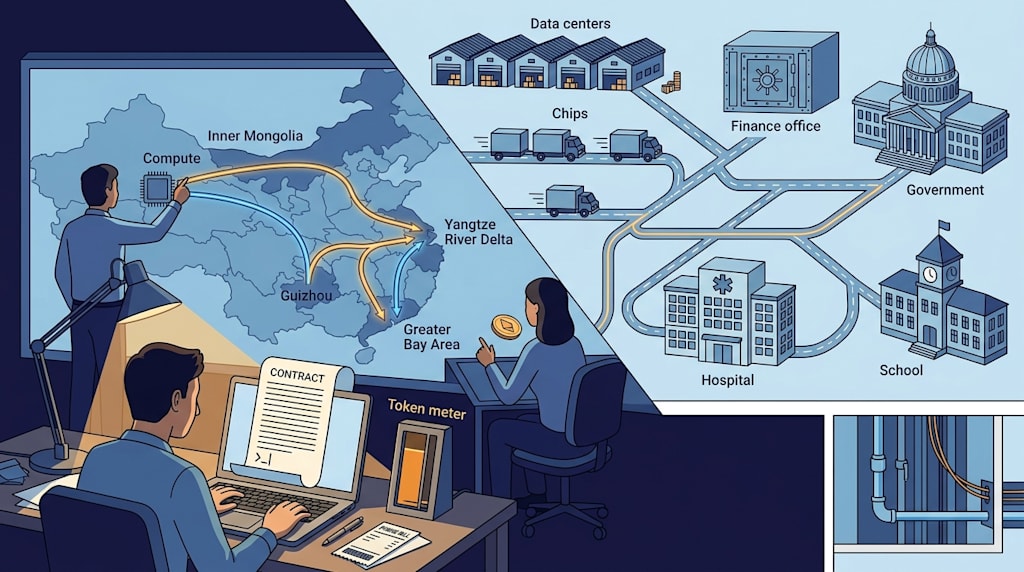
At ten at night, you are halfway through a weekly report. You type: "Help me organize this week's work." The screen stops. The cursor blinks eight times before the first line appears. You ask about a story that just broke. It answers with confidence and gets the time and place wrong. You paste in a long contract. By the second half, it has forgotten clauses it quoted earlier. At the start of the month, you use your AI membership every day. By the end, the token bill looks like your phone bill.
You blame the model. Sometimes that is fair. But a request goes through many steps before you see a word. The model is one step. Where the compute sits, whether the network is jammed, whether the chip matches the task, whether the job is queued, whether the cache hits, how inference scales. Any of these can change the answer you get. One slow link and you wait.
For businesses, the question is not just how smart the model is. It is whether you can call it when you need it, whether it holds up under load, and whether more people can afford to use it.
Bad AI is not always the model's fault
AI talk used to center on parameters, leaderboards, and demo clips. Daily use exposes other problems. Can compute be scheduled in time? Can a model run across different chips? Can the system scale up and down when traffic spikes? Can data and security boundaries hold?
As AI scales, compute has to deal with supply chain security, data compliance, and operations at the same time. Resources have to coordinate across regions. Models have to run on different chips. Capacity has to expand and shrink with demand. These things decide whether AI fits into a workday.
The competition is moving from one model's score to the whole delivery system. A great answer in a demo video does not mean the service is reliable on a Tuesday afternoon. Users do not want one good answer now and then. They want every request caught.
One approach: schedule compute like a delivery network
China Unicom says its Xingluo platform uses three layers: nationwide computing centers, regional computing nodes, and local intelligent computing hubs. It adds compute-network awareness, heterogeneous orchestration, and intelligent scheduling. Regional clusters, ten-thousand-card clusters, and ultra-ten-thousand-card clusters go into one system. Dispersed compute can connect across regions, be managed in one place, and be called when business needs it.
A training job comes in. The local cluster is queued at peak. Another region has spare capacity. The system looks at chip type, network latency, and task needs. It sends the job to a better node. Later, inference requests flood in. It allocates resources by live load and cache state. You see a shorter wait. Behind that wait, a scheduler is moving work around all day.
This is similar to a national delivery network. Warehouses sit in different cities. Roads get congested. Packages differ in size and deadline. If one warehouse works alone, peak hours mean queues. If warehouses cannot coordinate, one sits idle while another turns work away. Compute scheduling lets scattered resources be seen, connected, and assigned. Scale becomes steadier service.
Cross-region training
Inner Mongolia, Guizhou, the Yangtze River Delta, and the Greater Bay Area sit about 2,000 kilometers apart. They hold different types of domestic chips. In the past, they trained like separate teams, each with its own temper. Now they can work on one large model together.
China Unicom says Xingluo has run cross-region mixed training across four locations and three chip types. The company says cross-region routing latency reaches sub-millisecond levels and overall compute efficiency ratio rises to 300%. Those are company figures, not independently verified here.
The hard part is that the compute is not in one place. It does not use identical chips or runtimes. Networks change. Chip architectures differ. Task types vary. Cluster load moves. In the past, compute looked like islands. Move a model, and you often had to adapt it again. Xingluo brings heterogeneous compute into one scheduling system first. Then it decides how those resources work together based on the task, the resource state, and the network.
Two dispatchers run this inside Xingluo. One arranges compute. The other arranges model requests.
The compute dispatcher picks the cluster. It weighs chip type, network latency, resource load, and task priority. It pools resources inside clusters and orchestrates across regions. Ascend, Metax, Kunlunxin, and other architectures come under one management layer for training, inference, and mixed deployment.
The token dispatcher handles the units a model generates and processes as it writes. It decides which model a request calls and which path it takes. It adjusts by load, cache, and hardware capability. You do not need to know which data center or chip handles your request. The system tries to send it to a better node.
What this means for users
For an ordinary user, the path behind the screen can be complex. The experience should be simple. Responses stay steady. Resources go further. AI services scale without a new headache every week.
A finance example
A consumer finance company wants AI to help write code, handle office work, and test software. Financial work has cost, speed, and security demands. When more people log in, the system cannot lag. The company needs to see how much compute it uses. Sensitive data cannot leave the business system at will.
China Unicom says Xingluo gives the company a plan. On top of nationwide compute scheduling, it offers mainstream model services. A unified interface lets different apps call the same AI capability. When business rises, the system temporarily allocates more compute. In normal hours, it bills by actual usage.
End-to-end encryption and security mechanisms protect data transmission and model calls. China Unicom Mogong's AI security capability watches model output in real time. It blocks harmful content. It also sets permission boundaries for AI actions. That prevents sensitive data leaks and high-risk operations. AI stays compliant and controllable in financial work.
AI does more than install a model. It runs inside the daily workflow. Employees call it when they need it. The system carries peak load. After use, cost is managed by actual consumption.
Steady delivery
The next stage of AI competition will still test model capability. It will also test whether a model can be delivered without drama. Scattered compute, models, and applications need one organizing layer. Only then can they move from one demo after another to services people rely on daily.
You should not need to know where the compute comes from. You should not need to know which nodes your request passes through. You open an app. You get a result that is steady, safe, and affordable.
You open the input box again. You type a question. The cursor blinks twice. The answer appears. You close the window and head to a meeting.
About the Creator
Jin
Writer of reamstories
https://reamstories.com/jin
Enjoyed the story? Support the Creator.
Subscribe for free to receive all their stories in your feed. You could also become a paid subscriber, letting them know you appreciate their work.
Comments
There are no comments for this story
Be the first to respond and start the conversation.