
Why Workforce Management Is Becoming a Strategic Priority for Modern Businesses
As organizations embrace AI, hybrid work models, and data-driven decision-making, workforce management solutions are transforming how companies schedule, engage, and optimize employees.

The workplace has undergone dramatic changes over the past few years. Remote work, flexible schedules, labor shortages, rising wage pressures, and increasingly complex compliance requirements have forced organizations to rethink how they manage their employees. What was once considered a back-office administrative function has evolved into a strategic business priority.
Today, workforce management is no longer simply about tracking attendance or creating work schedules. It has become a comprehensive approach to optimizing labor resources, improving employee experiences, controlling costs, and ensuring compliance with constantly changing regulations.
As businesses navigate a rapidly changing employment landscape, workforce management (WFM) solutions are emerging as essential tools for maintaining productivity and competitiveness.
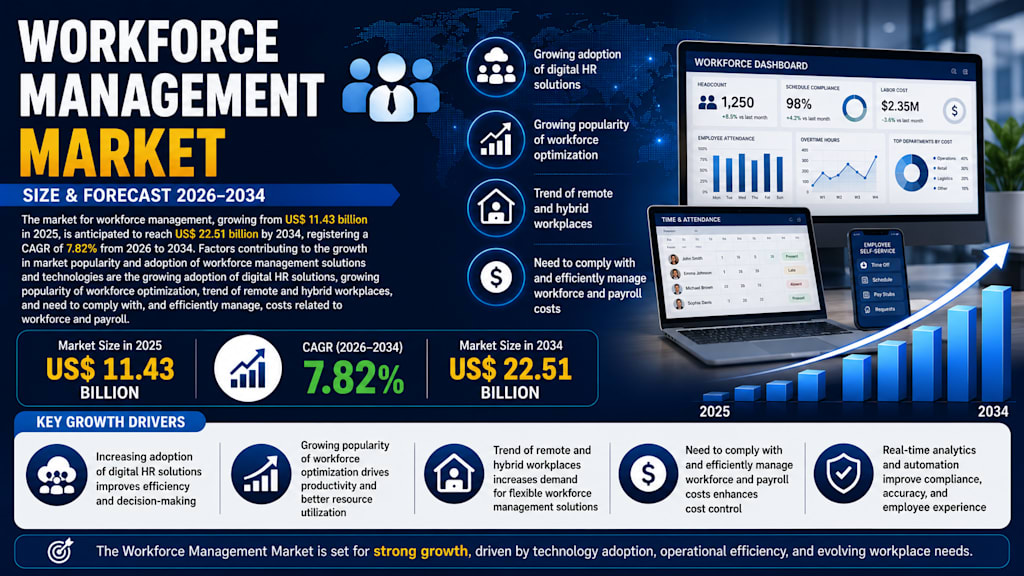
According to Renub Research, the Global Workforce Management Market is expected to grow from US$ 11.43 billion in 2025 to US$ 22.51 billion by 2034, expanding at a compound annual growth rate (CAGR) of 7.82% between 2026 and 2034. This growth reflects increasing demand for intelligent workforce solutions that help organizations balance operational efficiency with employee satisfaction.
As the future of work continues to evolve, workforce management technologies are becoming indispensable across industries ranging from retail and healthcare to manufacturing, education, and financial services.
Understanding Workforce Management
Workforce management refers to a collection of processes, technologies, and strategies designed to optimize employee productivity and align labor resources with business objectives.
A modern workforce management system typically includes several key functions, including employee scheduling, time and attendance tracking, payroll integration, labor forecasting, performance monitoring, absence management, and compliance reporting.
These solutions help organizations ensure that the right employees are available at the right time while minimizing unnecessary labor costs and maintaining service quality.
In the past, many workforce management tasks were handled manually through spreadsheets, paper schedules, and administrative processes. However, growing workforce complexity has made manual methods increasingly inefficient and error-prone.
Cloud-based workforce management platforms now allow organizations to automate routine processes while gaining access to real-time workforce insights that support smarter decision-making.
The Rise of Workforce Optimization
One of the primary factors driving growth in the workforce management market is the increasing focus on workforce optimization.
Organizations are under constant pressure to improve productivity while controlling labor expenses. Since labor costs often represent one of the largest operational expenditures, businesses are seeking more effective ways to allocate resources and maximize workforce efficiency.
Workforce management systems provide valuable visibility into staffing patterns, employee availability, workload demands, and operational performance.
By analyzing historical data and forecasting future requirements, organizations can make more informed staffing decisions while avoiding overstaffing and understaffing situations.
The result is improved productivity, lower costs, and enhanced customer experiences.
As competition intensifies across industries, workforce optimization continues to move higher on executive agendas.
Artificial Intelligence Is Transforming Workforce Management
Artificial intelligence has become one of the most influential technologies shaping the future of workforce management.
Traditional scheduling and labor planning often relied on manager experience and manual calculations. While effective to some extent, these methods frequently resulted in inefficiencies and missed opportunities.
AI-powered workforce management platforms are changing this dynamic.
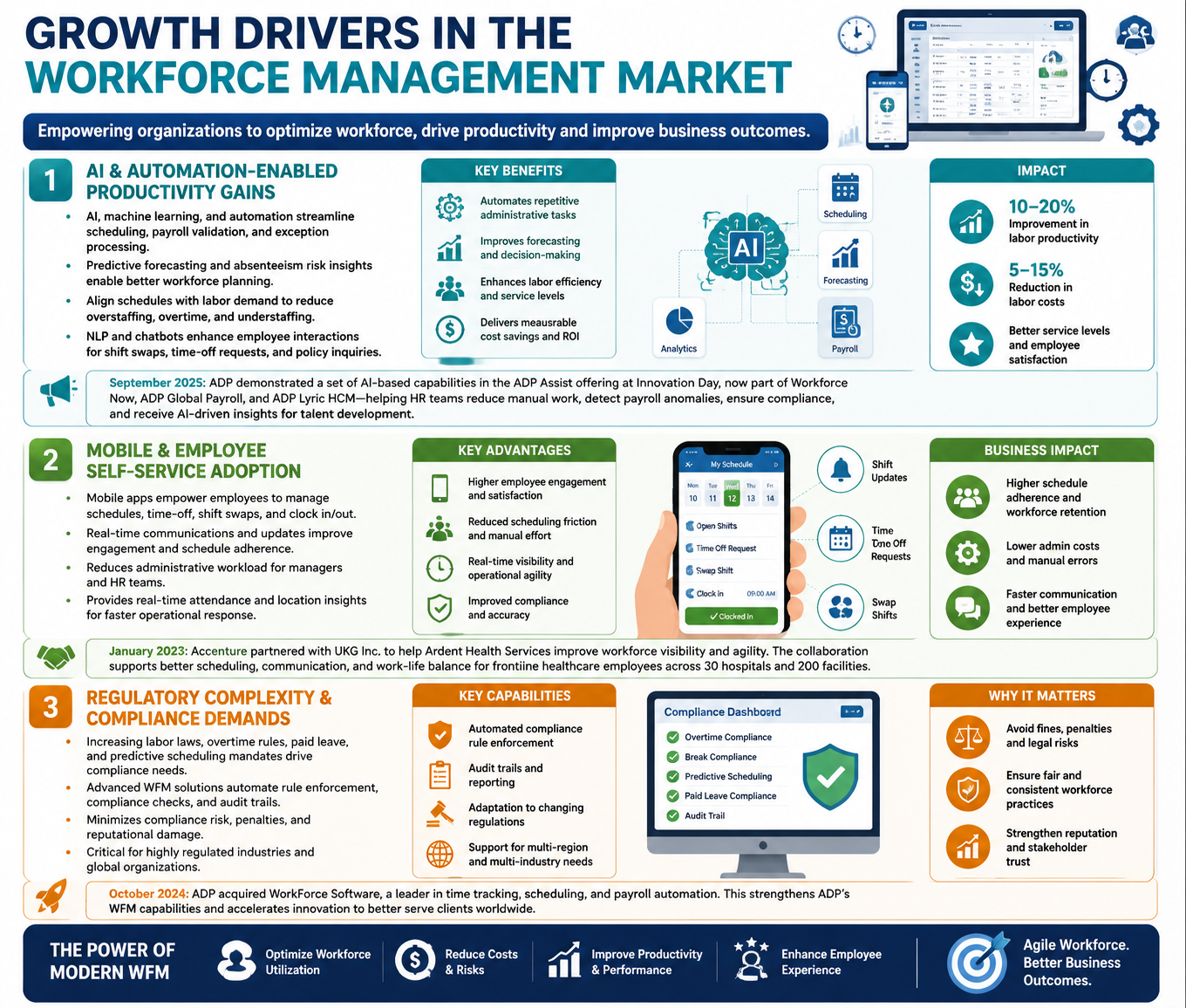
Modern systems can analyze vast amounts of historical and real-time data to predict staffing requirements, identify attendance patterns, forecast labor demand, and recommend optimized schedules.
Machine learning algorithms continuously improve forecasting accuracy by learning from changing business conditions and workforce behaviors.
Organizations can use these insights to reduce overtime costs, improve scheduling accuracy, and ensure adequate staffing during peak periods.
Artificial intelligence also supports automated payroll validation, compliance monitoring, and workforce analytics, helping HR departments reduce administrative burdens while improving operational efficiency.
Automation Reduces Administrative Work
Automation is another major driver behind workforce management adoption.
Many HR and operational processes involve repetitive administrative tasks that consume significant time and resources.
Activities such as schedule creation, attendance tracking, payroll processing, shift approvals, and leave management often require extensive manual effort.
Modern workforce management solutions automate many of these tasks, reducing errors and freeing managers to focus on higher-value activities.
Automated scheduling systems can instantly generate optimized work schedules based on employee availability, labor laws, skill requirements, and anticipated demand.
Similarly, automated compliance monitoring helps organizations avoid costly violations while simplifying audit preparation.
For businesses facing labor shortages and increasing operational complexity, automation provides a powerful tool for improving efficiency.
Mobile Workforce Management Is Becoming Essential
The widespread use of smartphones has transformed employee expectations.
Workers increasingly expect workplace technologies to provide the same convenience and accessibility they experience in consumer applications.
Mobile workforce management platforms address these expectations by enabling employees to access schedules, request time off, swap shifts, receive notifications, and clock in or out directly from their mobile devices.
For frontline employees and hourly workers, mobile access significantly improves convenience and communication.
Managers also benefit from real-time visibility into attendance patterns and workforce activity, allowing faster responses to operational challenges.
Mobile-first workforce management solutions are becoming especially valuable for organizations with geographically dispersed teams, remote workers, and shift-based operations.
As digital experiences continue to influence workplace expectations, mobile functionality will remain a key competitive differentiator.
Hybrid and Remote Work Are Reshaping Workforce Strategies
The rise of hybrid and remote work models has fundamentally changed workforce management requirements.
Organizations must now coordinate employees working across multiple locations, time zones, and schedules while maintaining productivity and engagement.
Traditional workforce management approaches designed for centralized workplaces are often insufficient in today's distributed work environments.
Modern platforms provide real-time visibility into workforce activity regardless of location. Organizations can monitor attendance, manage schedules, track productivity, and ensure compliance across remote and hybrid teams.
These capabilities have become increasingly important as businesses embrace flexible work arrangements.
The future workplace is likely to remain highly distributed, creating ongoing demand for advanced workforce management technologies.
Compliance Requirements Continue to Grow
Compliance remains one of the most important drivers of workforce management adoption.
Labor laws and employment regulations are becoming increasingly complex across many countries and industries.
Organizations must comply with requirements related to overtime, paid leave, scheduling practices, employee classifications, workplace safety, and wage regulations.
Failure to comply can result in financial penalties, legal disputes, and reputational damage.
Workforce management systems help organizations automate compliance processes by enforcing labor rules, generating audit trails, and monitoring regulatory requirements in real time.
This functionality is particularly valuable for multinational companies and heavily regulated sectors such as healthcare, transportation, and manufacturing.
As regulatory complexity continues to increase, workforce management solutions are becoming critical compliance tools.
Time and Attendance Solutions Remain Core Components
Time and attendance management remains one of the most widely adopted workforce management functions.
Modern systems have evolved far beyond traditional punch clocks.
Today's solutions support biometric verification, geofencing, mobile clock-ins, web-based attendance tracking, and automated overtime calculations.
Organizations benefit from greater accuracy, reduced payroll errors, and improved visibility into workforce activity.
Advanced reporting capabilities also enable managers to identify attendance trends and address potential issues proactively.
As workforce mobility increases, cloud-based time and attendance solutions continue gaining popularity.
Scheduling Software Is Becoming More Intelligent
Employee scheduling represents one of the most impactful workforce management applications.
Creating schedules manually can be time-consuming and difficult, particularly for organizations managing large numbers of employees across multiple locations.
Advanced scheduling platforms use predictive analytics and business data to generate optimized schedules automatically.
These systems consider factors such as employee skills, availability, labor regulations, historical demand patterns, and operational requirements.
Some platforms even incorporate employee preferences to improve fairness and satisfaction.
Intelligent scheduling helps organizations reduce labor costs while enhancing employee experiences and service quality.
Industry-Specific Applications Drive Adoption
Different industries have unique workforce management requirements.
Retail
Retail organizations face highly variable demand driven by promotions, holidays, and seasonal fluctuations. Workforce management systems help retailers forecast staffing needs and maintain service quality while controlling labor expenses.
Healthcare
Healthcare providers must balance patient care requirements with strict regulatory obligations and staffing constraints. Workforce management solutions support scheduling, credential tracking, overtime management, and workforce planning.
Education
Educational institutions manage complex schedules involving faculty, staff, substitute teachers, and seasonal workforce fluctuations. Workforce management platforms help streamline operations while supporting compliance requirements.
Manufacturing
Manufacturers rely on workforce management systems to coordinate shift schedules, monitor attendance, manage certifications, and optimize labor utilization across production facilities.
Challenges Facing the Market
Despite strong growth prospects, the workforce management market faces several challenges.
Integration Complexity
Many organizations continue to operate legacy HR, payroll, and ERP systems.
Integrating modern workforce management platforms with existing infrastructure can be technically challenging and resource-intensive.
Organizations often require extensive customization and ongoing support to ensure seamless data synchronization.
Resistance to Change
Employee and manager adoption remains another significant challenge.
Workforce management systems often introduce new processes and technologies that may disrupt established routines.
Without effective communication, training, and change management strategies, organizations may encounter resistance that limits adoption success.
Building trust and demonstrating value are essential for achieving long-term success.
Regional Markets Leading Growth
United States
The United States remains one of the most advanced workforce management markets globally. High labor costs, regulatory complexity, and rapid adoption of cloud technologies continue driving demand.
United Kingdom
Organizations across the UK increasingly rely on workforce management solutions to support flexible work arrangements and maintain compliance with evolving labor regulations.
China
China's large workforce and ongoing digital transformation initiatives are fueling rapid adoption of workforce management technologies across manufacturing, logistics, and service industries.
Brazil
Brazilian organizations are increasingly investing in workforce management solutions to improve efficiency and comply with labor regulations while supporting digital transformation efforts.
Saudi Arabia
Workforce modernization initiatives and economic diversification programs are driving growing adoption of workforce management platforms across multiple sectors.
The Future of Workforce Management
The future of workforce management will likely be shaped by greater automation, advanced analytics, artificial intelligence, and employee-centric design.
Organizations will increasingly use predictive insights to anticipate workforce needs, identify risks, and improve decision-making.
Employee self-service capabilities will continue expanding, giving workers greater control over schedules, time management, and career development.
At the same time, workforce management platforms will become more integrated with broader HR ecosystems, enabling seamless collaboration between workforce planning, talent management, payroll, and employee engagement functions.
As the nature of work continues evolving, workforce management will remain a critical component of organizational success.
Final Thoughts
The global workforce management market is entering a new phase of growth driven by digital transformation, changing workforce expectations, and increasing operational complexity.
With the market projected to grow from US$ 11.43 billion in 2025 to US$ 22.51 billion by 2034, organizations are increasingly recognizing the value of intelligent workforce management solutions in improving productivity, reducing costs, and enhancing employee experiences.
While challenges such as integration complexity and change management remain important considerations, advances in artificial intelligence, automation, cloud computing, and mobile technologies are creating significant opportunities for innovation.
As businesses continue adapting to the future of work, workforce management will become more than an operational necessity—it will be a strategic advantage that helps organizations thrive in an increasingly competitive and dynamic world.
About the Creator
Enjoyed the story? Support the Creator.
Subscribe for free to receive all their stories in your feed.
Comments
There are no comments for this story
Be the first to respond and start the conversation.