
Why Website Maintenance Is Becoming More Important in the AI Search Era
AI search has changed how people find answers, but it has not replaced the basics of search visibility.

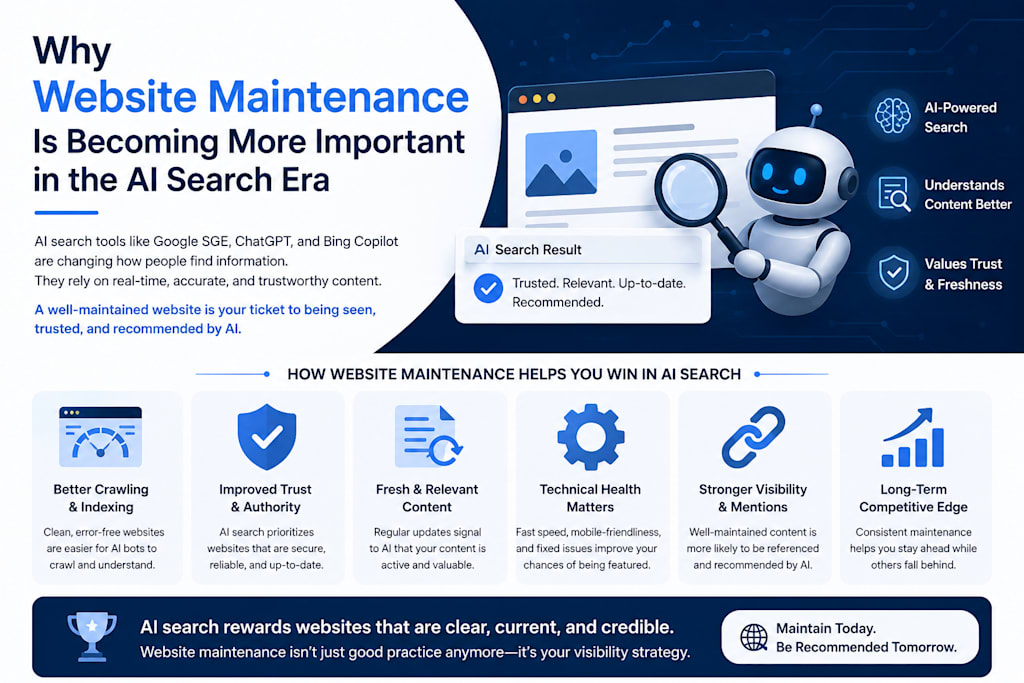
AI search has changed how people find answers, but it has not replaced the basics of search visibility. Google says its generative AI features still rely on core Search ranking and quality systems, and that pages still need to be technically accessible, crawlable, indexable, and genuinely helpful to be considered for those experiences. That means website maintenance is no longer just a back-office task. It is part of your visibility strategy.
Website maintenance is now a visibility issue, not just a technical one
For years, many businesses treated website maintenance as a set of routine chores: update the CMS, renew the SSL certificate, fix broken links, and make sure the site did not crash. That still matters, but the AI search era has raised the stakes. Search systems are now trying to answer people faster, with more confidence, and with content that is current, useful, and easy to understand. Google’s guidance consistently points creators toward helpful, reliable, people-first content and strong technical foundations.
In simple terms, a website that is old, slow, confusing, or poorly maintained is easier to ignore. A website that is regularly improved, checked, and refreshed is easier to trust. That difference matters more now because AI-driven search experiences often summarize or surface answers from pages that look credible and technically sound. Google’s 2026 guidance explicitly says to apply SEO best practices to generative AI search and to focus on unique, expert-led content that provides value beyond common knowledge.
What website maintenance means today
Website maintenance is the ongoing work of keeping a site secure, current, fast, and useful. At a basic level, it includes updates, backups, security monitoring, and bug fixes. In a modern search environment, it also includes content refreshes, internal linking checks, page quality reviews, mobile usability checks, and SEO maintenance. Google’s documentation describes SEO as improving a site’s presence in Search by helping search engines crawl, index, and understand content while also helping users find what they need.
That broader definition matters because AI search does not reward content in isolation. It rewards content that is accessible, understandable, and worth surfacing. Google says pages need to meet its technical requirements so they can be found, crawled, indexed, and considered for search results, including AI-related formats. If a page is blocked, broken, or not indexable, it is simply less likely to show up.
Snippet-ready answer: Website maintenance is the ongoing process of keeping a site secure, fast, accurate, and easy to crawl. In the AI search era, it matters because search systems still depend on technically healthy, helpful pages when deciding what to surface.
How AI search changed the rules
The biggest mistake businesses make is assuming AI search has made traditional SEO less important. Google’s own guidance says the opposite. Its generative AI features rely on core Search systems, and its documentation says foundational SEO best practices remain the basis for visibility in generative AI search experiences and in Search overall.
This is important because AI search still needs source material. Search systems still need pages that can be crawled, understood, and trusted. Google’s documentation also makes it clear that structured data helps Search understand content, but it is not a shortcut and must match the visible page content. So the pages that perform best in AI-driven environments are usually not the most heavily optimized in a shallow sense. They are the most useful, technically sound, and well maintained.
Google’s helpful-content guidance reinforces the same point. It says ranking systems are designed to prioritize helpful, reliable information created to benefit people, not content made mainly to manipulate rankings. That is a strong signal that maintenance now includes editorial discipline: updating pages, removing weak sections, and making sure the content still answers a real user need.
Why website maintenance matters more in the AI search era
Freshness affects trust
One of the clearest reasons maintenance matters is freshness. If a service page still shows outdated pricing, an old FAQ still mentions retired services, or a blog post still uses obsolete examples, the site begins to look neglected. Google’s guidance on helpful content and generative AI visibility points toward content that is unique, reliable, and current enough to be worth surfacing. While Google does not say “freshness alone wins,” it is reasonable to infer that stale content works against the kind of trustworthy page experience its systems are trying to reward.
Technical issues can quietly block visibility
A website can look fine to a human visitor and still have problems that reduce search performance. Broken links, redirect errors, slow-loading pages, mobile usability issues, and crawl blockers all make it harder for Google to find, parse, and index content. Google’s documentation on crawling and indexing is direct about this: if search systems cannot access the page properly, the page is less likely to appear in results.
Maintenance supports better user experience
AI search is not just about rankings. It is about usefulness. If users click through from a result and land on a page that feels outdated, unclear, or broken, trust drops quickly. Google’s people-first content guidance emphasizes creating content for people rather than for search manipulation, which is another way of saying the user experience still matters. The better the site experience, the easier it is to keep both users and search systems confident in the brand.
Snippet-ready answer: Website maintenance matters more in the AI search era because search systems still depend on helpful, crawlable, indexable pages. If your site is outdated, slow, broken, or difficult to trust, it becomes less competitive in both traditional search and AI-driven search results.
The problems users are really trying to solve
People usually do not search for “website maintenance” because they love website administration. They search because something feels off. Traffic drops. Leads slow down. Rankings change. Competitors appear more often in AI-generated answers. Forms stop working. Pages look old. These are business problems first and technical problems second. Google’s guidance on generative AI search and helpful content points toward the same pattern: the search system is trying to reward content that actually helps people solve a problem.
That is why this topic matters to a business owner, marketer, or startup founder. They are usually not asking, “Do I need more updates?” They are asking, “Why is my website underperforming, and what do I need to do to fix it?” Website maintenance is the answer when the real issue is that the site has become stale, fragile, or hard to trust.
Common website maintenance problems that hurt AI search visibility
Outdated content
Outdated content is one of the most visible signs that a site needs maintenance. Old pricing, old screenshots, old service descriptions, and old statistics all weaken trust. Google’s helpful-content guidance encourages people-first content that is genuinely useful and reliable, so pages that have not been reviewed in a long time are less likely to fit that standard.
Broken forms and broken links
A contact form that does not work is a direct conversion loss. A broken internal link is a smaller issue on its own, but a collection of them can make the site feel unfinished. Google’s Search Essentials also recommends crawlable links so search engines can discover pages through the site structure. Maintenance is what keeps those links and paths clean.
Slow pages and mobile problems
Google continues to recommend mobile-first best practices, and it says the mobile version of a site is used for indexing and ranking. That means slow or awkward mobile experiences are not just a design issue. They are a search issue too. In an AI search world, where users expect quick answers, that matters even more.
Thin or duplicated pages
Many sites accumulate pages that overlap, repeat, or provide very little value. Google’s guidance on generative AI content and spam policies is a warning here: publishing lots of pages without adding value can violate policy, especially when automation is used at scale. Maintenance helps you merge, prune, and improve weak pages instead of letting them drag down the site as a whole.
What a strong maintenance process should include
A practical maintenance plan needs more than one kind of check. It should combine technical work, content work, and search visibility work.
- Technical maintenance
- update the CMS, plugins, and themes
- monitor uptime
- test forms and checkout flows
- fix broken links and redirects
- improve page speed
- check mobile usability
- keep security patches current
- Content maintenance
- refresh important pages
- update facts, dates, examples, and screenshots
- improve weak sections
- merge overlapping articles
- remove pages that no longer serve a purpose
- SEO maintenance
- review indexing status
- check internal links
- monitor changes in traffic and rankings
- validate structured data where it is relevant
- prioritize pages that already attract impressions or clicks
This kind of maintenance aligns with Google’s guidance that Search should be able to crawl and index your pages, and that structured data should help Search understand page content when it is used correctly. It also aligns with Google’s 2026 generative AI guidance, which says to keep a clear technical structure and create unique, valuable content.
Snippet-ready answer: A strong website maintenance process includes technical updates, content refreshes, SEO checks, and user experience improvements. The goal is to keep the site secure, accurate, fast, and easy for both users and search systems to trust.
Step-by-step: how to maintain a website for AI search
Step 1: Audit the website
Start by identifying what is broken, outdated, or underperforming. Look for crawl issues, slow pages, old content, broken links, and pages that no longer match the business. Google’s crawl and index guidance makes clear that if the site cannot be accessed properly, visibility suffers.
Step 2: Fix technical issues first
Resolve anything that blocks access or weakens usability. That includes server problems, noindex mistakes, redirect chains, broken forms, mobile issues, and speed problems. Google’s mobile-first guidance makes mobile content especially important for indexing and ranking.
Step 3: Refresh the pages that matter most
Do not start with low-value pages. Start with pages that already matter to the business: core service pages, high-traffic blog posts, FAQ pages, and landing pages. Google’s helpful-content guidance favors pages that create a satisfying experience for visitors, so the most important content should get the most attention.
Step 4: Improve trust signals
Make sure the site clearly shows who you are, what you do, and how users can contact you. Review author details, business information, contact pages, and policy pages. Google’s guidance around helpful content and structured data both point toward clarity and transparency as part of a stronger page experience.
Step 5: Review results regularly
Maintenance should not be a one-time cleanup. Review traffic, indexing, conversions, and page performance on a regular basis. Google’s 2026 guidance says technical structure and valuable content are the foundation for visibility in generative AI search experiences, which means ongoing monitoring is part of staying competitive.
Website development vs website maintenance
Website development creates the site. Website maintenance keeps it working, useful, and competitive. Development is usually a launch project; maintenance is the ongoing work that protects the investment. If the site is treated like a one-time asset, it ages quickly. If it is treated like a living business tool, it stays relevant longer. This is a practical conclusion from Google’s emphasis on crawlability, helpfulness, and technical quality as ongoing requirements, not one-time tasks.
How this topic connects naturally to website maintenance cost
Once readers understand that maintenance is essential to visibility, the next question is usually practical: how much should it cost? That is a natural follow-up because different websites need different levels of support. A simple brochure site does not require the same maintenance workload as a content-heavy or eCommerce site, and Google’s guidance on technical structure, content quality, and usability shows why those differences matter.
A smooth transition into your pillar page could look like this:
As AI search raises the standard for technical health, content quality, and user trust, website maintenance becomes a budgeted business requirement rather than an optional extra. To understand what that investment usually looks like, see our guide to website maintenance cost.
That link placement feels natural because the article has already established why maintenance matters. Now the reader is ready to evaluate pricing.
Signs your website needs immediate maintenance
A website usually gives warning signs before it becomes a serious problem. Watch for these issues:
- traffic declines without a clear reason
- rankings drop on important pages
- the site feels slow on mobile
- forms stop sending leads
- old information is still visible
- pages are not being indexed properly
- competitors begin showing up more often
These symptoms usually mean the site needs a content update, a technical fix, or a broader maintenance review. Google’s guidance on crawlability, helpful content, and mobile-first indexing all support the idea that these problems can hurt search visibility and user trust at the same time.
How businesses can stay competitive in AI search
The best approach is not to chase every new trend. It is to keep the website strong enough that it can support whatever search experience users prefer next. That means focusing on clear technical structure, helpful content, and regular review of the pages that matter most. Google’s 2026 guidance says exactly that: apply SEO best practices, keep the site accessible, and create unique content with real value.
A practical strategy looks like this:
refresh your best pages before writing dozens of new ones
keep your content accurate and easy to scan
maintain fast, mobile-friendly pages
use structured data where it is truly relevant
avoid mass-producing weak pages with AI
review your site as a system, not as separate posts and pages
Google’s spam policies and generative AI guidance are especially relevant here. They warn against generating many pages without adding value, and they clarify that AI-generated content is only appropriate when it still meets Search Essentials and spam policy standards.
Conclusion
AI search has made website maintenance more important because search visibility now depends even more on trust, accessibility, and usefulness. Google’s documentation is consistent on this point: pages need to be crawlable, indexable, technically healthy, and genuinely helpful if they are going to perform well in Search, including generative AI experiences.
For business owners, that creates a simple decision. A website can either be treated as a static asset that slowly declines, or as a living business tool that is maintained, improved, and protected over time. In the AI search era, the second approach is the safer one. And once that is clear, the next question is usually the one that matters most for planning: what level of maintenance do you actually need, and what should it cost? That is where a detailed breakdown of website maintenance cost becomes the next logical step.
About the Creator
Henry Davids
Hi, I’m Henry Davids!
I’m passionate about technology, web development, and helping businesses grow online. I write about website development, SEO, digital marketing, and practical tech insights that make complex ideas easier to understand.
Enjoyed the story? Support the Creator.
Subscribe for free to receive all their stories in your feed.
Comments
There are no comments for this story
Be the first to respond and start the conversation.