
Why the United States Data Center Cooling Market Is Becoming the Backbone of the AI Economy
Explosive growth in artificial intelligence, cloud computing, and hyperscale data centers is driving unprecedented demand for advanced cooling technologies across the United States.

The United States is at the center of the global digital revolution.
From artificial intelligence and cloud computing to e-commerce, streaming platforms, financial services, and enterprise software, nearly every aspect of modern life relies on digital infrastructure operating behind the scenes. At the heart of that infrastructure are data centers, massive facilities that process, store, and distribute vast amounts of information every second.
As these facilities become larger and more powerful, one challenge is attracting increasing attention from technology leaders, investors, and infrastructure operators alike: cooling.
Modern data centers generate enormous amounts of heat. Without effective cooling systems, servers can overheat, performance can deteriorate, equipment can fail, and critical digital services can be disrupted. What was once considered a supporting operational requirement has now become one of the most important technologies enabling the future of computing.
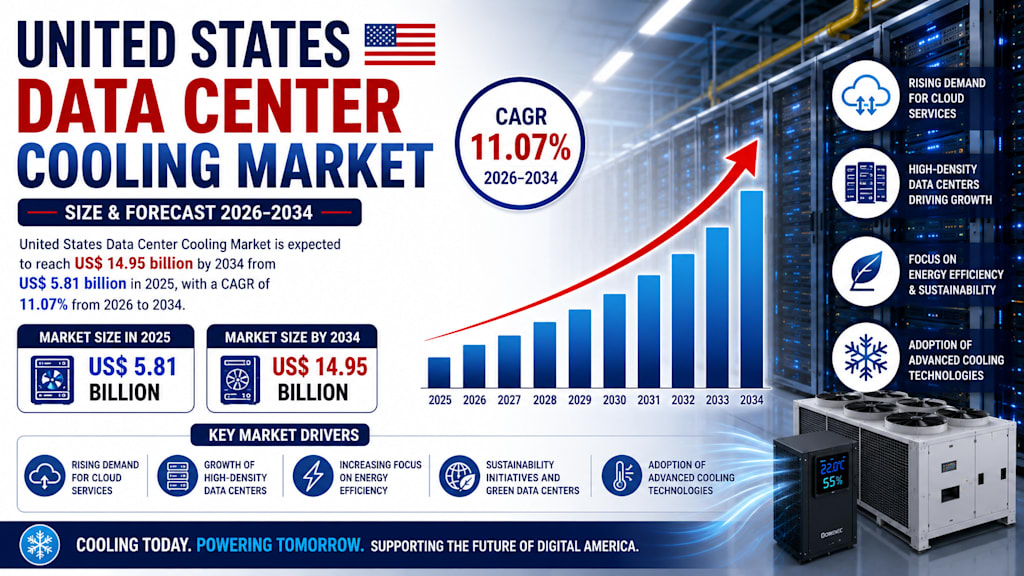
According to Renub Research, the United States Data Center Cooling Market is expected to grow from US$ 5.81 billion in 2025 to US$ 14.95 billion by 2034, expanding at a compound annual growth rate (CAGR) of 11.07% between 2026 and 2034. The growth is being fueled by increasing cloud adoption, rising AI workloads, expanding hyperscale infrastructure, and growing emphasis on energy efficiency and sustainability.
As America continues building the infrastructure needed for an increasingly digital economy, cooling technologies are becoming essential to ensuring that growth remains reliable, efficient, and sustainable.
America's Digital Infrastructure Boom
Over the last decade, the United States has experienced extraordinary growth in digital infrastructure.
Businesses of every size have accelerated their adoption of cloud computing platforms. Consumers stream more video content than ever before. Online shopping continues to expand, while remote work, digital collaboration tools, and artificial intelligence applications have become part of everyday life.
Each of these activities generates enormous volumes of data that must be processed and stored continuously.
To meet this demand, technology companies have invested billions of dollars in building hyperscale, enterprise, and edge data centers across the country. These facilities contain thousands of servers operating around the clock, creating substantial heat that must be managed efficiently.
The rapid expansion of digital services is therefore creating a parallel surge in demand for advanced cooling systems capable of supporting increasingly complex computing environments.
Without effective thermal management, the growth of America's digital economy would be difficult to sustain.
Why Data Center Cooling Matters
Every electronic component generates heat during operation.
Within a data center, servers, storage systems, networking equipment, and power infrastructure all contribute to rising temperatures. As computing intensity increases, thermal management becomes more challenging.
Excessive heat can have serious consequences.
Equipment may operate less efficiently, hardware lifespan can be shortened, and the risk of system failures rises significantly. For organizations that depend on continuous digital operations, downtime can result in financial losses, reputational damage, and service disruptions affecting millions of users.
Cooling systems help prevent these outcomes by maintaining optimal environmental conditions.
By regulating temperature, airflow, and humidity levels, modern cooling technologies ensure that critical infrastructure remains operational regardless of workload intensity. As server density continues increasing, the role of cooling systems is becoming more important than ever.
Today, cooling is no longer simply about comfort or equipment protection. It has become a strategic component of digital infrastructure planning.
Artificial Intelligence Is Driving a New Wave of Demand
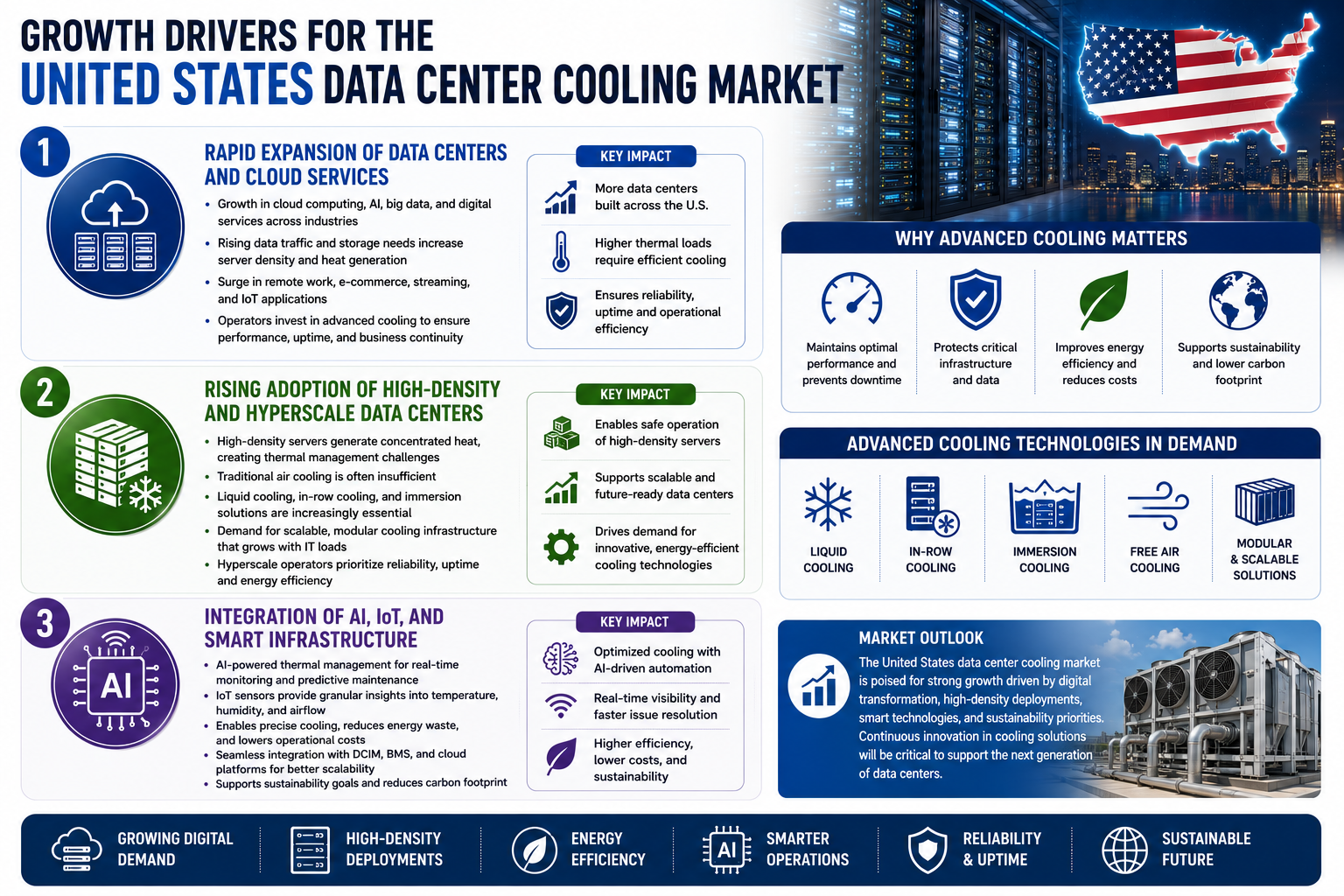
Artificial intelligence has emerged as one of the most powerful forces reshaping the data center industry.
Training advanced AI models requires immense computational resources. Graphics processing units, specialized AI accelerators, and high-performance computing systems consume significantly more power than traditional servers.
This increased power consumption generates substantially more heat.
As organizations race to deploy AI applications, many existing cooling systems are reaching their operational limits. Traditional air-based approaches often struggle to manage the thermal loads created by AI-focused infrastructure.
As a result, data center operators are investing heavily in next-generation cooling technologies capable of supporting higher power densities.
AI is also improving cooling operations themselves.
Advanced monitoring systems now use artificial intelligence to analyze environmental conditions, optimize cooling performance, predict maintenance requirements, and reduce energy consumption. This combination of AI-driven workloads and AI-powered cooling management is transforming how modern facilities operate.
The continued expansion of artificial intelligence applications is expected to remain one of the strongest growth drivers for the market.
Cloud Computing Continues Expanding
Cloud computing remains another major contributor to market growth.
Organizations increasingly prefer cloud-based solutions because they offer scalability, flexibility, and cost efficiency. Rather than maintaining expensive on-premise infrastructure, businesses can access computing resources on demand through cloud service providers.
This shift has encouraged rapid expansion among hyperscale operators.
Large facilities operated by technology giants require sophisticated cooling systems capable of supporting tens of thousands of servers simultaneously. These environments place enormous demands on thermal management infrastructure.
The rise of multi-cloud strategies, hybrid cloud environments, and edge computing networks is creating even greater complexity.
Each new facility requires reliable cooling technologies that support continuous operation while minimizing energy consumption and operating costs.
As cloud adoption continues accelerating across industries, demand for efficient cooling solutions is expected to grow accordingly.
Energy Efficiency Has Become a Critical Priority
Energy consumption represents one of the largest operating expenses for data center operators.
Cooling systems can account for a significant percentage of total facility energy usage, making efficiency improvements a major business priority. Reducing cooling-related energy consumption not only lowers costs but also supports broader sustainability objectives.
Environmental considerations have become increasingly important.
Technology companies face growing pressure from regulators, investors, customers, and environmental organizations to reduce carbon emissions and improve energy performance. Many organizations have established ambitious sustainability targets that require significant improvements in infrastructure efficiency.
Advanced cooling technologies play a crucial role in achieving these goals.
Solutions such as free cooling, hot aisle containment, cold aisle containment, liquid cooling, intelligent airflow management, and automated environmental controls help reduce energy waste while maintaining performance.
As energy prices continue fluctuating and environmental expectations rise, operators are expected to invest heavily in efficient cooling technologies.
The Shift Toward High-Density Data Centers
Modern data centers are becoming increasingly compact and powerful.
Rather than expanding physical footprints indefinitely, operators are maximizing computing capacity within existing facilities. This approach improves space utilization but also creates higher heat densities.
High-density environments require more sophisticated cooling strategies.
Traditional room-level cooling systems may struggle to deliver sufficient thermal control for concentrated workloads. Consequently, operators are adopting row-based cooling, rack-based cooling, and targeted thermal management solutions that provide more precise performance.
Hyperscale facilities, in particular, demand scalable cooling infrastructure capable of adapting to changing workloads.
As organizations continue pursuing higher computing densities, cooling technologies will need to evolve accordingly.
This trend is expected to accelerate further as AI applications continue increasing power requirements.
Liquid Cooling Is Gaining Momentum
Among the most significant innovations in the industry is liquid cooling.
Unlike air, liquids are highly effective at transferring heat. This makes liquid cooling particularly attractive for managing high-density computing environments and AI workloads.
Several approaches are becoming increasingly popular.
Direct-to-chip cooling delivers coolant directly to processors and other heat-generating components. Immersion cooling submerges servers in specially designed dielectric fluids capable of absorbing heat efficiently.
These technologies offer numerous benefits.
Operators can achieve higher thermal efficiency, lower energy consumption, improved equipment performance, reduced noise levels, and greater flexibility in facility design.
While liquid cooling systems often require higher upfront investment, many organizations view them as essential for supporting future computing demands.
The growing popularity of AI infrastructure is expected to significantly accelerate adoption over the coming years.
Smart Cooling Systems Are Improving Operations
The integration of artificial intelligence and Internet of Things technologies is making cooling systems smarter than ever before.
Modern facilities deploy extensive networks of sensors that continuously monitor environmental conditions, including temperature, humidity, airflow, and equipment performance.
This real-time visibility enables more proactive management.
Predictive maintenance tools identify potential problems before they lead to failures, helping reduce downtime and maintenance costs. Automated controls adjust cooling output dynamically based on changing conditions, improving efficiency and reliability.
These capabilities are particularly valuable in large-scale facilities where manual monitoring would be impractical.
As digital infrastructure becomes more complex, intelligent cooling systems are expected to become standard components of modern data centers.
State-Level Markets Driving Growth
California remains one of the most important markets for data center cooling in the United States.
Home to Silicon Valley and numerous technology companies, the state hosts a large concentration of high-performance data centers. Strict environmental regulations and strong sustainability commitments are encouraging adoption of advanced cooling technologies, including liquid cooling and energy-efficient thermal management systems.
Texas has emerged as another major growth hub.
The state's favorable business climate, abundant energy resources, and expanding digital infrastructure have attracted significant investments in hyperscale facilities. However, high temperatures create substantial cooling challenges, driving demand for advanced thermal management solutions.
New York continues expanding its digital infrastructure to support financial services, enterprise technology operations, and cloud computing. Operators increasingly rely on efficient cooling technologies to address space constraints and sustainability requirements.
Florida is also experiencing steady growth due to increasing investments in cloud infrastructure, enterprise data centers, and disaster recovery facilities. The state's warm and humid climate makes effective cooling a critical operational requirement.
Together, these states represent some of the most important opportunities within the broader U.S. market.
Challenges Facing the Industry
Despite strong growth prospects, the industry faces several challenges.
One of the most significant barriers is the high cost associated with advanced cooling technologies. Liquid cooling systems, AI-enabled monitoring platforms, and specialized thermal management infrastructure often require substantial capital investment.
Integration can also be complex.
Many existing facilities were originally designed around traditional cooling architectures, making upgrades technically challenging and expensive. Retrofitting operations without disrupting critical services requires careful planning and specialized expertise.
Another challenge involves workforce requirements.
Advanced cooling systems demand skilled personnel capable of managing installation, maintenance, and optimization activities. Shortages of specialized technical talent can slow adoption and increase operational risks.
Addressing these challenges will be essential as the industry continues evolving.
Looking Ahead
The future of data center cooling is closely tied to the future of digital innovation.
Artificial intelligence, cloud computing, edge infrastructure, and emerging digital technologies will continue increasing demand for advanced thermal management solutions. Cooling systems are expected to become more intelligent, efficient, and integrated into overall facility operations.
Emerging technologies such as direct-to-chip liquid cooling, immersion cooling, AI-driven environmental management, and modular cooling architectures will likely redefine industry standards over the next decade.
At the same time, sustainability considerations will remain central to investment decisions as operators seek to reduce environmental impact while supporting growing computational demands.
The next generation of digital infrastructure will depend heavily on innovations in cooling technology.
Final Thoughts
Data center cooling has become one of the most important yet often overlooked technologies supporting America's digital economy. As cloud computing, artificial intelligence, and high-performance computing continue expanding, the need for reliable thermal management solutions will only grow stronger.
With the United States Data Center Cooling Market projected to increase from US$ 5.81 billion in 2025 to US$ 14.95 billion by 2034, the industry is positioned for substantial growth. Rising demand for data centers, increasing adoption of AI, stronger sustainability goals, and rapid technological innovation are creating powerful opportunities throughout the sector.
As the nation continues investing in digital infrastructure, cooling technologies will play a vital role in ensuring that data centers remain efficient, resilient, and capable of supporting the next generation of technological progress. In many respects, the future of America's digital economy may depend as much on keeping servers cool as it does on making them faster.
About the Creator
Enjoyed the story? Support the Creator.
Subscribe for free to receive all their stories in your feed.
Comments
There are no comments for this story
Be the first to respond and start the conversation.