
Why SaaS Startups Are Switching to Dedicated Developers Over In-House Hiring
Dedicated Developers Over In-House Hiring
Introduction
Most SaaS founders default to in-house engineering because that's what the startup playbook says. Build your team, own your talent, and move faster. The problem is that the playbook was written when senior engineers were available, equity actually motivated people, and product cycles ran in quarters instead of weeks.
That world doesn't exist anymore. The Bureau of Labor Statistics projects 1.4 million unfilled computing jobs in the US by 2027, and senior backend roles are taking 90+ days to fill at most early-stage companies. That's why dedicated developers for SaaS startups have stopped being a fallback option and started becoming the primary engineering model below Series B.
This post walks through the friction pushing founders out of in-house hiring, what dedicated developers for SaaS startups actually solve, and the scenarios where the model fits best.
The Challenges of In-House Hiring for SaaS Startups
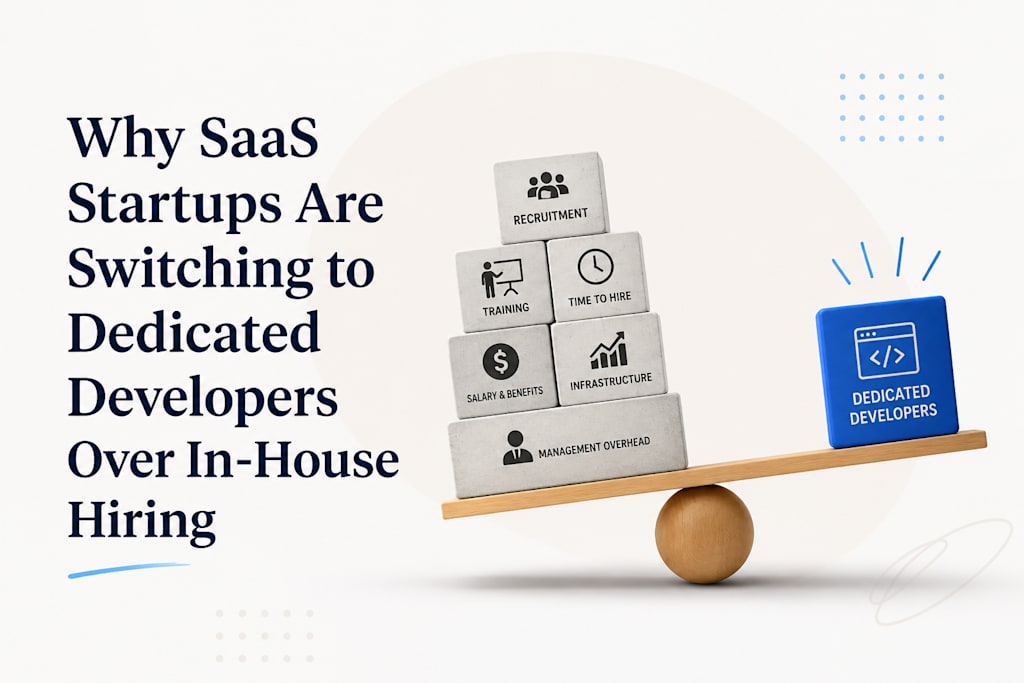
Hiring engineers in 2026 isn't broken because of effort. Founders post on AngelList, LinkedIn, and Wellfound. They run referral campaigns, pay sourcers $8K per hire, yet the pipeline still doesn’t move. Five structural problems are stacking on top of each other.
Shrinking Senior Talent Pool
Gartner reports that 86% of CIOs face greater competition for qualified tech talent than in any prior cycle. Junior candidates exist in volume. The engineers who can own a production system are already employed at companies that aren't letting them go.
Rising Time-to-Hire
The average senior developer hire now takes 90+ days from job posting to first commit, up from 52 days in 2024. Add 5 to 8 months of internal ramp before they ship at full capacity. That's roughly a year of payroll burn before you see real velocity.
Costly Hiring Mistakes
A senior engineer who doesn't work out runs $150K+ in salary, equity, signing bonus, and severance. The same money funds a four-person offshore pod for six months.
Declining Equity Appeal
Senior engineers in 2026 run the math before accepting. Most early-stage SaaS grants don't pencil out against a $250K base at a public company. Founders lose candidates at the offer stage even after good interviews.
Founder Bandwidth Drain
Five open roles absorb 10 to 15 hours of founder time per week. That's a full day of product and customer work surrendered to a pipeline that may not close.
Why SaaS Startups Prefer Dedicated Developers
The shift comes down to five practical advantages that in-house hiring can't match at the seed-to-Series-A stage.
Lower Fully-loaded Cost without Quality Trade-offs
A US senior developer in 2026 runs $150K to $200K+ annually. The offshore equivalent costs $45K to $65K for comparable skill. Across a five-person pod, that's $30K to $42K saved per month and six extra months of runway with zero equity dilution.
Onboarding in Days, Not Quarters
Reputable vendors place vetted engineers in 7 to 14 days, often with first-commit activity inside 48 hours. Compare that to the 90-day domestic hiring cycle plus 5 to 8 months of internal ramp. Dedicated developers for SaaS startups recover roughly six months of shipping speed per role.
No Cap-table Cost
No equity grants, no signing bonus, no severance liability. You pay a flat monthly rate, the engineer ships, and the cap table stays clean for the next round.
Clean Replaceability with a 15-day risk-free trial
If the engineer isn't the right fit, the vendor swaps them under the existing engagement. No HR cleanup, no equity claw-back conversations. That reversibility is why founders increasingly view dedicated developers for SaaS startups as the lower-risk option, not the cheaper-but-worse one.
Specialist Access Without a Five-month Search
Need a senior LangChain engineer or a Stripe Connect expert? When you hire dedicated developers from a pre-vetted bench, you skip the screening cycle and start shipping in two weeks.
Use Cases: When Dedicated Developers Make More Sense
The model doesn't fit every situation. Here are the scenarios where dedicated developers for SaaS startups consistently outperform in-house hiring.
Pre-product-market fit, Post-MVP
You've validated the idea. Paying customers exist. The product needs 6 to 18 months of sustained engineering before the next round. In-house hires compress runway too aggressively. A dedicated pod ships at full velocity for half the cap-table cost.
Specialized Feature builds With a Deadline
A regulated SaaS needs HIPAA-compliant audit logging. A fintech needs PCI-DSS-aligned tokenization. Dedicated developers for SaaS startups with pre-vetted compliance experience ship the feature without a long discovery cycle.
AI Feature Acceleration
Most early-stage teams don't have an in-house LangChain or RAG-pipeline specialist. Hiring one in San Francisco runs $250K+ all-in. When you hire SaaS developers through a vetted vendor, you get AI-fluent engineering at a fraction of the cost and first-commit activity within two weeks.
Engineering Scaling between Funding Rounds
You need to double shipping velocity for a six-month sprint, but you can't justify four in-house seniors that might need to be laid off if the next round slips. Dedicated developers for SaaS startups give you reversible capacity. Scale up in 14 days, scale down on 30 days' notice.
Founder-led Teams with Limited Management Bandwidth
You don't want to run sourcing, interviews, performance reviews, or contractor payroll. The vendor owns that layer entirely.
Conclusion
The in-house model still wins at one specific stage. After product-market fit, with sustained revenue, where you can compete on equity and tolerate a year of ramp on each hire. Before that point, the playbook has flipped.
Dedicated developers for SaaS startups give founders three things that in-house teams can't deliver fast enough: senior talent at offshore rates, a 14-day ramp instead of nine months, and clean exit clauses that protect the cap table. Combine those with proper vendor vetting on engineer retention, IP terms, and SOC 2 attestation, and you have an engineering setup that fits how SaaS actually gets built in 2026.
About the Creator
Maitrii
Tech writer covering AI, software, tools and technology, digital trends, and breakthrough innovations shaping the modern tech world.
Enjoyed the story? Support the Creator.
Subscribe for free to receive all their stories in your feed.
Comments
There are no comments for this story
Be the first to respond and start the conversation.