
Why Revit BIM Coordination Is Essential for Complex Construction Projects
Revit BIM Coordination for Complex Projects

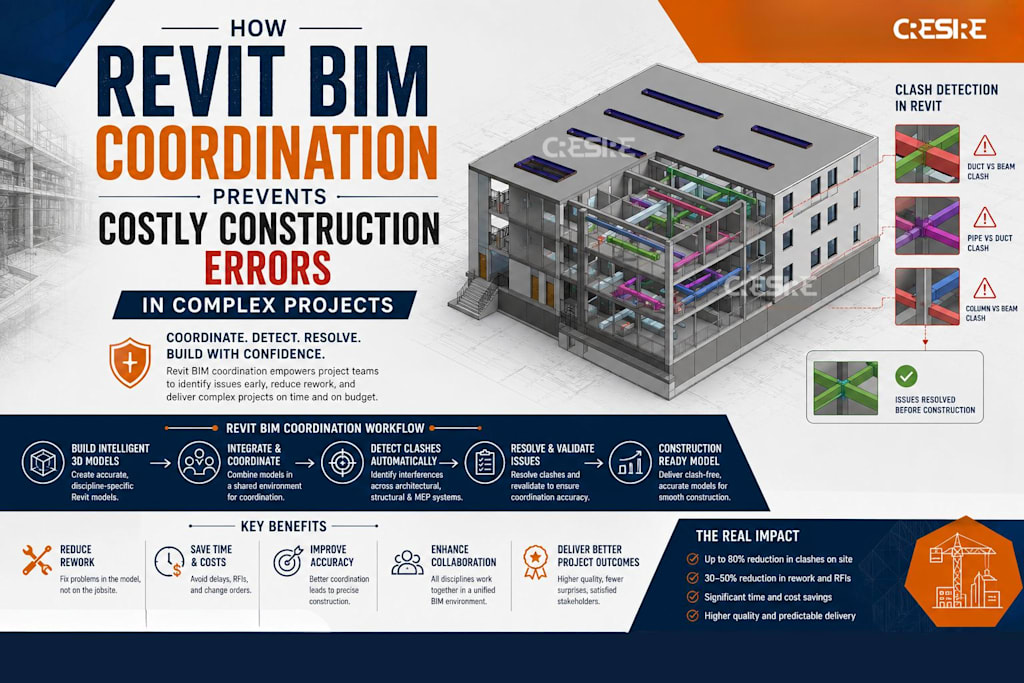
Complex construction projects rarely fail because of poor design ideas. More often, they struggle because teams work with disconnected information, outdated drawings, and limited visibility across disciplines. A mechanical duct clashes with a structural beam. An electrical conduit conflicts with a plumbing system. A late design revision never reaches the site team. These coordination issues may seem small individually, but together they can lead to delays, change orders, budget overruns, and frustrated stakeholders.
This explains why Revit BIM coordination is now vital for modern project delivery. Since projects grow more complex and deadlines tighten, architects, engineers, contractors, and owners require a collaborative setting where all parties work using precise, coordinated data.
Why Project Complexity Is Increasing
Today's buildings are more technically demanding than ever before. Hospitals contain advanced MEP systems, manufacturing facilities require highly coordinated equipment layouts, and commercial developments often involve multiple stakeholders spread across different locations.
At the same time, project owners expect:
- Faster project delivery
- Greater cost certainty
- Sustainable building performance
- Minimal disruption during construction
- Better asset information for operations
Meeting these expectations with traditional design workflows is becoming increasingly difficult. Manual coordination and disconnected drawings simply cannot keep pace with modern construction requirements.
The Real Cost of Poor Coordination
Many project teams underestimate the impact of coordination failures. A single clash discovered during construction can create a chain reaction:
- Rework and demolition
- Delays in material procurement
- Schedule disruptions
- Increased labor costs
- Reduced productivity
- Contract disputes
The study of the sector shows that rework will always remain one of the largest hidden costs of construction projects. Most of these challenges arise due to lack of information and poor coordination during the planning process.
This is where Revit BIM Modeling comes into play.
Creating a Single Source of Truth
The major advantage of the Revit BIM coordination is the creation of a central model where collaboration happens between the different disciplines with the use of the same project information.
There is no need to work with separate drawings since all the following aspects can be included into the collaboration process:
- Architectural BIM Model
- Structural BIM Model
- MEP BIM Model
- Information on fabrication
- Information about existing conditions
- Construction sequencing information
Clash Detection Before Construction Begins
One of the most apparent benefits of BIM coordination is clash detection.
This process detects any clashes in advance through sophisticated coordination tools, and such issues could be fixed using computers instead of discovering them in the field.
Typical clashes include:
- Ductwork interfering with structural members
- Piping conflicts with electrical systems
- Equipment clearance issues
- Ceiling coordination problems
- Space allocation conflicts
Resolving these issues in the virtual environment is significantly less expensive than correcting them on-site.
Supporting Fast-Track Construction Schedules
Construction schedules continue to shrink while project complexity continues to increase.
Owners expect faster delivery, and contractors are under constant pressure to improve efficiency.
Revit BIM coordination helps teams:
- Reduce design revisions
- Accelerate decision-making
- Improve construction planning
- Support prefabrication workflows
- Minimize installation conflicts
As more firms embrace off-site manufacturing and modular construction, accurate coordination becomes even more important.
Improving Communication Between Project Teams
Large projects involve numerous participants:
- Architects
- Structural engineers
- MEP consultants
- Contractors
- Subcontractors
- Facility managers
- Owners
Without a coordinated BIM process, communication gaps can quickly emerge.
A coordinated Revit model gives every stakeholder access to reliable project information, helping teams make informed decisions and reducing misunderstandings that can affect project outcomes.
Enabling Better Renovation and Retrofit Projects
The existing buildings projects pose some more challenges because their documentation is not up-to-date or even missing.
Combining laser scanning, point cloud to BIM, and Revit BIM modeling enables working with precise digital models of existing buildings.
It offers multiple advantages such as:
- Decreased number of visits to the site
- Improved design accuracy
- Better coordination with existing infrastructure
- Less chances for any unexpected situations
- Increased speed of renovation process
In today’s growing market of renovation projects, BIM coordination becomes more and more necessary.
Supporting the Rise of Digital Construction
A data-driven future lies ahead for the AEC industry.
The concepts of digital twins, smart buildings, and integrated project delivery depend on precise and synchronized building information.
Revit BIM coordination becomes the basis of these trends through developing rich information models which will be able to provide for:
- Facility management
- Assets monitoring
- Maintenance planning
- Building performance evaluation
- Potential renovations and extensions
Companies willing to engage in Revit BIM coordination now are setting themselves up for future digitalization.
Why Coordination Is No Longer Optional
Previously viewed as an optional additional service, BIM Coordination is now recognized as an indispensable part of a project.
Due to the complexity of modern building designs, there is simply too much information for traditional construction workflows and processes to accurately and consistently manipulate, so keeping up is nearly impossible without the help of BIM.
Effective teams understand that cost incurred through Revit BIM Coordination, 3D BIM Models and Clash Detection isn't a waste of money, but an investment to mitigate risk and improve overall project performance.
Final Thoughts
The construction industry is under increasing pressure to deliver projects faster, more accurately and with fewer surprises. As buildings get more complex, the need for reliable coordination grows.
Revit BIM coordination helps project teams find clashes early, improve collaboration, reduce rework and make smarter decisions throughout the entire project lifecycle.
For architects, engineers, contractors and owners working on sophisticated projects, coordinated BIM workflows are one of the best ways to achieve predictable, successful project outcomes.
About the Creator
Cresire Consulting
Cresire Consulting is the best CAD and BIM Outsourcing Services company in USA and India that provides CAD and BIM Services across the globe. For more info, email us at [email protected].
Enjoyed the story? Support the Creator.
Subscribe for free to receive all their stories in your feed.
Comments
There are no comments for this story
Be the first to respond and start the conversation.