
Why Node.js Still Dominates Backend Development in 2026
Python grew, Go matured, and Rust also gained traction. Yet Node.js still leads backend development. Here's why it's held the top spot for over a decade.

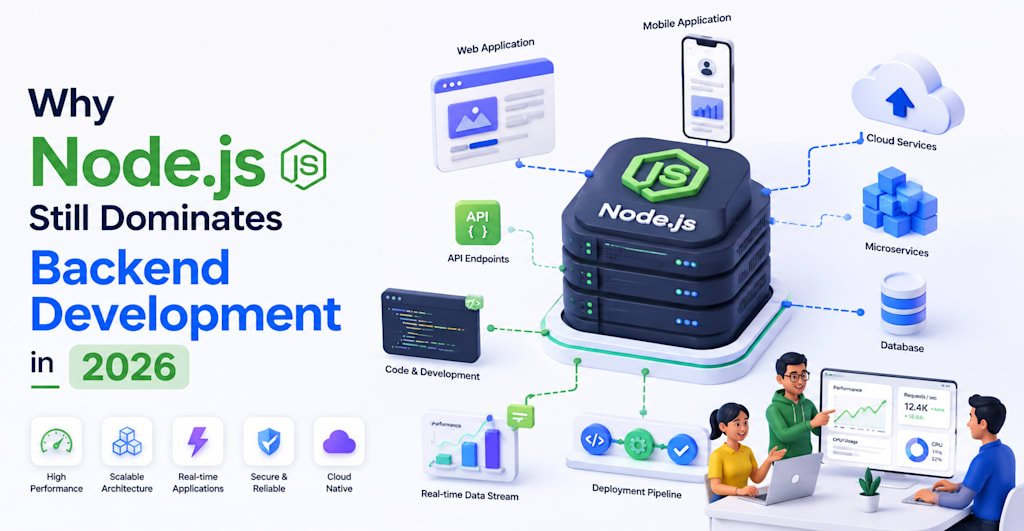
Every year, someone declares Node.js is dying. Python is faster for AI workloads. Go handles concurrency better. Rust is safer. Bun is faster. The arguments are real, but Node.js keeps topping the surveys, keeps growing its ecosystem, and keeps showing up in production at companies you recognize.
Node.js isn't dominant by default or legacy inertia alone. It's dominant because it solves the problems most backend teams actually have, runs on infrastructure most companies already have, and has an ecosystem no other runtime can match.
Here's why that hasn't changed in 2026.
The npm Ecosystem Is an Unfair Advantage
Node.js has over 2.1 million packages on npm. That number alone doesn't tell the full story; what matters is that virtually every third-party service, API, and tool your application needs has a maintained Node.js client.
Stripe, Twilio, SendGrid, AWS, Firebase, MongoDB, Prisma, and Redis all maintain first-party Node.js SDKs. When you're building a product and need to integrate a payment processor or a messaging API, the Node.js SDK works, is documented, and is actively maintained.
Compare this to Go or Rust, where third-party SDK coverage is inconsistent. Some services have official clients, many have community-maintained packages of varying quality. When you need to integrate quickly, Node.js reduces the friction that other runtimes don't.
The ecosystem compounds over time. Every year, there are more packages, more maintained tools, and more solved problems you don't have to solve yourself. That advantage doesn't disappear because a newer runtime has better benchmark numbers.
JavaScript Everywhere Solves a Real Organizational Problem
Most product companies have frontend teams writing JavaScript or TypeScript. Most backend teams have choices. When those companies choose Node.js for the backend, they get a shared language, shared tooling, and the ability to move developers between frontend and backend work as needs shift.
This sounds like a small advantage until you're a startup with eight engineers trying to ship fast, or a company trying to staff a backend team in a competitive hiring market. JavaScript developers are the most available talent pool in software engineering. Node.js makes that pool accessible for backend work.
TypeScript made this argument stronger. TypeScript brought static typing, better tooling, and more maintainable codebases to JavaScript ecosystems. Teams that struggled with large JavaScript codebases moved to TypeScript and got the productivity benefits of a typed language while staying in the Node.js ecosystem.
It Handles What Most Applications Actually Need
The technical critiques of Node.js are real but narrower than they sound.
Yes, Node.js is single-threaded. CPU-intensive tasks block the event loop. For machine learning inference, image processing, or heavy computation, Node.js isn't the right tool. For those workloads, Python, Go, or Rust genuinely perform better.
But most backend applications aren't CPU-intensive. They're I/O-intensive, handling HTTP requests, querying databases, calling external APIs, and reading and writing files. For I/O-bound workloads, Node.js's non-blocking event loop is well-suited. Requests come in, they wait for database responses or external API calls, and the event loop handles other requests in the meantime.
The companies running Node.js in production at scale, Netflix, LinkedIn, Uber, PayPal, aren't doing it despite its limitations. They picked it because their actual workload profile matches what Node.js does well, and they've built architectures that route CPU-intensive work to specialized services when needed.
The Runtime Keeps Improving
One argument for switching away from Node.js in 2022 was performance. Bun and Deno were benchmarking significantly faster. Node.js felt like it was falling behind.
That gap has narrowed. Node.js 22 and 23 brought substantial performance improvements, faster startup times, better HTTP performance, and improved memory management. The V8 engine underneath Node.js keeps getting faster with every release.
Node.js also adopted the Web Crypto API, improved native fetch support, added native test runners, and improved ES module support. The runtime is modernizing, just on a conservative, stability-first schedule that enterprise teams depend on.
Bun is faster on benchmarks. But Node.js runs in production at enough scale that its stability, predictability, and LTS release schedule matter more to most engineering teams than raw benchmark numbers.
What the Data Shows
The usage data backs this up consistently. The Node.js trends show Node.js has led backend framework surveys for over a decade, with no sign of losing significant ground. Stack Overflow's developer survey consistently places JavaScript and Node.js at the top of most-used technologies. npm download numbers continue growing year over year.
This isn't a technology that's maintaining position because teams haven't gotten around to switching. Teams evaluate their stacks actively. When they look at what would replace Node.js in their architecture, the answer is usually "nothing replaces the full package": the ecosystem, the talent pool, the tooling, the frameworks, the deployment options.
When Node.js Isn't the Answer
Node.js dominates overall, but it's the wrong choice in specific situations. If your backend is primarily ML inference, Python with FastAPI or Flask makes more sense. If you're building a system where memory safety is critical and performance is paramount, Rust is worth the learning curve. If your team is already deep in Go and the hiring market supports it, Go's concurrency model handles certain workloads more elegantly.
Most backend applications aren't those cases. They're APIs, web servers, real-time applications, and microservices handling I/O-bound work at a reasonable scale. For that workload, which describes most of the backend development happening in the industry, Node.js is still the most practical choice in 2026.
The dominance isn't accidental. It's earned, and the ecosystem strength means it won't disappear quickly even as alternatives improve.
About the Creator
Sanket Parmar
Sanket Parmar is a Digital Marketer with 5+ years of experience, specializing in content strategy and brand building. He writes about emerging technologies and evolving digital trends.
Enjoyed the story? Support the Creator.
Subscribe for free to receive all their stories in your feed.
Comments
There are no comments for this story
Be the first to respond and start the conversation.