
Why Juggling Dozens of AI Tools Is Destroying Your Focus — And What Smarter Learners Do Instead
The case for consolidated AI learning environments, and how professionals are reclaiming their time and attention
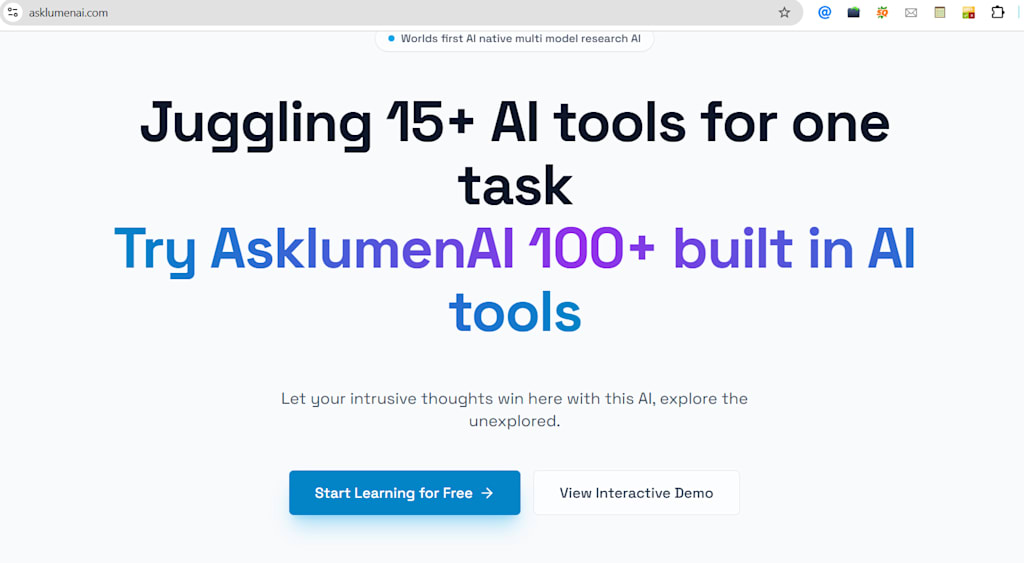
The Tab-Switching Trap
Open your browser right now and count how many AI tools you have bookmarked. For most people actively using artificial intelligence to study, research, or upskill professionally, that number sits somewhere between eight and twenty. There is one tool for summarizing articles, another for generating practice questions, a third for explaining complex concepts, and yet another for checking whether your understanding is correct. Sound familiar?
This is what researchers and productivity coaches have started calling "tool fragmentation" — and it is quietly sabotaging the learning goals of millions of people worldwide.
The problem is not that any individual AI tool is bad. Many of them are genuinely impressive. The problem is that the human brain was never designed to work efficiently across a constellation of disconnected applications. Every time you close one tab and open another, your cognition pays a switching cost. You lose your train of thought. You re-orient. You spend mental energy on navigation rather than understanding. By the time you have gathered information from four different platforms, the mental thread connecting them has frayed considerably.
What Cognitive Science Tells Us About Fragmented Learning
Decades of research in educational psychology point toward the same conclusion: depth of learning depends heavily on continuity of environment. Students who work within stable, consistent learning contexts — where feedback, instruction, and assessment all live in the same place — consistently outperform those who patch together their education from multiple disconnected sources.
This is not an abstract theory. It is visible in the way effective teachers operate. A great teacher does not hand you a different textbook for every sub-concept, send you to a separate room for practice problems, and then route you to a third building for feedback. They do all of it — explaining, questioning, correcting, encouraging — within a single, coherent relationship. The environment itself becomes part of how you learn.
When AI tools replicate the fragmented model rather than the integrated one, they introduce the same inefficiencies that have held back self-directed learners for generations. You end up doing a lot of work that feels productive without actually moving your understanding forward very much.
The Shift Toward Unified AI Learning Environments
Something meaningful is changing in how the most effective AI platforms are being designed. Rather than optimizing a single function in isolation, a growing number of tools are being built around the idea of consolidation — bringing adaptive instruction, content generation, real-time feedback, and progress visualization into one continuous experience.
For the learner, this changes everything. When your AI tutor already knows where your understanding broke down yesterday, it can pick up exactly there today. When your practice questions are generated from the same material your tutor just explained, the connection between instruction and application is immediate. When feedback arrives in the same place you are already working, you do not have to reconstruct context every single session.
This kind of integrated experience is not a luxury feature — it is increasingly recognized as the baseline requirement for serious learning outcomes.
Who Benefits Most From This Approach
Students preparing for high-stakes examinations tend to see some of the most dramatic improvements when they move from fragmented tool-sets to unified platforms. The reduction in friction means more time spent on actual content and less time on logistics. Professionals pivoting into new industries benefit similarly — when the learning curve is already steep, the last thing you need is an obstacle course of disconnected applications standing between you and the knowledge you need.
Even casual learners — people exploring history, science, philosophy, or creative fields out of genuine curiosity — find that consolidation makes the experience more enjoyable. Learning feels like an activity rather than a project management exercise.
The broader lesson here is simple: the quality of your tools matters, but the architecture connecting them matters just as much. Fragmentation has a cost that most people underestimate until they experience what a more unified alternative actually feels like.
The next time you find yourself with fifteen tabs open and a growing sense of overwhelm, it might be worth asking whether the problem is the subject matter — or the environment you are trying to learn it in.
About the Creator
Enjoyed the story? Support the Creator.
Subscribe for free to receive all their stories in your feed.
Comments
There are no comments for this story
Be the first to respond and start the conversation.