
Why I Set My Phone and Computer to English (Even Though I’m Not Fluent)
It’s not about showing off. It’s about error messages, app stores, search results, and a cleaner digital life.
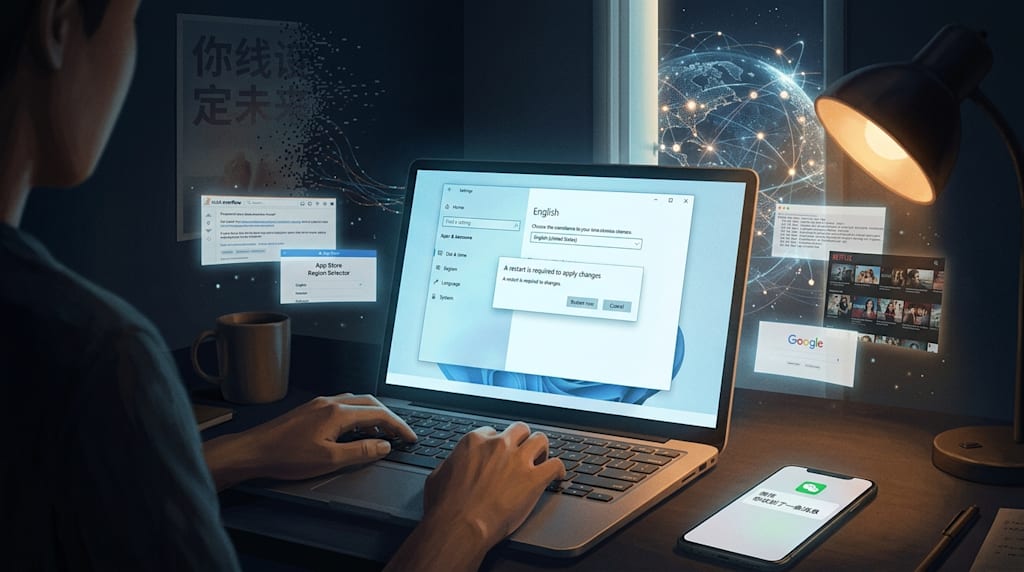
At two in the morning, he changed the Windows display language from Chinese (Simplified) to English (United States). The system asked for a restart. He clicked "Restart now." The screen went dark. The fan kept spinning. Three minutes later, the lock screen was in English. He opened the browser and pasted yesterday's error message into the search box. The error was in English, because the software outputs English logs by default under an English system. The first result was a Stack Overflow thread. Someone had asked five years ago. Someone else updated it three years ago. The answer sat at the top.
He was not an English major. He did not work at a foreign company. He wrote code. He changed the system language because it worked better for him.
The action was small. A dropdown in Settings. Many people have done it. Programmers. International students. Tech enthusiasts. Foreign-company employees. Heavy internet users. Their WeChat is in Chinese. Alipay is in Chinese. The input method is in Chinese. The system is in English. The phone is in English. The computer is in English.
Ask them why, and they will not say "because my English is good." They will say: it is easier to search error messages. Or: some features are missing in the Chinese region. Or: domestic Android has too many ads. Or: the English interface is cleaner.
Those reasons sound scattered. They point to one thing. System language does more than set interface text. It sets defaults. It tells apps and services who you are, where you are, what you are used to, and what you should see. It changes the default search engine. It changes the app store region. It changes what content you see, what language ads arrive in, which voice assistant you get, which map data loads, which payment methods appear. It can even decide whether a feature exists for you.
Setting the system to English is often a way to change those defaults.
1
Among early Windows 10 users, some changed the system language to English and the region to the United States to unlock a fuller Cortana. Android users set the system to English and the region overseas to make Google Now easier to enable, and later Google Assistant. App Store and Google Play are more direct. Apps available in different regions, update times, content libraries, and prices all differ.
The same app may work better under an English environment. It may be cleaner. It may have more features. It may stay closer to the original design. The Chinese region often gets a special edition: fewer features, more ads, more push notifications, slower updates. Users notice quickly. So changing the system language becomes a low-cost workaround. It does not solve everything. It makes some services identify you as an international user and give you another set of defaults.
2
For technical users, an English system has another practical benefit. Error messages are in English.
When software crashes, code throws an error, or the system reports something abnormal, the English error can be copied directly into a search engine. Stack Overflow, GitHub Issues, official documentation, Reddit discussions. The first-hand answers are usually in English. Chinese error searches often turn up copied tutorials and ads.
This does not mean Chinese search is bad. The English technical community has deeper archives. It updates faster. It discusses more. Many first-hand answers are in English. Searching in Chinese means going through an extra translation. Once the translation distorts, the problem becomes harder to solve.
So many people set the system to English to make software output English logs and errors by default. The English interface may be less comfortable. The English information environment is more efficient. They are not reading English on the screen. They are using English in the search box.
3
Localization has its own problems.
Domestic Android ROMs often carry ads. They push notifications. They preinstall apps. They bind you to an app store. Some Chinese translations are machine-translated. Terminology is inconsistent. Updates are slow. After translation, interface text gets longer. Layouts get crowded. Buttons get stretched. The visual result is less clean than the English original.
The English original is usually cleaner. It updates faster. It has fewer ads. It stays closer to the developer's design. For technical users, reading the English original is often less effort than reading translation-style Chinese. The common vocabulary is only a few hundred words. After a while, it becomes reflex. Settings, Network, Storage, Battery, Accounts, Privacy. These words do not need translation. Their positions are already fixed.
4
Programmers, operations engineers, product managers, designers. Many of their workflows are already in English. Command lines, API documentation, variable names, logs, configuration files, open-source projects. Almost all English. If the system is also in English, terminology stays consistent.
Device Manager, Control Panel, Environment Variables. You know what they correspond to in Chinese. When searching, writing documentation, or communicating with colleagues, the English terms are often more universal.
More practically, some old software, scripts, and development tools do not handle Chinese paths or Chinese usernames well. English system, English username, English path. Compatibility is more stable. This reduces unnecessary failures.
5
The internet is not flat. Many services give you different content based on your language, region, and IP.
An English system plus a United States region often makes service providers identify you as a user from another market. Netflix, Spotify, YouTube, App Store, Google Play. Content libraries differ greatly by region. Some content is invisible in the Chinese region. Some features are not open there. Some updates arrive later.
What users mean by escaping geographic discrimination and discovering a bigger world is essentially this. System language here acts as an identity statement. I do not belong only to the Chinese internet. I also want access to a larger information network.
6
Aesthetic and psychological factors exist too.
English interfaces are usually more concise. Buttons are shorter. Layouts are less crowded. In some people's eyes, an English system signals an international outlook and technical fluency. It is like a circle's secret signal. I care about technology. I am used to English information. I do not live only on the Chinese internet.
But this is usually not the main reason. What makes someone tolerate an English system over the long term is not coolness. It is efficiency. Coolness lasts a few days. Efficiency lasts a few years.
7
Setting the system to English does not mean rejecting Chinese. Most people are in a mixed state. System in English. WeChat in Chinese. Alipay in Chinese. Input method in Chinese. Food delivery, ride-hailing, payments, verification codes, customer service. All in Chinese.
An English system has costs too. The Chinese input method may glitch occasionally. Font rendering may be imperfect. Local customer service may not support it. Some domestic apps display abnormally under an English environment. For ordinary users who do not know English, a Chinese system is easier. It feels familiar. It causes less worry.
So this is a layered choice. Give the system layer to English. Leave the life layer to Chinese.
8
The Chinese system could be clean and open. Chinese search could be free of content farms. Domestic app stores could be less bloated. Localization could be more accurate and faster. Regional restrictions could be fewer and services more complete. Then many people would switch back without hesitation.
They choose English. They are not rejecting their mother tongue. They are voting with their feet. They vote for efficiency and for boundaries. They vote for information quality. They vote for a digital environment with less noise.
That small language dropdown is like a door. Behind it is a world that is more searchable. It has fewer ads. It stays closer to the original. It connects more easily to the global information network.
At two forty in the morning, he closed the Settings window. WeChat popped up a Chinese message. He switched back to the Chinese input method and replied, "Okay." The system was still in English. He went on to paste the next error message.
About the Creator
Jin
Writer of reamstories
https://reamstories.com/jin
Enjoyed the story? Support the Creator.
Subscribe for free to receive all their stories in your feed. You could also become a paid subscriber, letting them know you appreciate their work.
Comments
There are no comments for this story
Be the first to respond and start the conversation.