
Why Good Videos Sometimes Grow Slowly
A realistic look at timing, audience fit, and the quiet work behind online discovery

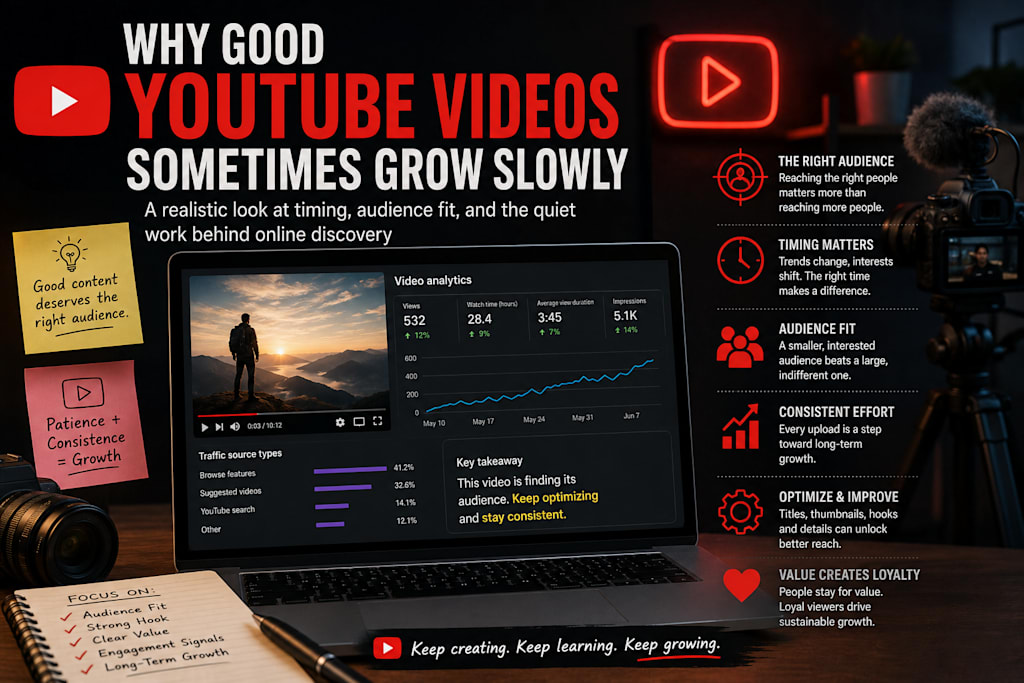
A creator uploads a video, checks the analytics a few hours later, and sees almost nothing happening.
The thumbnail looks good. The audio is clear. The subject matters. Friends who watched it said they enjoyed it. Yet the numbers barely move.
This is one of the most frustrating experiences in online publishing because it creates an immediate temptation to reach the wrong conclusion.
The video must be bad.
Sometimes that conclusion is correct. A weak opening, an unclear title, poor sound, or a confusing structure can certainly limit a video. But slow growth is not always evidence of poor quality.
Quality and visibility are two different problems.
A strong piece of content can remain unnoticed because it has not yet reached the people most likely to care about it. At the same time, a highly visible video can attract attention without offering much lasting value.
Understanding the difference can help creators make calmer and more useful decisions.
Publishing Is Not the Same as Distribution
Uploading a video makes it available. It does not automatically make it discoverable.
The internet contains more content than any person could reasonably consume. Every viewer is constantly choosing between videos, messages, articles, music, conversations, and ordinary daily responsibilities.
A new upload enters that crowded environment without any guarantee that the right audience will encounter it.
This is particularly difficult for smaller channels.
An established creator already has returning viewers, previous watch history, subscriber activity, and an audience that understands what the channel offers. A newer creator may have none of those advantages.
The content is therefore asked to perform two jobs at once.
It must be good enough to hold attention, and it must somehow earn the opportunity to be seen in the first place.
The second job often takes longer.
The First Viewers Matter More Than They Appear To
Early numbers can feel insignificant, but they contain useful information.
A video with fifty interested viewers may be in a healthier position than a video with five hundred indifferent ones.
The most useful question is not simply how many people watched. It is what happened after they arrived.
Did they remain long enough to understand the video?
Did they visit another page or watch another upload?
Did they leave a meaningful comment?
Did they share it with someone who might care?
Did the video appear to solve a problem, create an emotion, or satisfy a specific curiosity?
A small audience can provide clearer signals than a large but poorly matched audience.
This is why creators should resist the urge to judge every result by volume alone. Numbers need context.
Audience Fit Comes Before Scale
A video can be professionally made and still be presented to the wrong people.
Imagine an independent musician releasing a song built around regional language, local references, and a particular underground scene. Showing it to a broad audience may create impressions, but not necessarily connection.
The same song presented to listeners who understand the genre and cultural context may receive fewer initial views but stronger engagement.
The principle applies beyond music.
A technical tutorial requires viewers who are already facing the problem it solves.
A long interview requires people interested enough in the guest or subject to invest their time.
A local business video is more relevant to people within a practical geographic area.
A personal story may reach viewers through emotional identification rather than search intent.
The larger the audience becomes, the more likely it is to contain people who are simply not a good match.
Growth becomes more sustainable when the creator first identifies the smaller group for whom the video has an immediate reason to exist.
Slow Growth Can Reveal Useful Weaknesses
Patience does not mean ignoring problems.
A slowly growing video gives the creator time to inspect the elements surrounding the content.
The title may describe the subject accurately but fail to create curiosity.
The thumbnail may be attractive but too vague.
The opening may take too long to explain what the viewer will receive.
The description may not help people understand the topic.
The video may address an audience that has not been clearly identified.
These are not necessarily reasons to abandon the project. They are opportunities to improve how the video is introduced.
A creator can revise a title, replace a thumbnail, improve internal linking, create a shorter entry point, or present the video in a more relevant community.
The objective is not to disguise weak content. It is to remove unnecessary barriers between useful content and the people who may value it.
A Video Can Have More Than One Life
Online content does not always follow a straight path.
Some videos receive most of their attention immediately. Others remain quiet and become useful weeks or months later.
A change in public interest can revive an old subject.
A newer upload can send viewers toward an earlier one.
A search query can become more common.
A discussion in a community can suddenly make an older explanation relevant.
A creator can also discover a better way to introduce the same work.
This is why deleting or dismissing a video too quickly can be a mistake. A disappointing launch does not necessarily define the full life of the content.
Creators should think of their channel as a connected body of work rather than a collection of isolated attempts.
Every useful video gives a future viewer another reason to remain.
Promotion Should Support Discovery
Promotion is most useful when it helps the right people find content they may genuinely appreciate.
It becomes less useful when it is treated as a substitute for relevance, clarity, or quality.
The purpose is not merely to create a larger number beside a video. It is to shorten the distance between content and audience.
In my work with creators at Best YouTube Views, one recurring lesson has been that the same promotional method does not suit every video.
A music release, tutorial, interview, advertisement, and documentary may all require different audiences, entry points, and expectations.
Before increasing distribution, it is worth asking a few simple questions:
Who is this video really for?
Where do those people already spend their attention?
What would make them choose this video now?
What should they understand within the first few moments?
What would a meaningful result look like beyond the view count?
Clear answers make promotion more focused and evaluation more honest.
Slow Does Not Mean Dead
Creators work in an environment that celebrates sudden results.
Viral stories are visible because they are exceptional. The slower process of building an audience receives less attention, even though it is far more common.
A good video may still need better presentation.
It may need a more relevant audience.
It may need supporting content.
It may need time.
None of this guarantees that every video will eventually succeed. Some ideas simply do not connect, and every creator must learn to recognize that possibility.
But a slow beginning is not enough evidence on its own.
The better response is neither blind optimism nor immediate discouragement. It is careful observation.
Improve what can be improved.
Study who responds.
Notice where genuine interest appears.
Give useful content more than one opportunity to be discovered.
Growth often looks unimpressive while it is happening. Only later does the collection of small decisions begin to resemble progress.
About the Creator
Roy
I am a professional content writer.
Enjoyed the story? Support the Creator.
Subscribe for free to receive all their stories in your feed.
Comments
There are no comments for this story
Be the first to respond and start the conversation.