
Why Bare Metal Is Making a Comeback: Inside the Shift Away from Public Cloud
Your cloud invoice climbed again last quarter, and nobody on the team can say which service did it.


You are not an outlier. IDC's Cloud Pulse 4Q 2023 survey found that close to half of cloud buyers spent more on cloud than they expected in 2023, and 59% expected the same overrun the following year.
The direction of travel has shifted too. EE Times reported on a Barclays CIO survey showing 83% of enterprise CIOs planned to move at least some workloads out of public cloud during 2024.
The technology did not change. The arithmetic did.
Where your money actually goes
Public cloud sells elasticity. You pay a premium on every compute hour so capacity can appear and disappear on demand.
That premium earns its keep when traffic swings hard or the product is still finding its shape. It stops earning anything the moment your load flattens out.
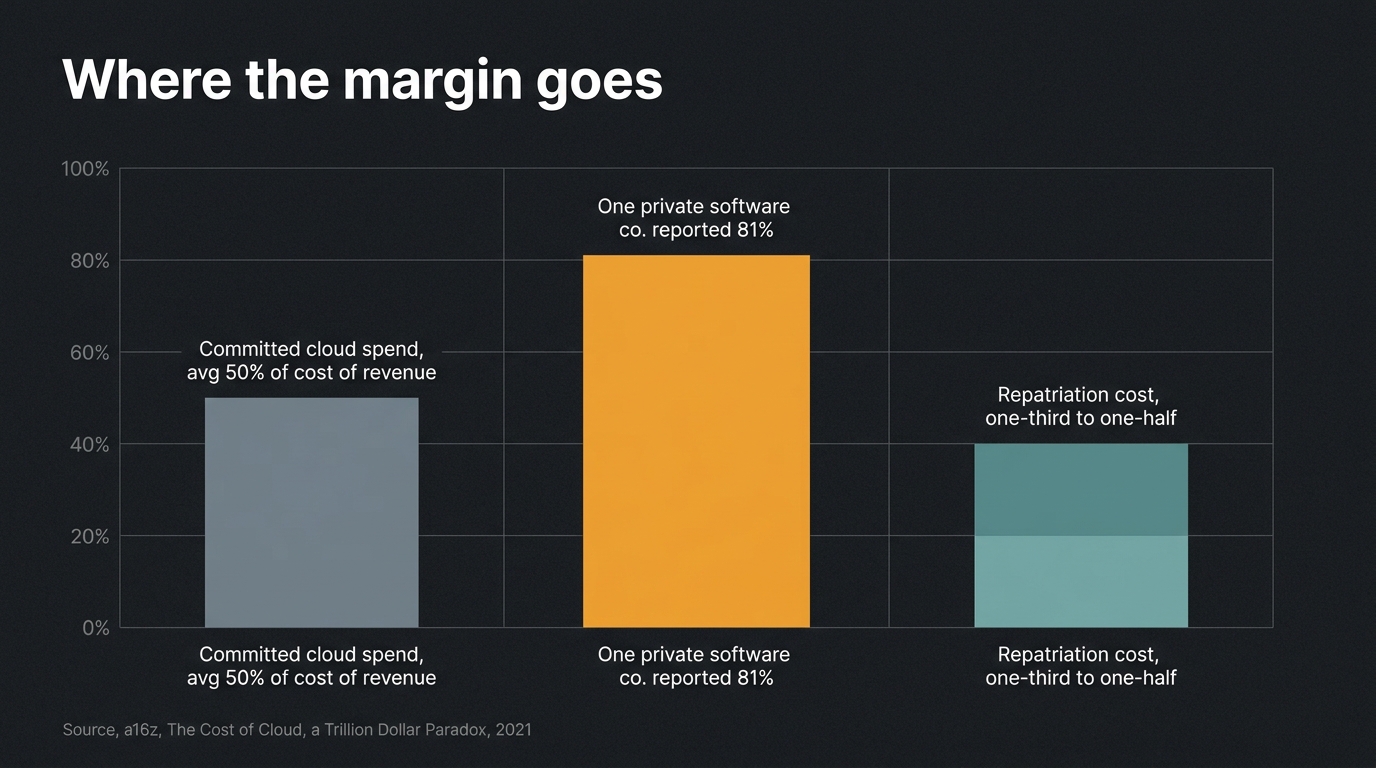
Andreessen Horowitz priced the gap in its 2021 analysis, The Cost of Cloud, a Trillion Dollar Paradox. AWS runs a roughly 30% blended operating margin even after committed-use discounts, and the practitioners a16z interviewed kept converging on one number. Running the same workload on your own hardware costs one-third to one-half of the cloud price.
The same analysis benchmarked committed cloud spend at an average of 50% of cost of revenue across public software companies that disclose it. One billion-dollar private software company told a16z its cloud spend reached 81% of cost of revenue.
Half your cost of goods, spent renting capacity you never switch off.
The part you probably recognise
There is a spreadsheet on your drive comparing one-year and three-year reserved instance pricing. Someone spent two weeks tagging resources so the cost dashboard would finally reconcile.
You clawed back 18%, felt good for a month, then a new managed service quietly absorbed the win. Every architecture discussion now opens with which service you are already tied to.
Does that feel like owning your infrastructure?
Four fixes people try first, and where each one stops
Reserved instances and savings plans. a16z notes committed use pricing brings cloud compute down 30% to 50%. You hand back the flexibility you were paying for, sign up for one to three years, and still pay margin on rented hours.
FinOps tooling. Third-party optimization tools deliver gains of 10% to 40%, based on a16z's observation of that market. Real money, and it reduces how much you consume without touching what a unit costs.
Rightsizing and autoscaling. Segment published how it cut infrastructure costs 30% while traffic volume grew 25% over the same period. Excellent engineering, and finite, because the price list is the floor.
A cheaper virtual server. A VPS gives you a slice of a shared host behind a hypervisor. Noisy neighbours and virtualization overhead arrive with the slice.
Every one of those trims the invoice. None of them touch what generates it, which is renting per-hour elasticity for workloads that run at a steady line.
What the receipts look like
37signals pulled Basecamp, HEY and five other apps out of AWS in 2023 and onto its own hardware, without adding a single person to the team. The company states on its cloud exit page that the move saves roughly $10 million over five years, cutting infrastructure costs by between half and two-thirds.
Dropbox went first. Its S-1 disclosed around $75 million in cumulative savings over the two years before IPO, with gross margins climbing from 33% in 2015 to 67% in 2017, credited primarily to that infrastructure work.
Hardware vendors see the same curve. MarketsandMarkets projects the bare metal cloud market growing from $14.32 billion in 2025 to $36.71 billion by 2030, a 20.7% annual rate.
One caveat worth stating plainly. IDC's Server and Storage Workloads Survey found only 8% to 9% of companies plan full repatriation, so this is a hybrid rebalancing rather than an exodus.
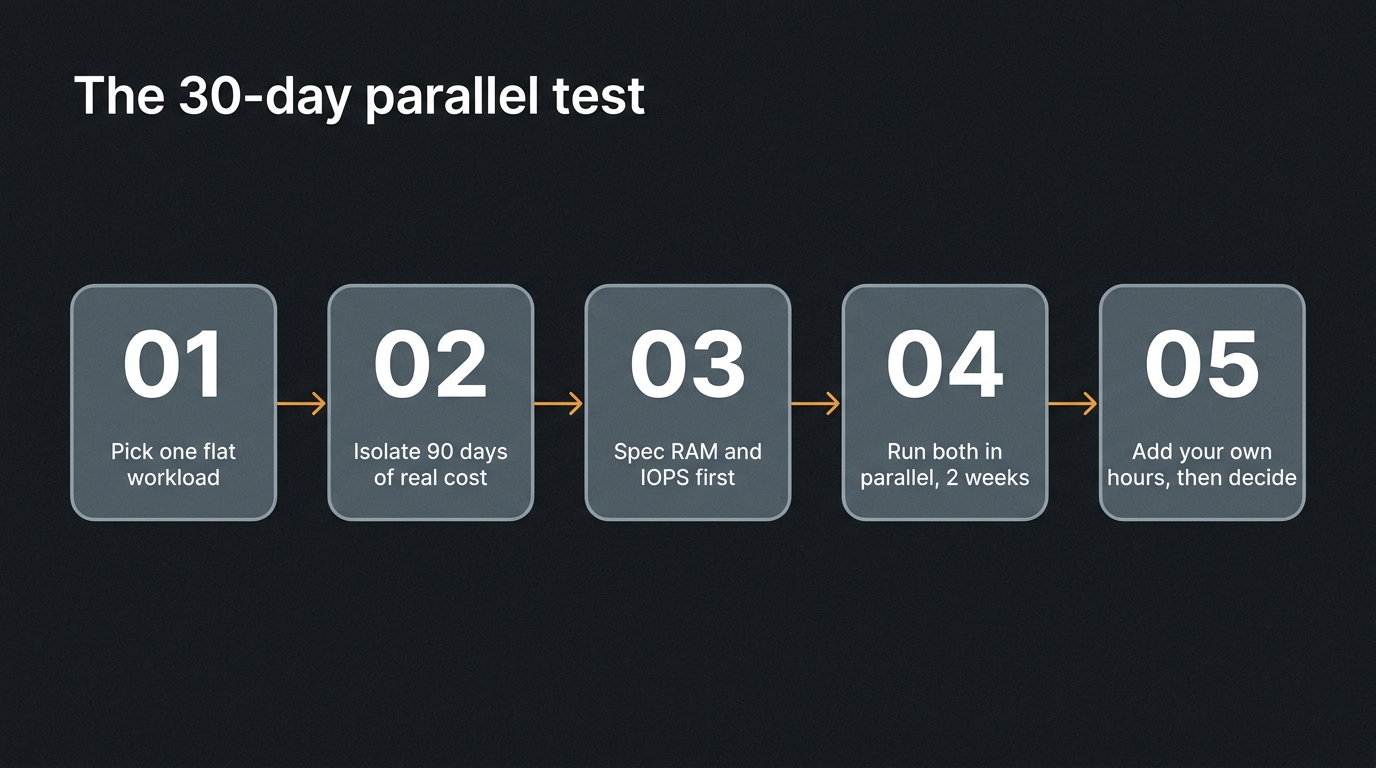
How to test it in 30 days
Pick one flat workload. A read replica, your CI runners, nightly batch jobs or staging. Predictable load, no spike risk, no customer-facing blast radius.
Isolate its real cost. Pull 90 days of billing, separate compute, storage, egress and support attributable to that workload, and write down one monthly figure.
Spec hardware against your actual bottleneck. Match RAM and disk IOPS first and cores second, because most database slowdowns come from memory pressure and random reads rather than clock speed.
Run both in parallel for two weeks. Compare p95 latency under production-shaped load, never averages, and complete one full backup and restore cycle before you trust it.
Add your own hours to the total. If the owned box still wins after labour, move the next workload and repeat.
Where I landed
I run my own flat workloads on 1Gbits, and my reasons are specific rather than universal.
The plan I use lists at $97 a month for an AMD EPYC 3151, 4 cores, 32GB of RAM and 1TB of NVMe on a machine nobody else touches. Their dedicated range runs from $63.32 to $2,463.75 monthly, and a 16-core Ryzen 9950X with 128GB and 2x1.92TB of NVMe sits at $372. Apply a16z's one-third-to-one-half rule to that last box and the cloud equivalent lands somewhere between $744 and $1,116 a month.
What sold me was the billing terms. I pay month to month with no twelve-month commitment attached to the price, which matters when you are still proving the case internally. IPMI comes with the server, so I can power cycle the box and watch a boot console without opening a ticket. 1Gbits has operated since 2014 across more than 20 regions in North America, Europe and Asia, publishes a 99.9% uptime guarantee, and gives you a 7-day money-back window, which is exactly long enough to run step four above.
Now the honest part, because you will find this yourself in ten minutes. OVH's RISE-1 at $70 a month gives you 6 cores and 32GB, beating 1Gbits on cost per core, and Hetzner starts dedicated servers at 59 per month. If your users are European and you will sign for twelve months, take one of those. 1Gbits wins when you need a specific US or Asian city, refuse a year-long contract, want your NVMe as one usable volume instead of a soft RAID pair, or pay in crypto.
"So why not just stay in the cloud and keep optimising?" Because optimisation has a floor and the unit price sets it. You can reach that floor and still be paying double.
"What happens at 3am when a drive dies?" You run two boxes and you keep the restore path tested, same as you already do. IPMI plus a 99.9% guarantee covers the rest, and reviewers on HostAdvice consistently mention 24/7 chat response.
"We don't have the headcount." 37signals moved seven production applications off AWS without hiring anyone. Your first workload is a CI runner, not your primary database.
Two more things you should weigh. Provisioning takes business days rather than seconds, there is no hourly billing and no autoscaling, and 1Gbits has 53 reviews on HostAdvice against only five on Trustpilot, so the public review pool is thin compared with the hyperscalers.
Start with the boring workload. Run the parallel test, keep the numbers, and let the invoice decide instead of the narrative. If you want to price the hardware against your own bill, the full 1Gbits configuration list shows every SKU and location with the monthly price attached.
About the Creator
Pavlos Giorkas
Blogger & Versatile Author with 10+ years of writing experience. Contributes to multiple publications. On Vocal I write for SEO, Cryptocurrencies, Alternative Health, Ai and Money. Personal blog: pavlosgiorkas.com (in Greek).
Enjoyed the story? Support the Creator.
Subscribe for free to receive all their stories in your feed.
Comments
There are no comments for this story
Be the first to respond and start the conversation.