
Why Are Motorcycles Becoming an Increasingly Popular Choice for Transportation and Adventure Across the United States?
How Recreational Riding, Electric Motorcycles, Fuel Efficiency, and Advanced Technology Are Driving Growth in the U.S. Motorcycle Market

Motorcycles have long represented freedom, independence, and adventure in American culture. From scenic highway road trips and motorsports events to daily urban commuting, motorcycles continue to attract riders seeking a unique blend of performance, affordability, and personal expression. While traditionally associated with recreational riding, motorcycles are increasingly becoming practical transportation solutions for consumers looking to reduce fuel costs, avoid traffic congestion, and enjoy greater mobility.
The market is also undergoing significant transformation as manufacturers introduce advanced technologies, electric powertrains, enhanced safety systems, and connectivity features designed to attract a broader range of riders. These innovations are helping motorcycles appeal not only to enthusiasts but also to commuters, younger consumers, and environmentally conscious buyers.
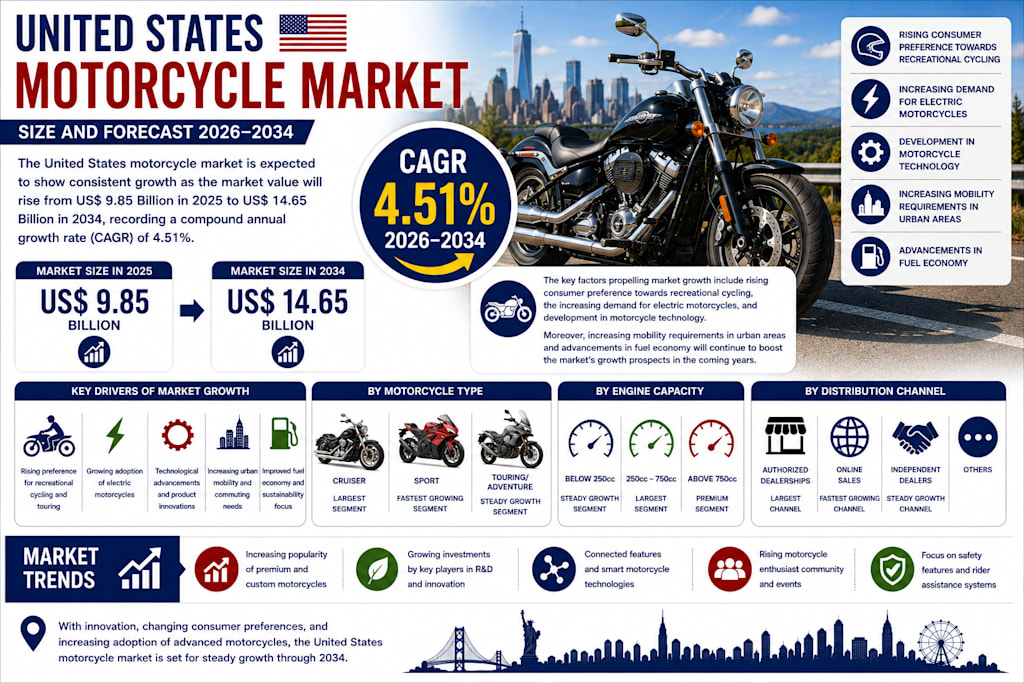
According to Renub Research, the United States Motorcycle Market is expected to grow from US$ 9.85 billion in 2025 to US$ 14.65 billion by 2034, registering a compound annual growth rate (CAGR) of 4.51% from 2026 to 2034. Growing demand for recreational riding, increasing interest in electric motorcycles, rising fuel efficiency concerns, and technological advancements are among the key factors supporting market expansion.
As consumer preferences continue evolving, motorcycles are becoming increasingly relevant across both lifestyle and transportation markets in the United States.
Motorcycles Continue to Symbolize Freedom and Adventure
Few vehicles carry the cultural significance of motorcycles.
For many Americans, motorcycles represent independence, exploration, and the thrill of the open road. Whether cruising along coastal highways, exploring mountain routes, or participating in organized rides, motorcycles offer experiences that many riders find difficult to replicate through other forms of transportation.
The market includes a diverse range of products such as cruisers, touring motorcycles, sports bikes, adventure motorcycles, off-road bikes, scooters, and electric motorcycles. This diversity allows manufacturers to serve a broad spectrum of consumer needs and preferences.
Motorcycles are used for personal transportation, recreational riding, motorsports participation, long-distance touring, commercial deliveries, and public service applications.
As outdoor recreation and adventure travel continue gaining popularity, motorcycles remain strongly positioned within American culture.
Recreational Riding Is Fueling Market Growth
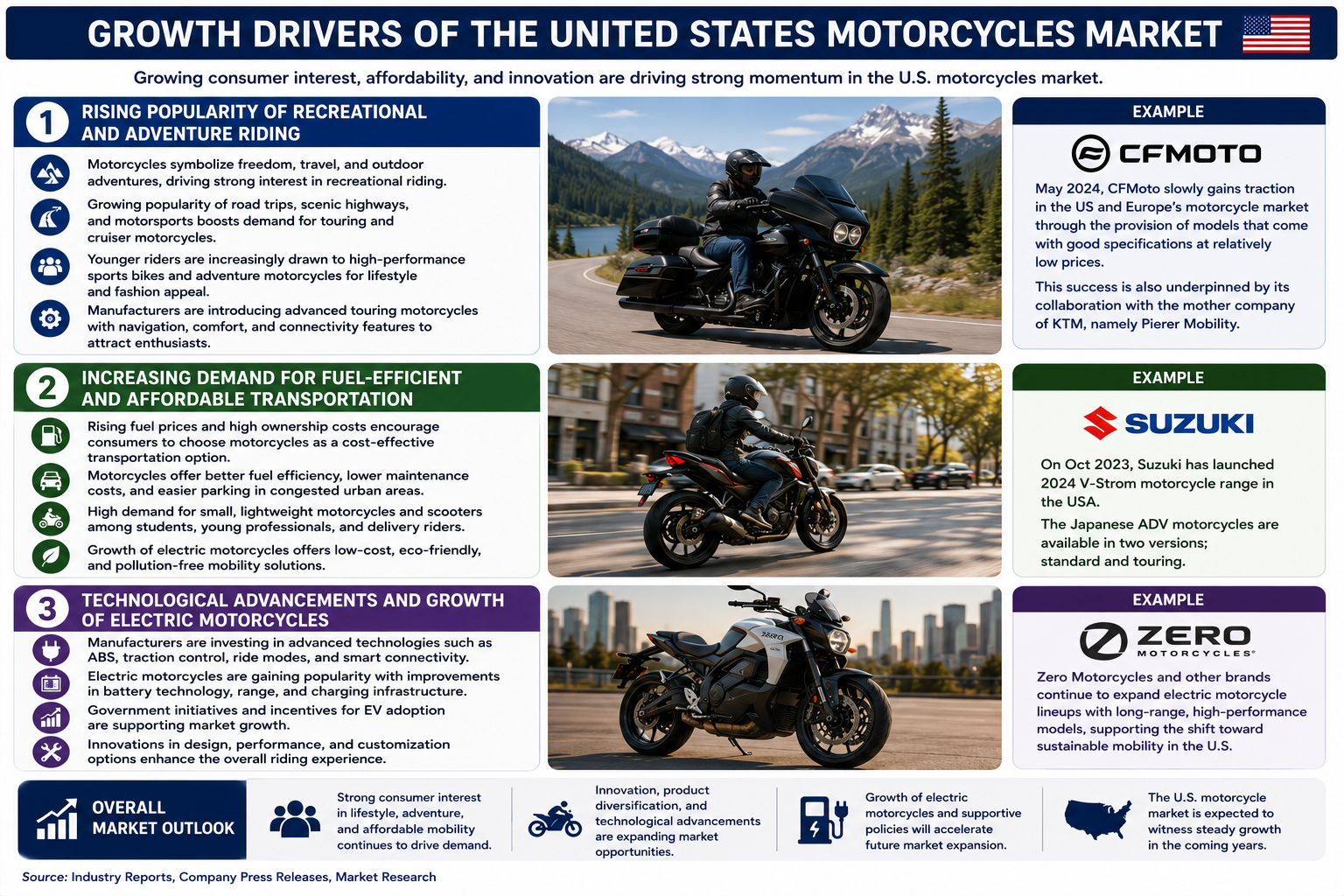
One of the strongest drivers of market expansion is the growing popularity of recreational and adventure riding.
Many consumers view motorcycles not merely as transportation tools but as lifestyle products that provide excitement, exploration, and social engagement. Motorcycle road trips, organized rallies, touring events, and outdoor adventure activities continue attracting enthusiasts across the country.
Touring motorcycles and cruiser bikes are especially popular among riders seeking long-distance travel experiences. Meanwhile, younger consumers increasingly gravitate toward sports motorcycles and adventure bikes that combine performance with versatility.
Social media platforms have amplified motorcycle culture by showcasing custom builds, road trips, riding communities, and lifestyle experiences that inspire new riders to enter the market.
Manufacturers continue responding with motorcycles featuring enhanced comfort, navigation systems, connectivity technologies, and rider-focused amenities designed specifically for recreational enthusiasts.
Affordable Transportation Is Expanding Consumer Interest
Economic considerations are also contributing significantly to market growth.
Rising fuel prices, increasing vehicle ownership costs, and urban traffic congestion are encouraging consumers to explore more economical transportation alternatives. Motorcycles generally consume less fuel, require lower maintenance costs, and occupy less parking space than traditional passenger vehicles.
Students, young professionals, urban commuters, and delivery service operators increasingly view motorcycles as cost-effective transportation solutions.
Lightweight motorcycles and scooters are particularly attractive in densely populated urban environments where maneuverability and parking convenience provide significant advantages.
As affordability continues influencing consumer purchasing decisions, motorcycles are expected to remain appealing alternatives to larger vehicles.
Electric Motorcycles Are Transforming the Industry
The emergence of electric motorcycles represents one of the most important developments within the market.
Consumers are becoming increasingly interested in environmentally friendly transportation options that reduce emissions and operating costs. Electric motorcycles address these concerns while offering additional benefits such as quieter operation, lower maintenance requirements, and strong acceleration performance.
Government incentives, emissions regulations, and growing environmental awareness are encouraging both consumers and manufacturers to embrace electric mobility solutions.
Leading motorcycle companies are investing heavily in battery technology, charging infrastructure, and high-performance electric models capable of competing with traditional internal combustion motorcycles.
The increasing adoption of electric motorcycles is expected to become a major contributor to long-term market growth.
Technological Innovation Is Enhancing Rider Experiences
Modern motorcycles are becoming increasingly sophisticated.
Manufacturers are introducing advanced technologies that improve safety, convenience, performance, and rider engagement. Features such as anti-lock braking systems (ABS), traction control, electronic rider assistance systems, smartphone connectivity, digital instrument clusters, and navigation integration are becoming increasingly common.
These innovations help attract both experienced riders and newcomers who prioritize safety and convenience when purchasing motorcycles.
Technological improvements also support premiumization strategies, allowing manufacturers to differentiate products while enhancing overall user experiences.
As consumer expectations continue evolving, technology will remain a key competitive factor shaping future market development.
Popular Motorcycle Models Continue Attracting Enthusiasts
Several motorcycle models have emerged as particularly popular choices among American riders in 2025.
The Honda Rebel 500 remains highly popular due to its beginner-friendly design, fuel efficiency, and stylish appearance. The Yamaha MT-07 attracts urban riders with its lightweight construction and strong performance.
Premium cruiser enthusiasts continue favor the Harley-Davidson Street Bob 114 and the Indian Scout Bobber, both known for powerful engines and distinctive styling.
Sports motorcycle enthusiasts frequently choose models such as the Kawasaki Ninja ZX-6R, Yamaha YZF-R9, and Suzuki GSX-8R.
Adventure riders continue embracing the BMW R1300GS, while electric motorcycle enthusiasts increasingly consider the Zero SR/S. Long-distance touring remains dominated by the Honda Gold Wing.
Sports Motorcycles Continue Capturing Younger Riders
The sports motorcycle segment continues experiencing strong growth.
Consumers are attracted to sports bikes because of their speed, handling characteristics, aerodynamic design, and racing-inspired aesthetics. Participation in motorsports events, track days, and performance riding communities further supports demand.
Manufacturers continue introducing lightweight models with advanced braking systems, improved aerodynamics, electronic rider aids, and fuel-efficient engines.
Social media exposure and motorcycle lifestyle content have further increased interest among younger demographics seeking excitement and performance-oriented riding experiences.
As disposable incomes rise and financing options become more accessible, sports motorcycles are expected to remain an important growth segment.
Mid-Size Motorcycles Are Gaining Popularity
Motorcycles within the 200cc to 800cc range continue attracting significant consumer interest.
The 200cc to 400cc category appeals to beginners, commuters, and younger riders due to affordability, fuel efficiency, and manageable performance characteristics. These motorcycles are widely used for urban transportation and rider training programs.
Meanwhile, the 400cc to 800cc segment offers a balance of power, comfort, and versatility that appeals to experienced riders, touring enthusiasts, and adventure travelers.
Manufacturers continue introducing technologically advanced models within these categories, further strengthening consumer demand.
Safety Concerns Remain a Market Challenge
Despite positive growth prospects, safety concerns remain one of the industry's most significant challenges.
Unlike passenger cars, motorcycles provide limited physical protection during accidents, contributing to higher injury risks. Many potential buyers remain concerned about rider safety, particularly in congested urban environments and adverse weather conditions.
Insurance costs can also be relatively high, especially for high-performance motorcycles and inexperienced riders.
Manufacturers continue addressing these concerns through advanced safety technologies, rider training programs, improved braking systems, traction control features, and protective equipment innovations.
Nevertheless, safety perceptions remain an important factor influencing purchasing decisions.
Seasonal Demand and Economic Conditions Impact Sales
Motorcycle sales are often influenced by seasonal weather patterns and broader economic conditions.
Demand tends to peak during warmer months when riding conditions are more favorable, while colder climates frequently experience slower sales during winter seasons.
Economic uncertainty can also affect purchasing behavior because many consumers view motorcycles as discretionary purchases rather than necessities.
Inflation, interest rates, disposable income levels, and consumer confidence all influence motorcycle demand, particularly within premium segments.
Manufacturers must carefully manage inventory, production schedules, and pricing strategies to navigate these market fluctuations effectively.
California Leads Motorcycle Adoption
California represents one of the largest motorcycle markets in the United States.
The state's favorable weather conditions, strong motorcycle culture, scenic road networks, and emphasis on outdoor lifestyles create ideal conditions for motorcycle ownership. Urban congestion in cities such as Los Angeles and San Francisco also encourages adoption of two-wheeled transportation solutions.
California is additionally a leading market for electric motorcycles due to strong environmental awareness and supportive regulatory policies.
The combination of recreational riding, daily commuting, and technological innovation makes California a highly influential market within the industry.
Texas, Florida, and New York Continue Supporting Growth
Texas benefits from extensive highway networks, a strong motorcycle culture, and high demand for touring and cruiser motorcycles. Road trips, outdoor recreation, and customization trends continue supporting market expansion throughout the state.
Florida's warm climate allows year-round riding opportunities, while tourism, coastal routes, and outdoor recreation contribute to strong motorcycle demand. Touring and cruiser motorcycles remain especially popular among riders in the state.
New York's urban environment encourages motorcycle adoption due to parking convenience, fuel efficiency, and traffic management advantages. Growing interest in electric motorcycles further supports market growth within the state.
Leading Companies Competing in the Market
The United States motorcycle market features competition among some of the world's most recognized motorcycle manufacturers, including Harley-Davidson, Honda Motor Co., Ltd., Yamaha Motor Co., Ltd., Suzuki Motor Corporation, Kawasaki Heavy Industries, BMW AG, Triumph Motorcycles, Ducati Motor Holding, KTM AG, and Polaris Inc.. These companies continue investing in innovation, electrification, safety technologies, and premium product development to strengthen their market positions.
Final Thoughts
The United States Motorcycle Market continues evolving as consumers seek transportation solutions that combine affordability, performance, freedom, and adventure.
With the market projected to grow from US$ 9.85 billion in 2025 to US$ 14.65 billion by 2034, manufacturers have significant opportunities to capitalize on rising recreational riding participation, expanding electric motorcycle adoption, and growing demand for technologically advanced models.
As innovation, sustainability, and lifestyle-driven purchasing decisions continue shaping the industry, motorcycles are poised to remain an important and dynamic segment of the American transportation market for years to come.
About the Creator
Enjoyed the story? Support the Creator.
Subscribe for free to receive all their stories in your feed.
Comments
There are no comments for this story
Be the first to respond and start the conversation.