
Why AI Startups Are Hiring Fewer People
New research shows that the leanest AI startups put AI inside the product they sell, and that is now the first thing I check when a small team asks me for money.

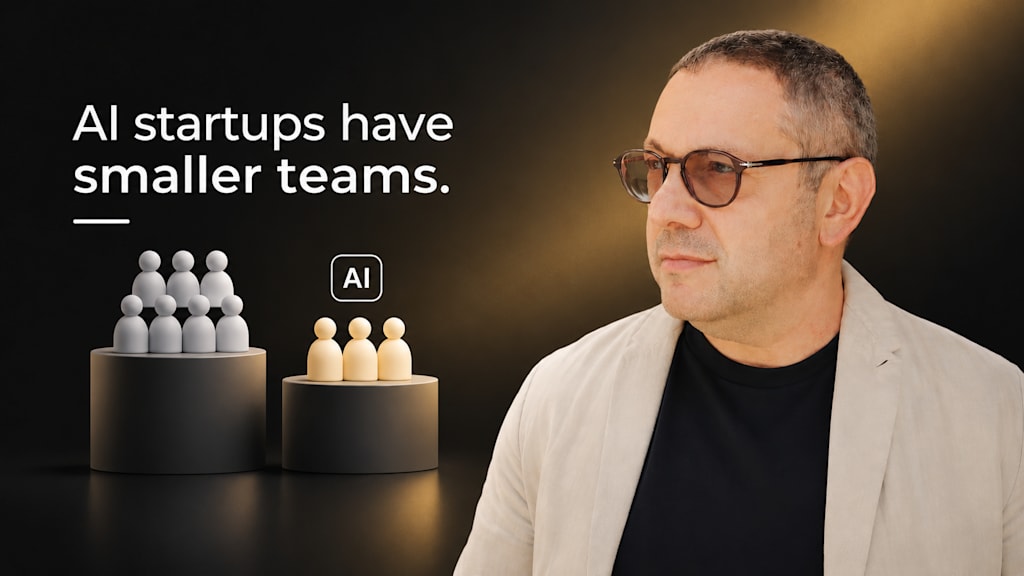
Startups built around AI have fewer employees than other startups. A June 2026 study by researchers Hyunjin Kim and Rembrand Koning puts a number on it: "AI-native firms are 25% smaller." AI-native simply means a company built around AI from day one.
The difference goes beyond size. These companies have fewer beginners and fewer bosses. In the researchers' words, "the shares of entry-level workers and managers are each roughly 15% lower." Their org charts are also "half a seniority level flatter," which means fewer layers between the founder and the newest hire.
My name is Alexander Kopylkov. I invest in AI, deeptech and infrastructure companies, from their first funding round to much later ones. When a small team asks me for money, I want to know why it is small. This study helps me answer that question.
The pattern holds in both groups of startups the researchers studied.
The researchers looked at two groups. The first came from a well-known startup accelerator, a program that helps very young companies get started. The second was a wider group of U.S. startups that got their first investment "between 2020 and 2024."
In the first group, AI startups were "roughly 25% smaller." In the wider group, they were "12% smaller."
Being smaller did not seem to lower what investors think these companies are worth. The study says "valuations are comparable." So each employee is linked to more of the company's value.
The study is still a working paper, and its cover notes that "working papers are in draft form." It also shows a pattern without proving the cause. The authors say their method "cannot pin down causal mechanisms." I treat it as a strong signal and keep that limit in mind.
Using AI tools at work does not, by itself, make a team smaller.
The researchers checked job ads for startups that named specific "worker-facing AI tools," meaning AI assistants that staff use in their daily work. AI startups were "2.6 times as likely" to mention them. Still, the researchers found that "this measure does not predict smaller firm sizes." In plain words, a company that gives its staff AI assistants is not reliably smaller.
I see this in my own work. Almost every founder now tells me the team uses AI assistants. That helps people work faster, and it is becoming as normal as email. So when a founder points to those tools to explain a small team, I keep asking questions.
The smallest teams put AI inside the product.
Smaller teams line up with AI built into the thing the company sells. The study found that putting AI into the product "is associated with less headcount and flatter structures." Put simply, the software does work that would otherwise need more staff.
The gap is largest in service businesses, such as "therapy, tutoring, telemedicine." In those fields, "AI startups are roughly 70% smaller than non-AI peers."
So my question to a lean founder is simple. Where does the AI do work that a paid employee would otherwise do? If the answer is inside the product, a small team is a real strength. If the answer is only inside the office, I expect the team to grow quickly once customers arrive.
Fewer beginner jobs today could mean fewer experienced people tomorrow.
AI startups employ "fewer entry-level workers and more senior workers," the study finds. Stanford's 2026 AI Index shows a similar trend in the United States. There, employment for software developers ages 22 to 25 "had fallen close to 20% from its 2022 peak" by September 2025.
The authors warn against reading this as bad news for all jobs. Each AI company may be smaller, but the total number of jobs at AI companies "need not fall if AI also enables many more startups to enter." In the wider group, the number of AI startups getting their first funding deal in 2024 was "nearly 8 times the 2020 average." More companies, each with fewer people, could still add up to more jobs.
Still, I worry about young people who never get a first job. Every senior engineer was once a junior. The study also follows companies "for at most a few years," so nobody knows yet how these teams will look as they grow. My advice to founders is to hire a few juniors on purpose and train them well. It costs a little now. Later, it saves you from searching for leaders that nobody trained.
A small team is impressive when the product does the work.
Counting employees has always been a rough way to judge a company. The companies that last are the ones whose results grow faster than their costs. AI gives founders a new way to get there, as long as the AI sits inside what customers pay for.
So count the people first. Then ask what the product can do without them.
About the Creator
Alexander Kopylkov
Alexander Kopylkov is a seasoned venture capital investor, entrepreneur, strategist, and founder with more than two decades of experience helping high-growth companies scale and secure strategic funding.
Enjoyed the story? Support the Creator.
Subscribe for free to receive all their stories in your feed.
Comments
There are no comments for this story
Be the first to respond and start the conversation.