
Why 80s and 90s Kids Still Love Computers More Than Phones
It comes down to the first screen they ever owned.
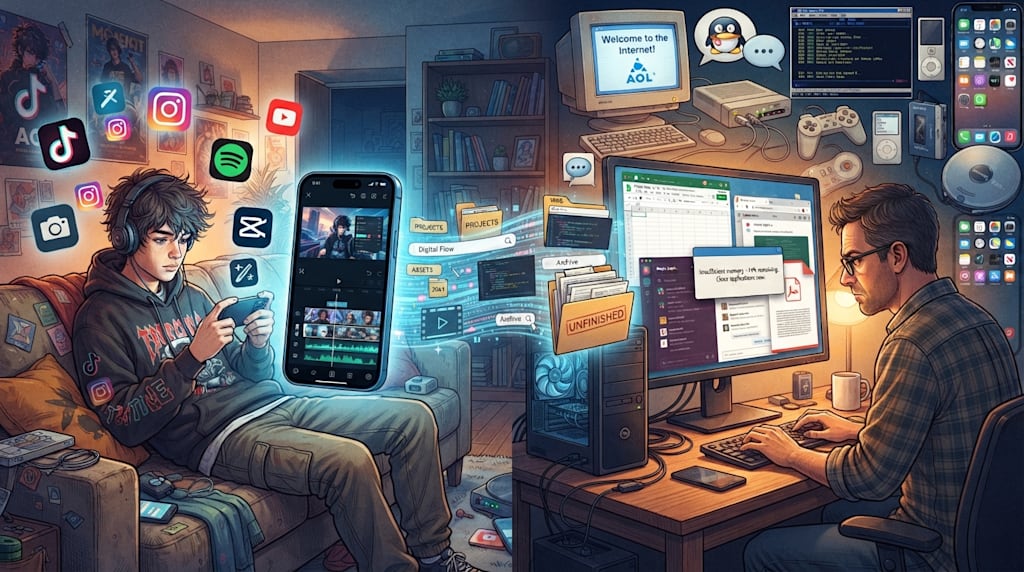
First, a scene.
A high school student sits on the sofa, phone in landscape mode, dragging the timeline in CapCut, adding subtitles and music, exporting. No computer. His father is in the study. The desktop fan whirs. Three browser windows, an Excel sheet, a QQ group, and a PDF are open. A pop-up: insufficient memory. The father curses, closes two tabs.
Both are processing information. One uses a phone. One uses a computer. Who loves computers more? Hard to say. But if you ask who cannot do without one, the answer often lands on people born in the 80s and 90s.
The difference comes down to entry points.
The “only” claim falls apart
It is not only 80s and 90s kids who love computers. Many 2000s kids are heavy PC users. Steam, esports, programming, editing, design, 3D modeling, AI art, quantitative trading, open-source communities, NAS, PT sites, building and overclocking rigs. A 2000s kid who grew up on Minecraft, Python, video editing, and Bilibili can be far more skilled with a computer than most 80s kids.
Among 80s and 90s kids, plenty only scroll short videos on a phone. They cannot install an OS, manage files, use Excel functions, search well, or browse specialist forums. Generational labels are easy. They are also lazy.
So why does the impression exist that 80s and 90s kids love computers more?
Because their youth memories are tied to the PC. For them, the computer was an entertainment center, a social gateway, an identity, and a subculture. By the time 2000s kids were born, phones had become infrastructure. The computer retreated into a special-purpose device. It gets opened for papers, big games, video edits, and programming. Then it gets closed, and the phone comes back. The default entry point changed.
People born before the 80s were not outsiders
The idea that people born before the 80s never touched computers fits a certain arrogance of the mobile generation.
China began large-scale promotion of microcomputers in the 1990s. After 1995, the internet exploded. WPS 97 was already integrated into Windows with WYSIWYG. The 70s generation was the first generation fanatical about the internet, QQ, single-player games, and online games. Many people born in the 50s and 60s started learning computers from DOS. Many 60s kids who have retired in recent years can still use computers skillfully at work.
In research, universities, government offices, state-owned enterprises, finance, foreign companies, and IT, people born in the 50s, 60s, and 70s have long histories with computers. They may not play Steam, build rigs, or overclock. They use computers to write documents, make spreadsheets, send emails, search databases, make courseware, and run programs. For them, the computer is a professional tool and a means of productivity.
They just did not make the computer the center of their entire digital world. Their youth had no internet cafes, no BBS, no QQ beeps, no all-night MP3 downloads, no World of Warcraft, no forum signatures. So they did not develop the hometown-like attachment to the PC that 80s and 90s kids have.
Where the PC complex comes from
The reverence of 80s and 90s kids for computers did not come from nowhere. It came from digital life experiences that have disappeared or been pushed to the margins.
Back then, the computer was a door to the world. Dial-up internet sounded like a ritual. Plug in the phone line. The modem lights up. The whole room tenses. Web pages load slowly. Images load one by one. Every link feels like a passage to a new continent. A QQ beep quickens the heartbeat. A reply on a BBS can make you happy for half a day. A long forum post can change your worldview.
Back then, the computer was the center of entertainment. The Subor console, the Famicom, the PS2, handhelds, Snake, Tetris, Double Dragon, Contra, River City Ransom. Later came internet cafes, Legend, MU, World of Warcraft, CS, DOTA, all-night battles, and LAN parties. The computer was a machine, and also brothers, teams, a jianghu, and youth.
Back then, the computer was an object to tinker with. Installing an OS, partitioning, overclocking, swapping graphics cards, adding RAM, cleaning dust, cable management, running benchmarks, checking specs. These words carried the pleasure of “I can control the device.” The PC was open. The file system was visible. Hardware was replaceable. Software was installable. The system was reinstallable. Phones were more closed. Replacing the phone meant replacing the whole machine. Parameter perception was weak. There was little room to tinker. Praising computer specs was, in essence, praising openness and control.
Back then, the computer was a creative tool. Writing blogs, building websites, editing videos, burning CDs, compressing MP3s, making e-zines, writing fan fiction, building forums, being a moderator. For many 80s and 90s kids, the first time they felt “I am not only a consumer, I can also create” was on a computer.
They love computers as a device. They also love the era that device represented: open entry points, scarce but searchable information, loose but real communities, and individuals who could still own a file system and local space.
The 2000s phone default
2000s kids do not lack computer skills. Their default entry point is the phone.
When they were born, mobile internet had already spread. WeChat, Alipay, Douyin, Kuaishou, Bilibili, Xiaohongshu, mobile games, food delivery, ride-hailing, health codes. All of it sits in the phone. The phone is infrastructure, social identity, payment tool, entertainment terminal, learning platform, and life itself.
For 2000s kids, the computer is more like a task device. Need to write a paper? Open the computer. Need to edit a video? Open the computer. Need to play a PC game? Open the computer. Need to program? Open the computer. Task done, close the computer, return to the phone. The phone is the always-online organ.
This has real advantages. Phones are low-threshold, portable, touchscreen, sensor-rich. They suit socializing, payment, photography, short videos, and light entertainment. Many things 80s and 90s kids took a long time to learn, 2000s kids know innately: scanning codes, photo editing, CapCut, livestreaming, mobile payment, multi-platform switching.
Phones also have limits. They are more closed. Apps are like islands. The file system is opaque. Information retrieval depends on platforms. Attention is sliced by algorithms. Use leans toward consumption. A person who equates the digital world only with the phone easily remains in the position of scrolling and watching, rather than searching and doing.
This is not the fault of 2000s kids. Device form and platform ecology shaped it.
Computer and phone: two postures
Screen size and performance get the attention. The difference that matters is posture of use.
Computers encourage multitasking, keyboard and mouse, large-screen processing, file management, deep search, and content production. They suit writing, programming, editing, design, modeling, data analysis, project management. When you use a computer, you are more like an operator, creator, manager.
Phones encourage one-handed use, fragmentation, quick feedback, swiping, liking, instant gratification. They suit socializing, payment, photography, short videos, light entertainment. When you use a phone, you are more like a consumer, browser, participant.
Phones can create. Computers can scroll short videos. Devices are not moral high ground. Overall, the PC leans toward production. The phone leans toward consumption. A person who only knows phones may be very good at living, but not necessarily at working. A person who only knows computers may be very good at working, but not necessarily at living.
A mature state is to use both and know which task calls for which tool. Write long texts on the computer. Reply to messages on the phone. Edit long videos on the computer. Shoot material on the phone. Look up information on the computer. Do fragmented reading on the phone. Tools have no high or low. Abilities do.
The digital literacy divide hidden by generational labels
“2000s kids are dumbed down and vulgarized” is a prejudice. Behind it sits a concrete problem: the digital literacy divide.
Some young people like watching Hong Kong dramas but do not know where to find them. They assume Hong Kong dramas equal TVB. They assume Hong Kong only had TVB. They ask on Xiaohongshu where they can watch all Hong Kong dramas at once. They assume the phone is omnipotent. When you tell them to use search engines, professional databases, legal platforms, or forum indexes, they are lost. If I recommend dramas from RTV, Commercial Television, ATV, or ViuTV, they think I am an alien.
This is not unique to 2000s kids. Among 80s and 90s kids, plenty cannot install an OS, find resources, or use library databases. The difference is environment. The environment in which 80s and 90s kids grew up forced them to learn wayfinding skills. How to search. How to download. How to install. How to repair. How to dig through the best posts in a forum. The environment of 2000s kids makes it easier to stay inside apps. Whatever is recommended is what you watch. Whatever you search is what you get. No need to find the way. Only to swipe.
The divide is this: some use tools to open the world. Others get fed by tools. The difference shows up in whether someone can search, verify, manage, and create, or only accept, forward, like, and forget.
What creates this divide is not the label of which decade you were born in. It is family, school, urban-rural differences, class, platform design, and the attention economy. Phone parenting, short-video feeding, and app islands have deprived some children of the chance to use computers deeply. Reducing all of this to “a generation is no good” is neither fair nor accurate.
The divide that matters: consume or create
That 80s and 90s kids love computers and 2000s kids love phones is worth discussing. The point is not to rank generations. The first screen shapes habits. It should not limit a whole life.
Every generation has its first screen. For the 50s and 60s, it might have been the workplace computer room. For the 70s, DOS. For the 80s and 90s, the PC. For the 2000s, the phone. The first screen determines how you first contact the world. It does not determine how far you can go.
The question is whether you can cross the default entry point and enter a broader world.
Can you search? Can you manage files? Can you use office software? Can you protect privacy? Can you write code? Can you edit video? Can you search databases? Can you tell true from false information? Can you turn what you see, hear, and think into something of your own?
If a person only scrolls and never searches, only watches and never does, only consumes and never creates, then the device does not matter. Phone or computer, same cage.
If a person can shoot with a phone and edit with a computer, collect with a phone and organize with a computer, socialize with a phone and produce with a computer, quickly obtain with a phone and think deeply with a computer, then generational labels and device wars fall away.
Ending
At eleven at night, he plugs the phone in to charge. The screen goes dark.
He opens the computer. The fan spins up. The screen lights up. On the desktop is a folder named “Unfinished.” He opens it and keeps writing.
Tomorrow, he will need it again.
About the Creator
Jin
Writer of reamstories
https://reamstories.com/jin
Enjoyed the story? Support the Creator.
Subscribe for free to receive all their stories in your feed. You could also become a paid subscriber, letting them know you appreciate their work.
Comments
There are no comments for this story
Be the first to respond and start the conversation.