
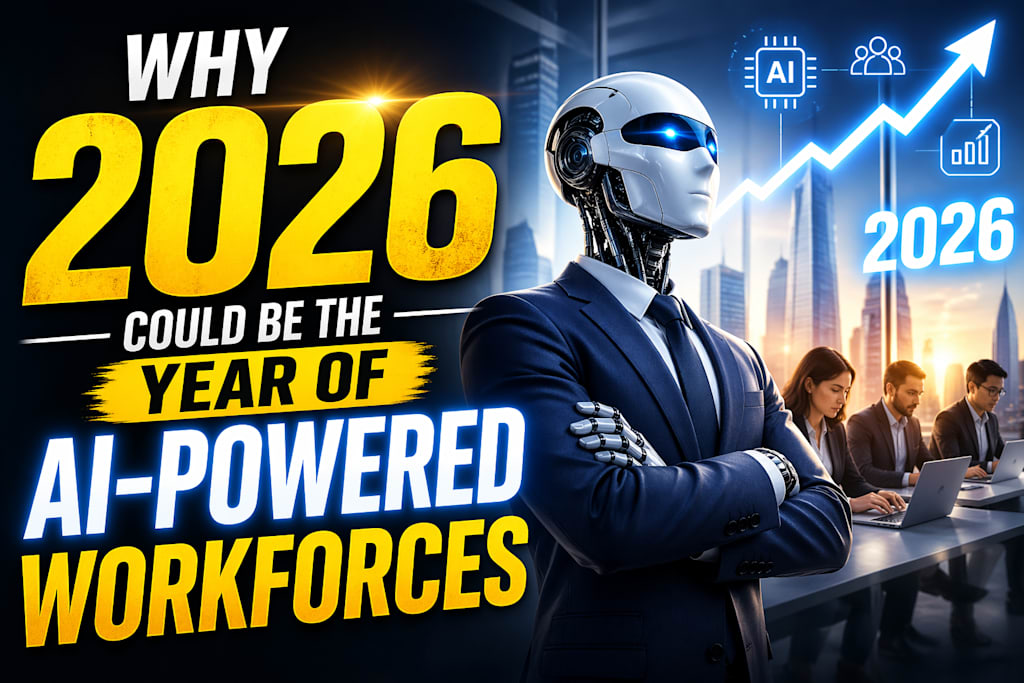
Why 2026 Could Be the Year of AI-Powered Workforces
From simple chatbots to systems that actually get work done.
For a long time, businesses have been using tools to make work easier. From email automation to CRM systems, most software has been designed to assist people rather than replace any part of the process. You still needed someone to manage it, respond, follow up, and keep things moving.
But something is starting to shift.
Instead of just helping with tasks, newer systems are beginning to handle parts of the work on their own. Not in a dramatic, “replace everyone” way, but in a quiet, practical way that changes how daily operations run.
That’s why many people are starting to believe that 2026 could be the year when AI-powered workforces become normal, not experimental.
The Change Most People Don’t Notice
If you look closely, the biggest change isn’t the technology itself. It’s how businesses are using it.
A few years ago, most automation was limited to small actions. You could send an automatic reply, trigger a follow-up email, or create a simple chatbot that answered common questions. These things were useful, but they only solved one small part of a larger process.
Now, businesses are trying to connect those pieces.
Instead of automating one step, they want systems that can handle a complete task from start to finish. For example, when a customer sends a message, the system doesn’t just reply. It understands the request, pulls the right information, updates internal records, and decides what should happen next.
That level of continuity is what makes the difference.
Where Most Businesses Still Struggle
What’s interesting is that many companies already have automation tools, but they still deal with a lot of manual work. The problem is not the lack of tools, it’s how disconnected everything is.
A chatbot might collect information, but someone still has to move that data into another system. A form might capture leads, but someone needs to follow up manually. Over time, these small gaps create a lot of hidden workload.
This is where things start to change. Businesses are no longer satisfied with partial automation. They are looking for ways to reduce the number of steps where human intervention is required.
From Chatting to Actually Getting Work Done
Earlier, most bots were designed for conversations. They were good at answering questions but not at doing anything beyond that. Once the conversation ended, the real work still had to be done by a person.
Now, the expectation is different.
Businesses want systems that can act, not just respond. When someone asks a question, the system should not only answer but also take the next logical step. That might mean updating a record, scheduling something, or triggering another action in the background.
This shift might sound small, but it changes the role of automation completely. It moves from being a support tool to becoming part of the workflow itself.
The Idea Behind AI Skills
One reason this is becoming possible is the way these systems are being built. Instead of trying to create one large, complicated setup, businesses are adding capabilities step by step.
These capabilities are often described as AI Skills, which simply means giving the system the ability to perform specific tasks. Rather than expecting one system to do everything at once, you gradually expand what it can handle.
For example, a system might start by answering customer questions. Then it learns how to collect user information. After that, it can update a database or send a follow-up message. Each new skill adds another layer of usefulness.
Over time, the system becomes more capable without becoming overly complex.
Why This Feels Different Now
The idea of automation isn’t new, so why does this moment feel different?
The answer is reliability.
In the past, these systems often required constant supervision. They would break, misunderstand inputs, or need frequent updates. That made businesses hesitant to trust them with anything important.
Now, they are becoming more stable and easier to manage. This doesn’t mean they are perfect, but they are good enough to handle real tasks without constant monitoring.
That’s a big shift. When businesses start trusting systems to handle actual work, not just assist with it, adoption increases quickly.
A More Practical Way to Look at It
Instead of thinking about this as a big technological leap, it’s easier to understand it as a gradual change in how work is distributed.
Imagine you have a small team. Some tasks require human judgment, while others are repetitive and predictable. If you can move those repetitive tasks to a system that runs in the background, your team naturally becomes more efficient.
Some businesses are already organizing their automation this way by using setups like Skillful agents, where each system is designed to handle a defined role instead of trying to do everything at once. This makes the process easier to manage and more aligned with real business needs.
What This Means for the Near Future
As more businesses adopt this approach, the way teams operate will continue to change. People will spend less time on repetitive tasks and more time on work that requires thinking, creativity, or decision-making.
This doesn’t happen overnight, and it doesn’t require a complete transformation from day one. Most companies start small, automate one process, then expand gradually as they see results.
That’s why 2026 feels like a turning point. Not because everything will suddenly change, but because enough businesses are reaching the stage where these systems are practical, reliable, and worth investing in.
Final Thoughts
The idea of an AI-powered workforce isn’t about replacing people or creating something futuristic. It’s about reducing unnecessary work and making everyday processes smoother.
When you look at it this way, the shift feels less dramatic and more practical.
Businesses are simply finding better ways to get work done. And as these systems continue to improve, it’s likely that more companies will adopt them, not because they have to, but because it just makes sense.
About the Creator
Shaun W.
I’m a digital marketer with over three years of experience. I help brands reach their audiences using strategies like SEO, content marketing, and social media. I focus on data-driven insights to improve engagement and visibility.
Enjoyed the story? Support the Creator.
Subscribe for free to receive all their stories in your feed.
Comments
There are no comments for this story
Be the first to respond and start the conversation.