
Who Invented the Battery? The Shocking Story of Alessandro Volta and the First Electric Cell
From a mysterious ancient clay jar to Galvani’s moving frog legs and Volta’s revolutionary experiment, this is the fascinating story of how humans learned to produce electricity.

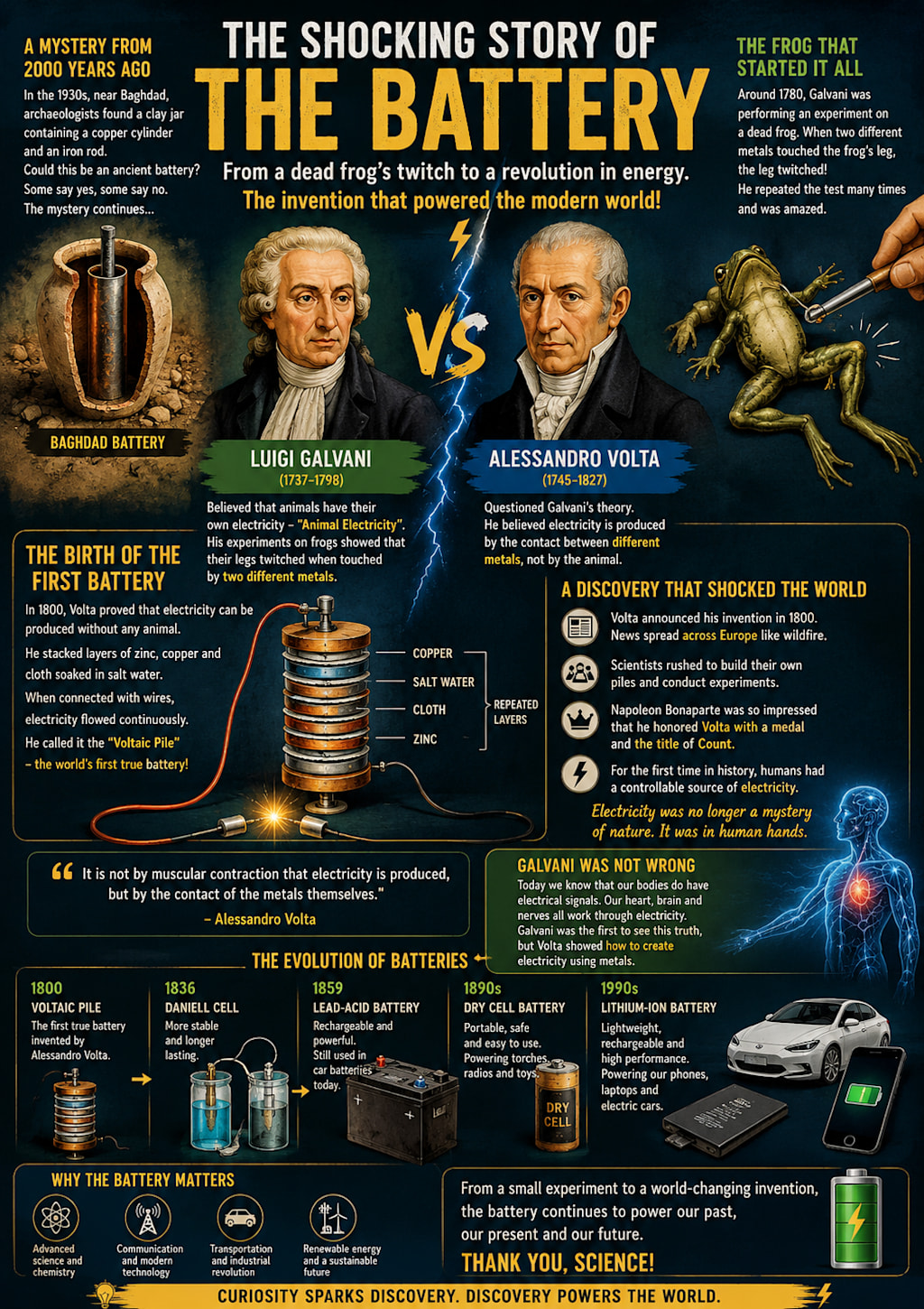
Today, batteries are everywhere. They power our smartphones, laptops, watches, remote controls, electric vehicles, medical devices and even spacecraft. Modern life would almost stop without them.
But there was a time when electricity was something humans could only observe in lightning storms or brief static sparks. It could not be stored, controlled or produced whenever needed.
That changed because of a disagreement between two Italian scientists.
One believed electricity came from living creatures. The other believed it could be produced by metals.
Their scientific rivalry eventually led to the invention of the world’s first true battery.
The Mystery of the Baghdad Battery
Before the modern battery was invented, an unusual archaeological object raised questions about whether ancient people had discovered a basic form of electricity.
During excavations near Baghdad in the 1930s, researchers found a small clay jar containing a copper cylinder and an iron rod. The object later became popularly known as the Baghdad Battery.
Some researchers suggested that if the jar had once contained an acidic liquid, such as vinegar, it might have produced a small electrical current.
This led to theories that people living nearly 2,000 years ago may have used electricity for metal plating, religious rituals or medical purposes.
However, there is no conclusive proof that the object was actually used as a battery. Many historians believe it may simply have been a storage container for scrolls or another ordinary object.
The Baghdad Battery remains a fascinating mystery, but the first scientifically proven battery appeared much later.
Luigi Galvani and the Moving Frog Legs
The modern story of the battery began in Bologna, Italy, during the late eighteenth century.
Luigi Galvani was a doctor, anatomist and university professor who studied the bodies of animals. Around the 1780s, Galvani began performing experiments on dead frogs.
During one of these experiments, the leg of a dead frog suddenly twitched when it came into contact with metal instruments.
Imagine standing in a laboratory and seeing the leg of a dead animal move as though it were alive. The experience must have been both frightening and exciting.
Galvani repeated the experiment many times. He discovered that the frog’s muscles contracted when certain metals touched its nerves and tissues.
He concluded that animals contained a special natural electrical force. He called it animal electricity.
Galvani believed he had discovered a hidden energy connected to life itself. According to his theory, the metal was only releasing electricity that was already stored inside the animal’s body.
His experiments attracted attention across Europe. Scientists began wondering whether electricity might be the force that controlled muscles, nerves and perhaps life itself.
But another Italian scientist was not completely convinced.
Alessandro Volta Questions Galvani’s Theory
Alessandro Volta was a physicist and professor living in Pavia, Italy.
When he heard about Galvani’s experiments, he initially found them impressive. However, after studying them carefully, Volta began asking an important question.
Was the electricity really coming from the frog?
Or was the frog simply acting as a conductor between two different metals?
Volta noticed that Galvani’s experiments often involved two different metals, such as iron and copper. He suspected that the contact between these metals was producing the electrical effect.
According to Volta, the frog’s body was not the source of electricity. It was only completing the electrical circuit.
This disagreement started one of the most important scientific debates in history.
Galvani continued defending his theory of animal electricity, while Volta performed experiments using metals, salt water and other materials. Scientists across Europe began supporting one side or the other.
What began as a scientific discussion slowly became a personal and professional rivalry.
Volta knew that theories alone would not settle the argument. He needed to build something that could produce electricity without using an animal.
The Experiment That Changed the World
Volta experimented with different combinations of metals and liquids.
He discovered that when two different metals were separated by a material soaked in salt water, an electrical current could be produced.
In 1800, he created a device using discs of zinc and copper. Between each pair of metal discs, he placed a piece of cloth or cardboard soaked in salt water.
He arranged these materials in repeating layers:
Zinc, copper, wet cloth.
Zinc, copper, wet cloth.
The layers were stacked on top of one another like a tower of coins.
When wires were connected to the top and bottom of the stack, electricity began to flow.
This invention became known as the voltaic pile.
It was the world’s first true battery.
Why the Voltaic Pile Was Revolutionary
Before Volta’s invention, scientists could produce static electricity, but it usually appeared as a sudden spark and disappeared almost immediately.
The voltaic pile was different.
It could provide a continuous and relatively reliable electrical current. For the first time, scientists had a source of electricity that could be created, controlled and studied inside a laboratory.
Humanity was no longer limited to observing electricity in lightning storms.
Electricity had become something people could produce with their own hands.
Volta announced his discovery in 1800 in a letter sent to the Royal Society of London. News of the invention spread quickly across Europe.
Scientists began building their own voltaic piles and using them for experiments. Volta later demonstrated his invention in Paris, where his work impressed Napoleon Bonaparte.
The invention transformed Volta from a university professor into one of the most celebrated scientists of his time.
Was Galvani Completely Wrong?
Although Volta proved that electricity could be produced using metals and an electrolyte, Galvani was not completely wrong.
Today, scientists know that the human body and the bodies of animals do use electrical signals.
Our brains communicate through electrical impulses. Our nerves carry signals across the body, and our hearts depend on electrical activity to maintain their rhythm.
This field is now known as bioelectricity.
Galvani had discovered an important connection between electricity and living tissue. His mistake was assuming that the frog’s body was the only source of the electricity observed in his experiments.
In a way, both scientists contributed to modern science.
Galvani helped reveal the electrical nature of the body, while Volta created a practical device capable of producing continuous electricity.
The Evolution of the Battery
Volta’s battery was revolutionary, but it was far from perfect.
The voltaic pile lost power relatively quickly. Its liquid electrolyte could leak, and the metal discs developed chemical problems that reduced performance.
However, Volta had opened the door.
Other scientists soon began improving his design.
In 1836, John Frederic Daniell developed the Daniell cell, which provided a more stable electrical current.
In 1859, Gaston Planté invented the lead-acid battery, the first practical rechargeable battery. Lead-acid batteries are still widely used in cars today.
Later came dry-cell batteries, which were safer and easier to carry. These batteries powered flashlights, radios, toys and household devices.
During the twentieth century, nickel-based rechargeable batteries became common.
The next major breakthrough was the lithium-ion battery. Lightweight, powerful and rechargeable, lithium-ion batteries made modern smartphones, laptops and electric vehicles possible.
In 2019, scientists John B. Goodenough, M. Stanley Whittingham and Akira Yoshino received the Nobel Prize in Chemistry for their contribution to the development of lithium-ion batteries.
Why the Battery Changed Human History
The battery did more than provide portable power.
It made countless scientific discoveries possible. Early batteries helped researchers study chemistry, separate elements and understand electromagnetism.
They contributed to the development of telegraphs, telephones, radios, computers and modern transportation.
Today, battery technology is at the centre of the global transition toward renewable energy. Large batteries can store electricity generated by solar panels and wind turbines. Electric vehicles depend on batteries to reduce the use of petrol and diesel.
Scientists are now developing solid-state batteries, sodium-ion batteries and other technologies designed to store more energy, charge faster and last longer.
Yet the basic idea remains connected to Volta’s original experiment: different materials interacting chemically to produce a flow of electrons.
Final Thoughts
The invention of the battery did not happen in a single moment.
It began with curiosity, strange experiments and a disagreement between two brilliant scientists.
Luigi Galvani saw the leg of a dead frog move and believed he had discovered animal electricity. Alessandro Volta questioned that explanation and proved that electricity could be produced using metals and a liquid conductor.
That scientific debate gave birth to the voltaic pile and placed controllable electricity in human hands for the first time.
More than two centuries later, Volta’s legacy remains part of our everyday language. The unit used to measure electrical potential is called the volt, named in his honour.
Every time we charge a phone, start a car or use a battery-powered device, we are benefiting from an experiment that began with a few pieces of metal, some salt water and one powerful question:
Where does electricity really come from?
About the Creator
parwinder singh
🎬 Movie & Entertainment Writer sharing reviews, ending explanations, story breakdowns, plot twists and hidden details from Bollywood, Hollywood, South Indian cinema, Korean dramas and OTT releases.
Enjoyed the story? Support the Creator.
Subscribe for free to receive all their stories in your feed.
Comments
There are no comments for this story
Be the first to respond and start the conversation.