
When Park Avenue became a gallery, Yanice Yang brought human-centered technology into public view
NEW YORK, August 2026. For three Saturdays in August, part of Park Avenue in Midtown Manhattan was closed to cars. NYC DOT Summer Streets opens major city streets to pedestrians, cyclists, families, and community programming. The Midtown Rest Stop between 51st and 52nd Streets became an open public art space within that program, run by Utopia.


The NYC DOT x Utopia. Public Art Show ran on August 1, 8, and 15, with eight emerging artists and designers working in painting, photography, illustration, industrial and interaction design, digital storytelling, and immersive technology.
A gallery without walls on Park Avenue
Nobody had to decide to go and see art. The work sat in the path people were already taking, so they came across it while walking, cycling, gathering, or passing through Midtown. Public drawing sessions and artist-led activities ran alongside the displays, which meant a visitor could join in rather than only look. For three Saturdays Park Avenue was a cultural space as well as a car-free corridor.
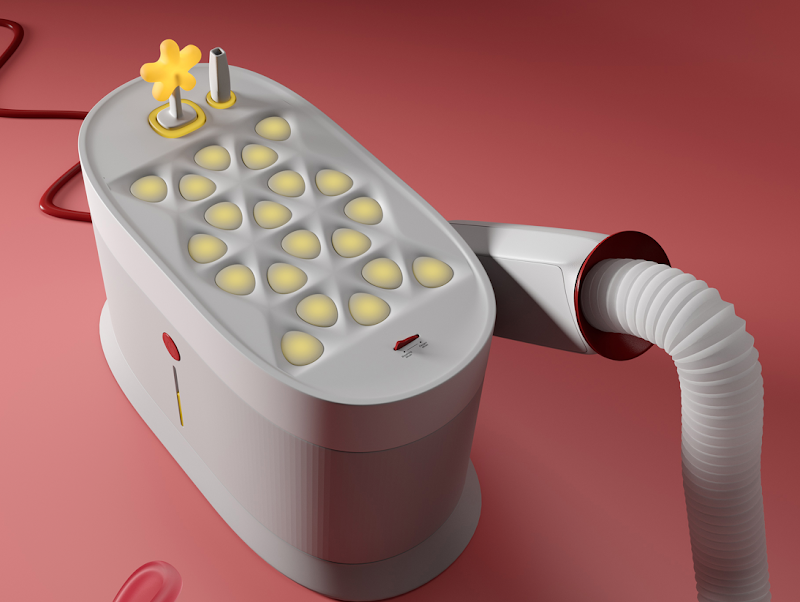
One of the eight was Yanice (Liuqingqing) Yang, who brought Breezy. Pediatric respiratory treatment is hard for a child to follow and easy to find frightening, and Breezy is built for that problem. It is a respiratory training and oxygen therapy concept for children with chronic asthma or recovering from pneumonia. It combines breathing exercises with continuous oxygen flow and real-time monitoring of lung capacity, then turns what it measures into visual, animated, and light-based feedback. Breathing strength, session completion, and therapeutic milestones show up in a form a child and a caregiver can read directly, instead of only as conventional clinical readouts. Progress is rewarded on screen, and a finished session makes a flower bloom.
At Summer Streets the device met an audience with no clinical background, which is a harder test than a specialist review. That is the argument behind the project: a system is more useful when the people using it can follow what it is doing. Yang treats a healthcare device as a technical problem and also as something a frightened child and a tired parent have to understand, stay motivated by, and trust. Turning a course of therapy into something that looks like play is the part that decides whether a child finishes it.
Breezy: Turning Treatment Into Something a Child Can Read
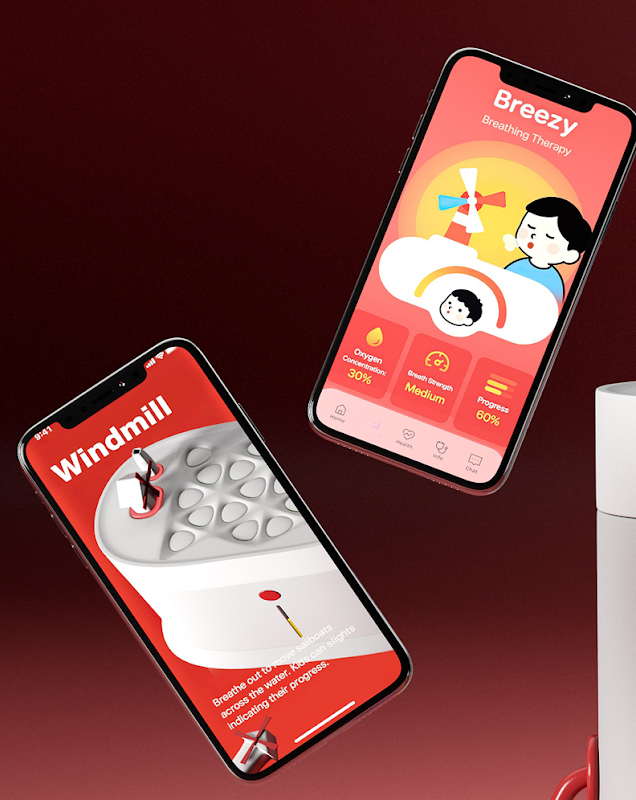
Breezy received a 2025 Red Dot Award: Design Concept in the Medical Devices and Technology category, where the official record lists Yang as one of two design leads, and a 2026 iF DESIGN AWARD in Product Concepts. Award juries are one audience. The public on Park Avenue is another, where accessibility stops being only a design principle and becomes a social one. A jury reads a submission. A stranger on a Saturday morning either understands the object in front of them or walks past it.
The same question, now inside AI products
Yang's work covers product design, human-computer interaction, enterprise tools, healthcare-centered concepts, and AI-assisted product systems. One question runs through all of it: can an interface help someone understand complicated information, decide what to do, and keep real control over the technology?
That question has grown harder as generative AI moves into content creation, marketing, analytics, and everyday business operations. Efficiency and automation are no longer the only things a product team designs for. Users also have to be able to tell what a system produced, what they can change, where it is uncertain, and when their own judgment should override it. Yang treats those as design problems, not only technical ones.
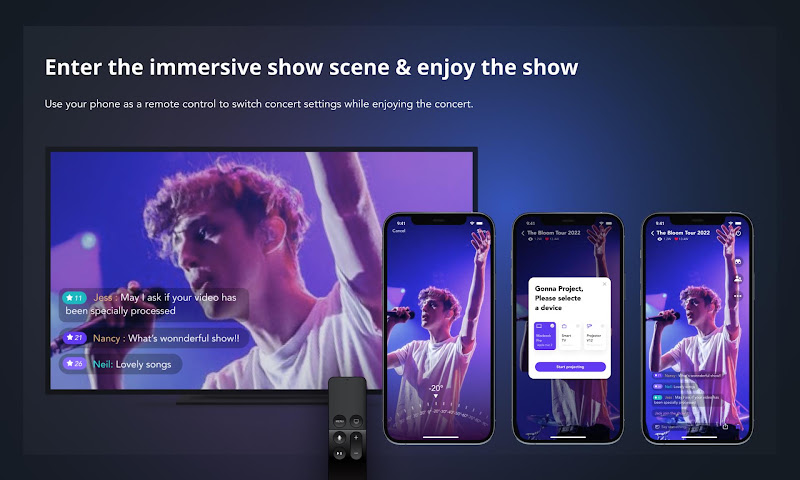
Sonic AI is her own work in that area. The platform, built for at-home concert experiences, was recognized at the 2025 Vega Digital Awards in UX - Product. It combines real-time AI processing, connected home devices, and biometric feedback, so an audience at home can set its own environment before a show, interact during it, and keep something personal from it afterward. Underneath, a stack of automated systems is making decisions. The design work is making that stack legible enough that the audience stays in charge of it.
From making design to judging it
Yang also reviews other designers' work. In 2026 she judged nominee websites for the international design platforms Orpetron and Top Design King, assessing the quality of each site's digital experience. Reviewing is a different job from designing: the standard has to hold across every entry, not only the one you made yourself.

A reviewer has to look past visual polish: is the information organized, is the navigation predictable, does the interface hold up on a phone, does it read as credible and purposeful? Yang's judgment now applies to those standards as well as to the products she designs herself.
The two activities ask the same thing. Building Breezy means making a difficult medical process understandable to a child. Reviewing a nominee site means deciding whether it communicates with the people who use it. Both come down to spotting where a design helps someone understand and where it gets in the way.
The program behind Utopia. was built on moving creative work out of conventional venues and into direct contact with the public, which is why Breezy fit there. The project does the same thing with specialized technology: take something built for clinicians and put it in a form an ordinary person can understand and respond to. In both cases the accessibility decisions come first, not at the end.
Yang's work is now judged on two counts: what she designs, and the standards she applies when reviewing other people's work. Usability, accessibility, and responsible interaction between people and technology run through both. At the Midtown Rest Stop on three Saturdays in August, that came down to a simpler question: whether something built for a clinic could explain itself to a stranger on a street.
______________________________________________________
About Utopia.
Utopia. is a forward-thinking organization that uses immersive art experiences to foster community engagement and social interaction. Through innovative pop-up exhibitions and events, Utopia. seeks to make art accessible to all, sparking creativity and dialogue among diverse groups of people.
For more information on Utopia., upcoming events, and future exhibitions, please visit https://www.utopiaevent.org/.
Media Contact:
Utopia team: [email protected]
About the Creator
Utopia Collaboration Inc.
Utopia is an NYC-based international art platform. It hosts exhibitions, installations, and creative events—including weekly Sunday Studio sessions for all levels—to foster artistic expression and community.
Enjoyed the story? Support the Creator.
Subscribe for free to receive all their stories in your feed.
Comments
There are no comments for this story
Be the first to respond and start the conversation.