
When AI Eats Your Joy
A computer science graduate, two months out, discovers that handing over the struggle means handing over the reward.
The Gift I Didn't Ask For
Two months out. Twenty‑two. CS degree. Paid research gig. Sounds like a win.
It's not.
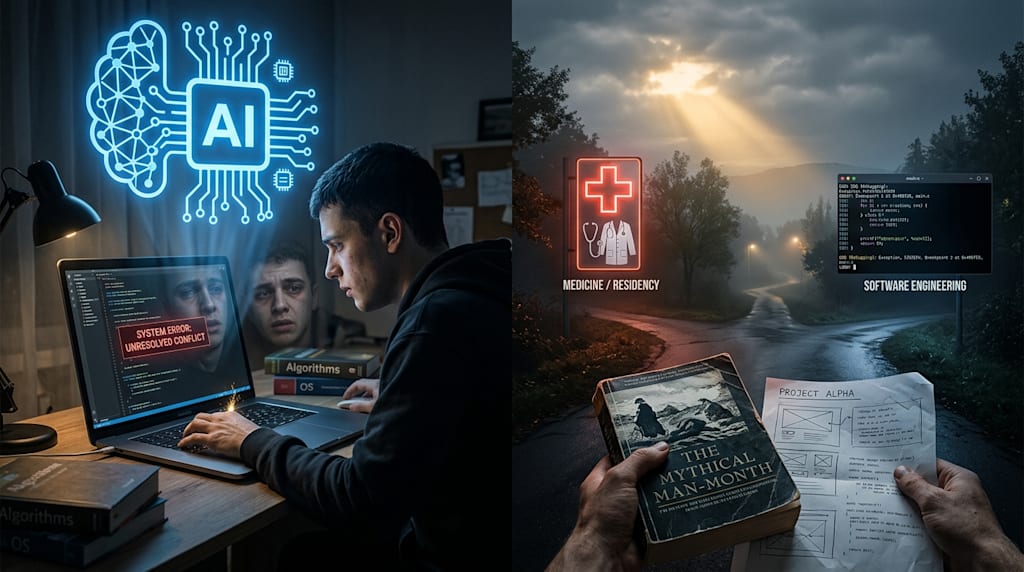
I ride the subway to work, stare at my reflection in the window, and don't recognise the guy staring back. He looks tired. Not sleep‑tired. Something else. Like the part of him that used to get excited about code just… checked out.
I used to stay up till 3 a.m. hunting bugs. Not because I had to. Because I couldn't stop. That rush when you finally corner the bastard—when you change one line and everything clicks—that's better than coffee. Better than anything.
Now? I open my editor. Paste the problem into ChatGPT. Wait ten seconds. Copy. Paste. Run.
Sometimes it works. Sometimes it doesn't. When it doesn't, I paste it again. Wait again.
I'm not programming anymore. I'm a human adapter—a pipe between prompts and generated text. Pipes don't get curious. Pipes don't get a dopamine hit.
And I've started wondering: Did I pick the wrong thing?
What I Gave Up Without Noticing
Remember what it used to feel like?
Crash. Red logs everywhere. You stare at those few lines, read them over and over. Add a print(). Run. Add another. Run again. Walk through every variable frame by frame, like reconstructing a car wreck.
And then—click—"There you are." Change one line. Recompile. It runs.
Something inside you actually cheers. You get up to refill your water, and you can't wipe the stupid grin off your face.
Now? I paste the error into a box, and the AI spits out a fix. I don't even need to understand why—as long as it runs.
That's the deal I made without realising: I handed over the struggle. And in doing so, I handed over the reward.
The AI isn't evil. I just used it wrong. I treated it like a replacement for thinking, not a sharpening stone.
So I made some rules for myself.
One. No AI debugging for a month. Back to print() and breakpoints and stack traces. Force my brain to retrace the chain. Let it feel slow—because slow is what makes the string inside my head actually vibrate.
Two. AI is my strategist, not my henchman. Before I write code, I sketch a design—architecture, data flow, edge cases. Then I throw that sketch at the AI and say, "Poke holes. Where does this break under load? What did I forget?" I'm using it to critique my thinking, not to do my thinking for me.
Three. The 70/30 rule. The core 70%—I type it myself. Only the boring, repetitive scaffolding gets outsourced. Code is my thought made visible. If every line comes from something else, I'll never feel like it's mine.
This Project Is a Dead End. That's Fine.
The research gig I'm paid for? Crappy data. Vague goals. I stare at it every day, feeling like I'm banging my head against a wall. Some days there's literally nothing productive to do.
I started thinking: I'm useless. I'm producing nothing.
But here's the thing—my disappointment isn't with programming. It's with this particular project. It's a dead end. That happens in academia. All the time. It's not my failure. It's just a dry well.
So I changed how I treat it.
First. Dead time becomes my study time. Since this project can't give me anything valuable, I use it for space—to read the papers I've been putting off, to build a silly tool just for myself, to dig into some weird language that makes me happy, whether it's "useful" or not. I'm getting paid to grow. That's not slacking. That's investing.
Second. I document the failure carefully. This project might never produce a shiny result. So I'll write down, in painful detail, exactly why it doesn't work—map every boundary, every dead end. In the AI age, a deep failure is more valuable than a cheap win. Being able to say, with precision, "the fatal flaw sits right here"—that's a skill. No road is wasted unless I forget to write down where it led.
The Grass Over There
Lately I've been eyeing medicine.
I'll be honest: what pulls me is status. Security. A clear track. I didn't choose it back then because CS felt more like me—I liked logic. I liked building order from chaos.
Now that CS stings, medicine looks like the perfect escape hatch.
But I have to ask myself a nasty question: Am I actually drawn to medicine, or am I just running from how helpless I feel right now?
Those are two completely different things.
The medicine I fantasise about is white coats and heroic saves. The real medicine—soul‑crushing residency, endless paperwork, bureaucratic mazes, the weight of losing patients—that's another system that demands a different kind of grind.
If I'm fleeing ambiguity for a "clear path," then when that clear path turns into a tedious routine, I'll be standing at another crossroads with the same confusion. Changing arenas doesn't fix an existential crisis. It just gives you a new way to suffer.
Ask Different Questions
We're all raised to find "the one right career." That's a trap.
So I try a different set of questions:
In the last five years, when did I lose track of time? Fixing a nasty concurrency bug. Breaking down a messy system into clean pieces. That moment when a diagram on paper finally made sense.
What problem actually keeps me up at night? A technical puzzle I can't crack. A phenomenon I can't explain.
In the AI age, what part of me can't be replaced?
The answer, I think, is this: deep understanding of complex systems. Abstract modelling. Using logic to tame chaos.
That's the grammar CS taught me. And that grammar isn't just for code—it works for bioinformatics, financial modelling, digital humanities, building educational tools. What I hold isn't a hammer. It's a language for how to build order.
So I stop locking myself in the "programmer" cage. I'm a problem‑solver who happens to write code.
48 Hours
I can't tell if I'm burned out or just over it. So I run a stupidly simple test:
No AI for two days.
No prompts. No Stack Overflow. Just a tiny, useless project—maybe a Snake game, or parsing a weird log file, or refactoring an old script into something I can actually read. Only my brain and the official docs. Start from scratch. Fight my way through.
If, in that loop of "stuck → think → breakthrough," my heart picks up and my face cracks into a grin when it finally runs—then I know the spark never died. It was just sleeping in the greenhouse of AI.
And if after 48 hours I feel nothing but dullness, no flicker of excitement—that's fine too. It means I've grown, and CS already gave me the best gift it could: a logical muscle memory. I can take that memory, turn around with a clear head, and walk toward whatever's next.
Take It Back
AI won't replace me. But a version of me that loses the nerve to think—that version will replace me from the inside.
I'm standing in the gap between an old way and a new one. The gap is narrow, the wind is strong, but that's exactly where the light gets in. In an age of instant answers, the rarest thing isn't speed—it's the willingness to slow down and actually figure something out.
That's the last romance of programming. And it's what I really wanted when I first chose this road.
So I pick up my debugger. I stare at that red line of error. I don't paste it into the box yet. I let it sit in my head for a while longer.
About the Creator
Jin
Writer of reamstories
https://reamstories.com/jin
Enjoyed the story? Support the Creator.
Subscribe for free to receive all their stories in your feed. You could also become a paid subscriber, letting them know you appreciate their work.
Comments
There are no comments for this story
Be the first to respond and start the conversation.