
What Trends Are Defining Crypto Influencer Marketing in 2026?
Crypto Influencer Marketing

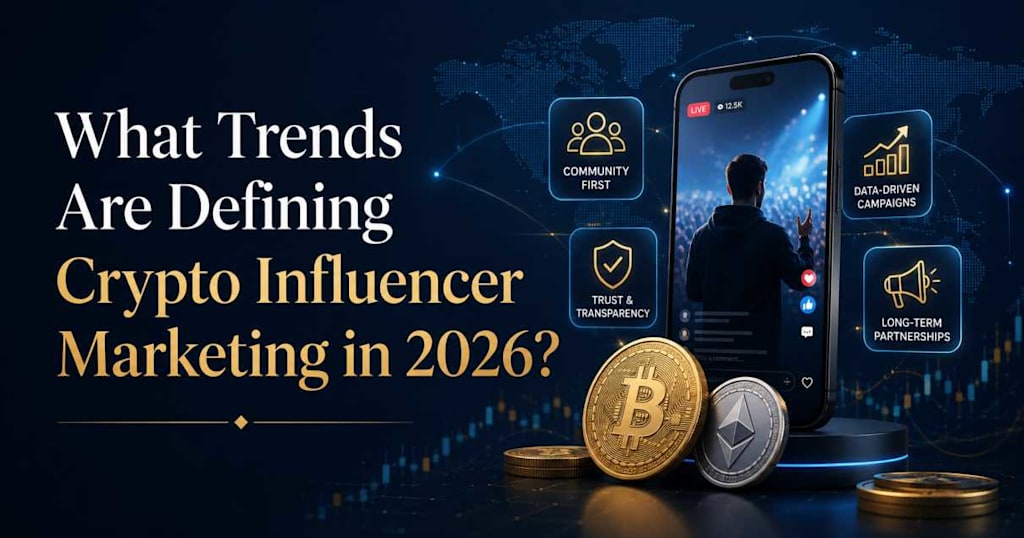
The cryptocurrency industry has entered a far more mature and competitive phase in 2026. What once revolved around speculative token launches and viral hype cycles has evolved into a sophisticated digital economy powered by decentralized finance (DeFi), Web3 infrastructure, AI-integrated blockchain applications, tokenized real-world assets, decentralized social platforms, and institutional-grade crypto ecosystems. As this transformation accelerates, marketing strategies within the industry are evolving just as rapidly.
Among the most significant developments is the rise of influencer-driven marketing as a dominant force in crypto brand growth. However, crypto influencer marketing in 2026 looks very different from the influencer campaigns that defined previous market cycles. The industry has shifted away from shallow promotional tactics toward highly strategic, community-focused, and data-driven engagement models. Influencers are no longer viewed merely as social media personalities posting sponsored content. Instead, they have become educators, ecosystem advocates, community leaders, researchers, and trust intermediaries within decentralized digital economies.
This evolution has also increased the importance of the modern Crypto Influencer Marketing Agency. These agencies now operate as strategic growth partners that help blockchain projects manage creator collaborations, audience targeting, compliance, campaign analytics, reputation management, and long-term community building. Their role is expanding because the influencer landscape itself has become more fragmented, competitive, and technologically sophisticated.
The trends shaping crypto influencer marketing in 2026 reflect broader changes in digital behavior, decentralized culture, regulatory frameworks, and consumer trust. Understanding these trends is critical for any Web3 brand seeking sustainable growth in an increasingly crowded market.
The Shift From Hype Marketing to Trust-Centered Campaigns
One of the most important trends defining crypto influencer marketing in 2026 is the industry-wide movement away from pure hype-based promotion.
Earlier crypto cycles were dominated by aggressive token shilling, exaggerated promises, celebrity endorsements, and fear-of-missing-out marketing tactics. During bull markets, projects often relied on influencer-driven speculation to generate rapid attention and trading volume. While this approach occasionally produced short-term growth, it also contributed to scams, rug pulls, and unsustainable investor behavior.
As a result, audiences became increasingly skeptical of promotional content. Many users lost trust in influencers who promoted low-quality projects without proper research or transparency. This shift fundamentally changed audience expectations.
In 2026, credibility has become the most valuable asset in crypto marketing. Today’s successful influencers prioritize research, transparency, and educational value over sensational promotion. Audiences expect creators to explain project fundamentals, discuss risks openly, and provide genuine insights rather than blindly promoting tokens.
Consequently, modern crypto influencer marketing agencies now focus heavily on trust alignment. Instead of simply finding influencers with large audiences, agencies carefully evaluate whether creators possess authentic engagement, technical understanding, and community credibility.
Projects are increasingly selecting influencers based on reputation quality rather than follower counts. A smaller creator with a highly loyal DeFi audience may generate significantly better results than a celebrity influencer with millions of disengaged followers. This trend reflects the growing maturity of the Web3 ecosystem itself. As institutional participation increases and users become more informed, superficial marketing strategies are becoming less effective.
Educational Content Is Dominating Influencer Campaigns
Another defining trend is the rapid rise of educational influencer content.
Blockchain technology remains highly technical for mainstream audiences. Concepts such as zero-knowledge proofs, liquid staking, decentralized governance, interoperability protocols, modular blockchains, AI-integrated smart contracts, and tokenized real-world assets can be difficult for average users to understand.
In previous years, many crypto campaigns attempted to bypass this complexity through speculative marketing narratives. However, as the market matures, users increasingly demand educational clarity before participating in ecosystems.
This has transformed influencers into educators. Modern crypto creators now produce long-form YouTube explainers, technical protocol breakdowns, live AMAs, on-chain analysis videos, governance discussions, step-by-step tutorials, tokenomics deep dives, and security assessments designed to help users understand ecosystems before investing or participating.
Educational content performs exceptionally well because it reduces uncertainty while improving audience trust. Crypto Influencer Marketing Agency teams are responding by designing campaigns that prioritize knowledge-sharing instead of direct promotion. Rather than asking creators to aggressively sell a project, agencies encourage them to explain ecosystem functionality, demonstrate platform usage, and discuss industry relevance.
This educational approach creates stronger community retention, better onboarding quality, and higher long-term engagement. Projects that invest in educational influencer campaigns are often more successful in building sustainable communities compared to projects relying solely on speculative hype.
Micro-Influencers Are Outperforming Mega Creators
The growing influence of micro-creators is another major trend shaping crypto influencer marketing in 2026.
In earlier years, projects frequently pursued large-scale influencers or celebrities in hopes of achieving massive visibility quickly. However, many of these campaigns generated weak engagement because audiences perceived them as transactional sponsorships rather than authentic endorsements.
Today, micro-influencers are increasingly delivering stronger performance metrics because they typically maintain highly engaged niche communities and stronger audience trust. Their interactions feel more personal and authentic, which resonates strongly with Web3 users who value transparency and direct communication.
For example, a creator specializing in DeFi yield strategies may have only a modest following compared to mainstream influencers, yet their audience may consist of highly active and knowledgeable crypto participants. Similarly, NFT gaming creators with smaller Discord communities often produce significantly better conversion rates for GameFi campaigns because their followers are already deeply involved in those ecosystems.
Crypto influencer marketing agencies are adapting by building multi-layered creator ecosystems that combine macro-level visibility with micro-level trust. Instead of relying on one major influencer, agencies now coordinate networks of niche creators across DeFi, NFTs, blockchain gaming, AI-based Web3 applications, developer education, and DAO governance discussions.
This decentralized creator strategy aligns naturally with the decentralized philosophy of Web3 itself. It also allows projects to reach highly targeted communities that are more likely to become active ecosystem participants.
Multi-Platform Influencer Ecosystems Are Becoming Essential
Crypto influencer marketing is no longer concentrated on a single social platform.
In previous market cycles, Twitter and Telegram dominated crypto discussions. While these platforms still play important roles, user attention has become fragmented across numerous digital ecosystems. Successful campaigns in 2026 now operate simultaneously across YouTube, TikTok, Reddit, Discord, Instagram, LinkedIn, podcasts, live-streaming platforms, and decentralized social networks like Farcaster and Lens Protocol.
Each platform serves a different audience behavior. YouTube excels at educational storytelling and long-form analysis. TikTok helps projects achieve viral visibility among younger audiences. Reddit supports deeper community conversations and organic sentiment analysis. Discord enables ecosystem retention and community coordination. LinkedIn has become important for enterprise blockchain visibility and institutional networking.
This diversification has significantly increased campaign complexity. A modern Crypto Influencer Marketing Agency must now manage platform-specific content strategies, audience segmentation, creator coordination, and cross-platform storytelling while maintaining consistent brand messaging.
Projects that fail to diversify their platform presence risk missing important audience segments entirely. As digital behavior becomes increasingly decentralized, multi-platform influencer ecosystems are becoming essential for scalable crypto growth.
AI Is Transforming Influencer Marketing Strategies
Artificial intelligence is rapidly reshaping the crypto marketing landscape in 2026.
AI-powered analytics tools now help agencies optimize campaigns with far greater precision than traditional marketing methods. Agencies use machine learning systems to evaluate audience authenticity, engagement quality, behavioral patterns, sentiment analysis, conversion potential, and content performance.
These systems help distinguish genuinely influential creators from accounts inflated by bots or artificial engagement. This is especially important in crypto marketing, where fake followers and manipulated metrics have historically created major inefficiencies.
AI is also improving content personalization. Campaign messaging can now adapt dynamically based on geographic regions, audience demographics, engagement history, and user behavior patterns. This enables projects to create far more relevant and targeted communication strategies.
Additionally, AI-powered monitoring tools allow agencies to track community sentiment across decentralized ecosystems in real time. Because crypto markets react quickly to news, regulations, and social media narratives, rapid sentiment analysis has become extremely valuable for campaign management and reputation protection.
Some agencies are even experimenting with AI-generated creator assistants, automated multilingual content systems, predictive trend analysis, and real-time market intelligence tools to improve campaign performance.
However, despite these technological advancements, authenticity remains central to influencer marketing success. Audiences still prioritize genuine human insight over fully automated communication.
Long-Term Creator Partnerships Are Replacing One-Off Promotions
Another defining trend in 2026 is the movement toward long-term influencer partnerships.
Earlier crypto marketing strategies often focused on short-term promotional bursts tied to token launches or exchange listings. Influencers were typically paid for isolated posts with little ongoing involvement in the ecosystem.
That model is rapidly disappearing.
Today, leading blockchain projects are developing ambassador-style partnerships designed around sustained collaboration. Influencers are becoming long-term ecosystem participants rather than temporary advertisers.
These partnerships often involve ongoing educational content, governance participation, community engagement, product testing, event collaborations, developer advocacy, and research-driven discussions. This continuity strengthens both trust and audience retention.
Audiences are more likely to believe creators who consistently interact with a project over time rather than those who suddenly promote unfamiliar ecosystems during sponsored campaigns. Long-term creator alignment also allows communities to evolve organically around shared narratives and ecosystem development.
Crypto influencer marketing agencies increasingly structure campaigns around relationship-building rather than isolated promotional transactions because long-term partnerships generate stronger community loyalty and ecosystem stability.
Compliance and Transparency Are Becoming Central Priorities
Regulatory scrutiny surrounding crypto promotions has intensified significantly in 2026.
Governments and financial authorities across multiple jurisdictions now monitor influencer campaigns more aggressively, particularly regarding sponsorship disclosures, investment-related claims, and misleading financial promotions.
This increased oversight has fundamentally changed how crypto influencer campaigns are managed. Transparency is no longer optional—it has become a core requirement for maintaining both regulatory compliance and audience trust.
Crypto Influencer Marketing Agency teams now play a major compliance role by helping projects structure campaigns responsibly. Agencies ensure proper sponsorship disclosures, messaging guidelines, regional adaptation, and reputation management protocols are implemented across campaigns.
Audiences themselves are also demanding greater accountability. Influencers who fail to disclose paid partnerships or promote questionable projects risk severe reputational damage. As a result, creators are becoming more selective about collaborations, choosing projects with genuine utility, transparent leadership, and long-term vision.
This trend is gradually improving the overall quality and professionalism of crypto marketing across the industry.
Community-Led Marketing Is Becoming More Powerful
Web3 ecosystems thrive on active community participation rather than passive consumer behavior.
Unlike traditional digital businesses, blockchain ecosystems often rely on users to contribute directly through staking, governance voting, liquidity participation, DAO involvement, development, and ecosystem advocacy.
As a result, community-led marketing has become one of the most powerful growth mechanisms in crypto.
Influencers increasingly function as community facilitators instead of traditional advertisers. They host Twitter Spaces, moderate discussions, organize governance conversations, lead educational workshops, and encourage collaborative ecosystem participation.
Crypto influencer marketing agencies now prioritize engagement quality and community retention over superficial visibility metrics. Instead of focusing purely on impressions or follower counts, agencies analyze long-term participation, Discord engagement, governance involvement, and organic ecosystem advocacy.
This reflects the broader evolution of Web3 itself, where communities are not just audiences—they are active participants in the success of decentralized ecosystems.
Regional Influencer Localization Is Expanding
The cryptocurrency industry has become deeply globalized.
Blockchain projects frequently target international audiences from the very beginning, creating unique marketing challenges related to language, culture, regulation, and platform behavior.
In 2026, localized influencer strategies have become essential for effective global expansion.
Crypto influencer marketing agencies increasingly build region-specific creator networks capable of communicating effectively within local communities. Korean crypto audiences, for example, often prefer highly technical educational content, while Indian Web3 communities may respond more strongly to startup innovation narratives and developer-focused ecosystems.
Latin American users frequently prioritize blockchain applications related to inflation resistance and financial accessibility, while European audiences may focus more heavily on privacy, regulation, and compliance.
Localization significantly improves campaign relevance and community engagement because audiences connect more strongly with culturally aligned messaging delivered by trusted regional voices.
On-Chain Reputation and Analytics Are Emerging
Blockchain-native analytics are introducing entirely new ways to measure influencer effectiveness.
Traditional marketing often relies on platform-based metrics such as impressions, likes, or click-through rates. However, crypto ecosystems now allow agencies to track actual on-chain participation generated through influencer campaigns.
Agencies increasingly analyze wallet activity, token participation, governance voting, staking behavior, NFT mint engagement, DAO involvement, and ecosystem interactions to determine whether campaigns are generating meaningful adoption.
This evolution is transforming influencer marketing from a visibility-focused strategy into a measurable ecosystem growth mechanism.
In the future, blockchain-based reputation systems may even allow users to verify influencer credibility transparently through on-chain records, helping reduce fraudulent promotions and improve accountability across the industry.
The Future of Crypto Influencer Marketing Agencies
The modern Crypto Influencer Marketing Agency is evolving into a highly specialized strategic growth partner rather than a simple intermediary between projects and creators.
Future agencies are likely to integrate AI-powered analytics, decentralized creator marketplaces, blockchain attribution systems, DAO-based campaign structures, tokenized creator incentives, predictive sentiment monitoring, and real-time ecosystem intelligence tools.
As decentralized technologies continue evolving, influencer marketing will become increasingly integrated with governance systems, creator economies, decentralized identity frameworks, and community-driven growth models.
Projects that adapt to these changes early will gain substantial advantages in visibility, audience trust, ecosystem participation, and long-term sustainability.
Conclusion
Crypto influencer marketing in 2026 is being shaped by a combination of technological advancement, audience maturity, regulatory development, and decentralized community culture.
The era of simplistic hype campaigns is fading quickly. In its place, the industry is embracing trust-centered communication, educational storytelling, micro-influencer ecosystems, AI-driven analytics, long-term partnerships, multi-platform engagement, and community-led growth strategies.
As blockchain ecosystems become more sophisticated and globally interconnected, influencer marketing will remain one of the most powerful tools for driving adoption and building sustainable digital communities.
At the center of this transformation is the growing importance of the Crypto Influencer Marketing Agency. These agencies now function as ecosystem architects that help projects navigate the complexities of Web3 communication while building authentic, trust-driven relationships with global audiences.
About the Creator
john
I focus on DeFi's disruptive potential via blockchain, crypto, and tokens. My interest: evolving NFTs into full metaverse economies.
Enjoyed the story? Support the Creator.
Subscribe for free to receive all their stories in your feed.
Comments
There are no comments for this story
Be the first to respond and start the conversation.