
What Is Ideogram 4? An Open Image Model Built for Text and Layout
A practical look at Ideogram 4.0’s open weights, structured prompts, typography, colors, and layout controls.

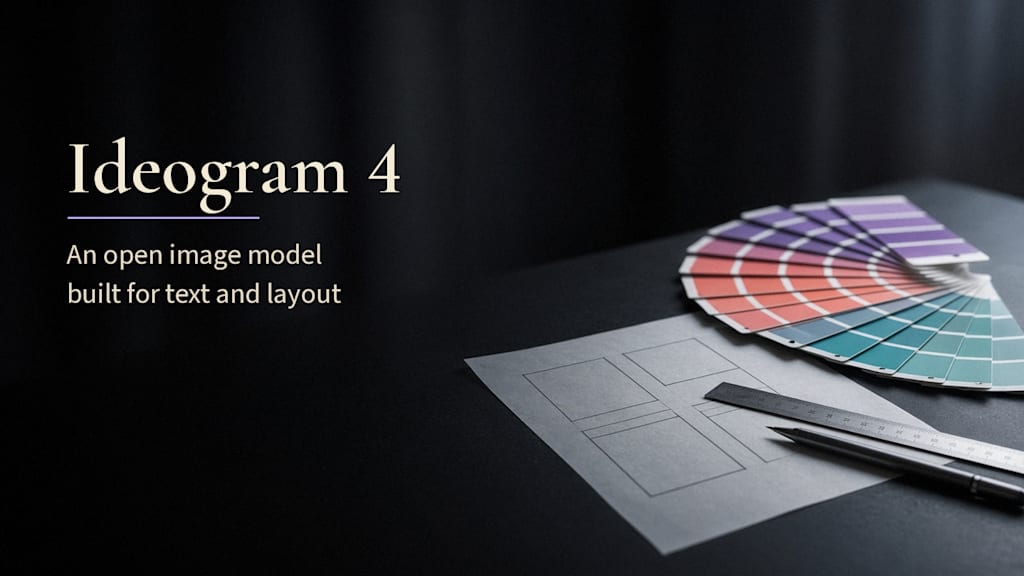
Ideogram 4 is the open-weight image model to try when the picture has to carry words, not just look good. Ideogram released Ideogram 4.0 in June 2026 as a 9.3-billion-parameter model trained only on structured prompts, where text, colors and layout are separate parts. If you make posters, ads, logos or social covers, this is the job it was built for.
Key Takeaways
It is open. Ideogram calls 4.0 its first open-weight foundation model, with weights on Hugging Face and code on GitHub.
Text is a separate element. Each piece of text has its literal wording and a separate style description.
Colors and layout can be exact. Prompts can set up to 16 hex colors per image, five per element, plus bounding boxes.
One model covers many sizes. A single set of weights runs from 256 to 2048 pixels per side, at flexible aspect ratios.
Speed is a dial. The official presets run 12, 20 or 48 denoising steps.
What Ideogram 4 Can Do
Ideogram's technical post describes a simple pipeline in which a frozen vision-language model, Qwen3-VL-8B, reads the prompt first. The 9.3-billion-parameter transformer then builds the image across 34 layers, with text and image tokens sharing one sequence.
The interesting part is the prompt format, because Ideogram trained the model only on JSON captions. A caption lists the overall scene, the background, each object and each text element in turn. Every text element has two fields: the exact string to render, and a description of how it should look. The official example poster spells out “MANGO SAGO SOCIAL” in bold reddish-orange letters stacked in the upper half, with a separate banner for the date and time.
That structure gives designers real control:
Typography. Headlines, dates and labels are written once, exactly, and styled separately.
Brand colors. Hex codes can be pinned to the whole image or to a single element.
Placement. Bounding boxes say where an element goes, so layouts stop drifting between versions.
Formats. The same weights handle square thumbnails, phone wallpapers and ultrawide banners.
The ideogram4.co workspace lists the everyday jobs this suits: logo concepts and wordmarks, launch and event posters, ad images, product visuals and social covers. It also highlights titles, slogans, brand names, product labels and multilingual text inside images.
How It Compares
On general image quality Ideogram 4.0 competes on a crowded board, and its clearest lead shows up wherever text is involved.
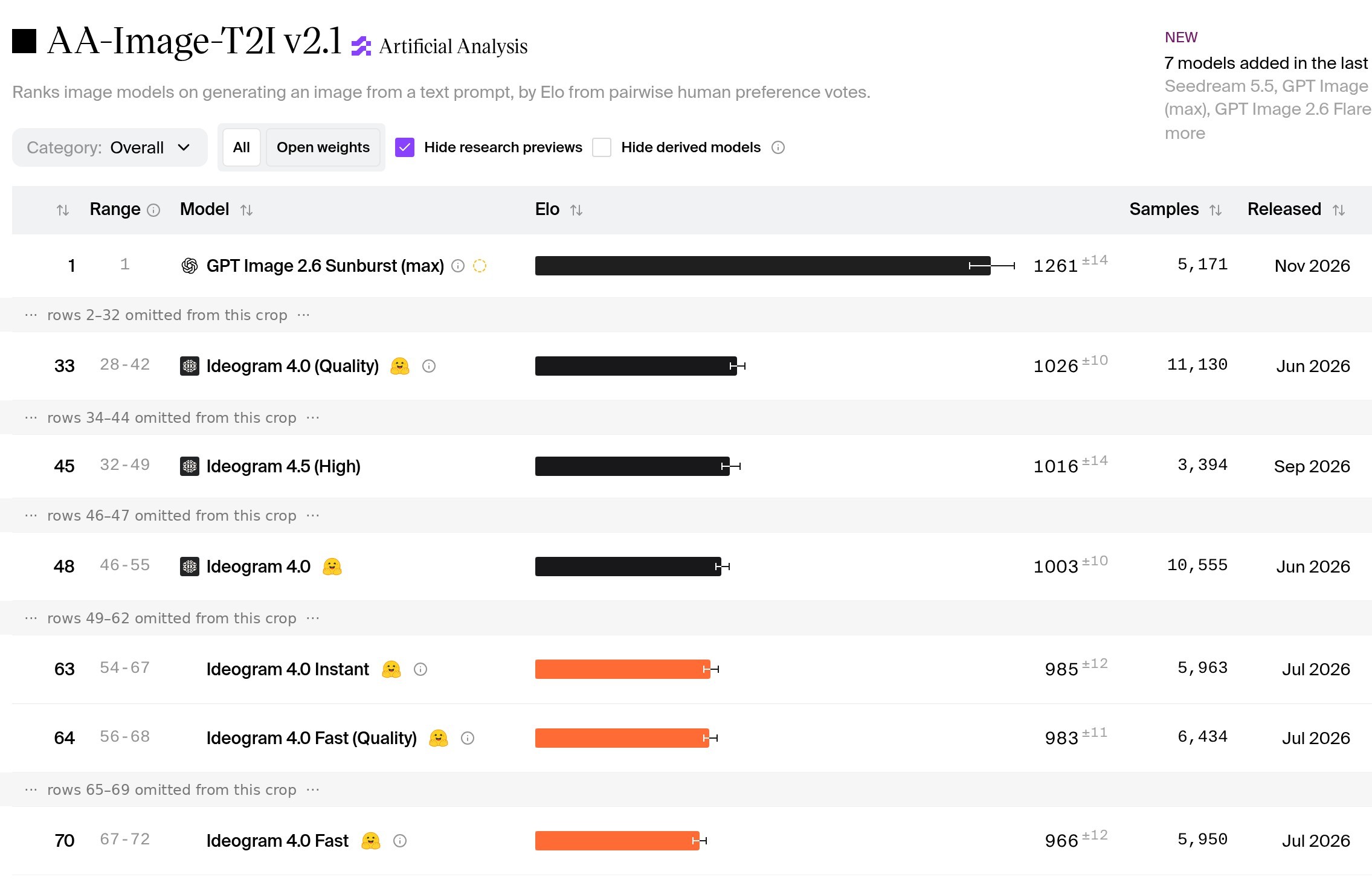
Source: Artificial Analysis, AA-Image-T2I v2.1 leaderboard, captured November 11, 2026.
On Artificial Analysis's text-to-image board, which ranks models by blind human votes, Ideogram 4.0 (Quality) sits at #33 with an Elo of 1026. That is 235 points behind the leader, GPT Image 2.6 Sunburst (max), on a board that scores whole images from general prompts rather than lettering.
On text, Ideogram's own chart puts 4.0 ahead of every other open-weight model on English OCR accuracy. In an independent blind test by Contra Labs, ten working designers compared four models, and Ideogram v4 won the most typography matchups.
How to Use Ideogram 4
Open Ideogram 4 and choose Ideogram 4.0 for text-to-image.
Pick the scenario first: logo, poster, ad, product visual or social cover.
Describe the subject, the text, the type style, colors, composition, use case, aspect ratio and mood.
Put each headline or date in quotes, then describe its style in its own sentence.
Generate several directions and review the text, layout and subject before style.
Refine the prompt, then finish the chosen design in Photoshop, Figma or Illustrator.
The site frames Ideogram 4.0 as a design starting point: you generate several usable directions from text prompts first, then refine, standardize and deliver them in your usual tools.
What's Still Unclear
Non-English text. The official OCR chart measures English, and comparable public numbers for Chinese or Japanese lettering are not out yet.
Preset trade-offs. Ideogram describes the 12-, 20- and 48-step presets but has not published side-by-side quality results.
Long copy. How many lines a poster can hold before accuracy drops has not been measured publicly.
About the Creator
Kling4 AI
Kling4 AI production notes, practical video editing workflows and visual references. https://kling4ai.io/
Enjoyed the story? Support the Creator.
Subscribe for free to receive all their stories in your feed.
Comments
There are no comments for this story
Be the first to respond and start the conversation.