
What Is Generative Engine Optimization (GEO) and Why Do You Need It in the AI Era?
A practical guide to Generative Engine Optimization and AI visibility growth


Search has not disappeared. It has changed shape. Instead of typing a keyword into Google and scanning a page of links, more buyers now ask AI tools to explain a topic, compare options, summarize vendors, or recommend a provider. That creates a new visibility problem for brands: it is possible to rank in traditional search and still be absent from the AI-generated answer that shapes the buyer’s shortlist.
That is where Generative Engine Optimization, often called GEO, comes in. GEO is the work of making a brand, website, content library, and wider online footprint easier for AI-powered search systems to find, understand, trust, cite, and recommend. It does not replace SEO. It builds on SEO, then expands the focus from rankings and clicks to mentions, citations, answer accuracy, competitor presence, and recommendation quality.
This guide explains what GEO means, why it matters in the AI era, what a serious GEO program should include.
What Is GEO?
Generative Engine Optimization is the practice of improving how a brand appears in AI-generated responses from systems such as ChatGPT, Perplexity, Gemini, Claude, Copilot, and Google’s AI-powered search experiences. The goal is not only to be discoverable. The goal is to be accurately understood and included when a user asks a question your brand is qualified to answer.
In traditional SEO, success is often measured by rankings, impressions, clicks, organic traffic, and conversions. In GEO, the measurement expands. A brand may track whether it is mentioned in AI answers, whether it is cited as a source, whether competitors appear more often, whether the answer describes the brand correctly, and whether the brand is recommended for the right use cases.
The academic paper that helped formalize the term GEO described optimization for generative engines as a way to improve visibility in generated responses. It also showed that different tactics work differently by domain, which is an important point: there is no universal GEO shortcut. A healthcare brand, SaaS company, fintech platform, and local service provider may all need different source strategies.
Why GEO Matters Now?
AI search compresses research. A user can ask one question and receive a synthesized answer that includes definitions, comparisons, recommendations, sources, and next steps. That is helpful for users, but it means brands may get fewer chances to make an impression before the buyer forms an opinion.
Google Search Central explains that AI Overviews and AI Mode may use query fan-out, which means the system can issue multiple related searches across subtopics and data sources to develop an answer. In plain English, the answer may be influenced by more than the exact phrase the user typed. It can draw from supporting pages, adjacent topics, and sources that help explain the broader issue.
For brands, this makes content depth and source coverage more important. A single landing page may not be enough. Your brand needs a clear website, consistent entity signals, strong supporting content, credible external references, and coverage across the real questions buyers ask before making a decision.
GEO vs SEO: What Actually Changes?
GEO and SEO overlap, but the success target is different. SEO helps your pages rank and earn traffic. GEO helps your brand become part of an answer.
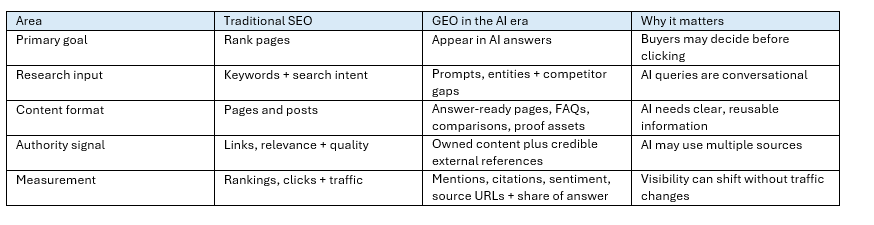
What a Strong GEO Program Should Include
A serious GEO program is not a one-time technical checklist. It is a visibility system. The best programs usually include the following components.
1. AI visibility benchmarking: Before changing content, a brand needs to understand where it appears today. That means checking mentions, citations, source URLs, sentiment, and competitor visibility across important prompts.
2. Competitor prompt-gap analysis: A score is useful only when compared against competitors. The important question is not simply “are we visible?” but “where are competitors being recommended while we are missing?”
3. Human prompt research: Tools can surface prompts and data, but human analysis decides which prompts are commercially relevant, which answers are misleading, and which gaps are worth prioritizing.
4. Entity and content clarity: AI systems need clear signals about what the company does, who it serves, what problems it solves, and how its services connect to related topics, people, products, and markets.
5. Technical SEO for AI discovery: Crawlability, indexation, structured data, page speed, internal links, canonicals, and clean rendering still matter. If key content cannot be accessed or understood, GEO work becomes harder.
6. Comparison content for AI answers: Buyers often ask AI systems to compare vendors, approaches, tools, and alternatives. Strong comparison content helps AI systems understand where a brand fits and when it should be recommended.
7. Reputable external references: Your own website is important, but third-party validation can strengthen credibility. Editorial coverage, expert commentary, customer stories, research, podcasts, and credible comparison guides can all support AI visibility.
8. Ongoing monitoring: AI answers change. A useful program tracks prompt coverage, cited sources, competitor presence, sentiment, and movement over time rather than treating GEO as a one-time audit.
Why Comparison Content Matters in GEO
Comparison content is one of the most practical GEO assets because AI users often ask decision-driven questions. They want to know which vendor is best for a use case, how two approaches differ, what alternative to consider, or which service is safest for a particular business situation.
Good comparison content is not a thin promotional page. It should define the options, explain the buyer’s decision criteria, show where each option fits, include a clear comparison table, address common objections, and support claims with credible evidence. For B2B brands, this content can also support sales teams because it helps prospects understand the category before a sales call.
The best version of this work combines owned comparison pages with external editorial comparison content. Owned pages explain the brand clearly. External content adds independent context and authority. When done ethically, this helps AI systems and human readers understand how a brand should be evaluated.
How to Choose a GEO vendor?
Because GEO is still developing, vendors package it in different ways. Some lead with SEO, some with digital PR, some with AI visibility software, and some with content strategy. The right choice depends on the gap you need to close.
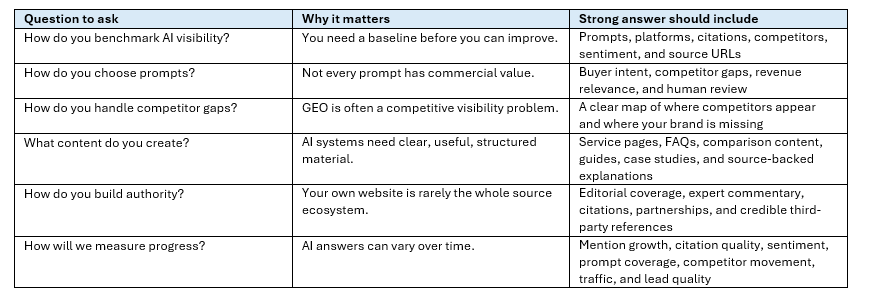
Top Generative Engine Optimization (GEO) Agencies for AI Visibility in 2026-2027
The following vendors are not presented as a definitive ranking. They are examples of agencies and service providers with public positioning around GEO, AEO, LLM SEO, AI visibility, technical SEO, content, digital PR, or related work. The best choice depends on your market, budget, internal team, and whether your biggest gap is technical, content-led, authority-led, or competitor-driven.
The most useful way to read this section is by fit, not hype.
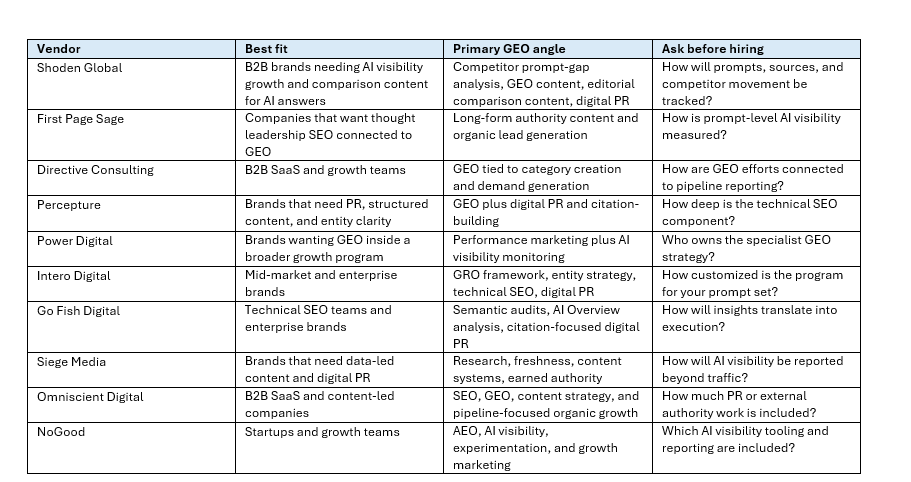
1. Shoden Global
Best for: B2B brands that need AI visibility growth in addition to powerful SEO and PR services that get results.
Shoden Global, is a strong fit when a company suspects competitors are being mentioned in AI answers while its own brand is missing. Shoden Global's core services focuses on AI visibility, LLM SEO, GEO, digital PR, and growth-focused marketing for B2B companies. The differentiator is the combination of benchmark analysis, human prompt review, competitor gap mapping, GEO-optimized comparison content, and editorial outreach supported by long-standing editor relationships. That makes it especially relevant for brands that need to be accurately positioned in recommendation and comparison-style AI answers.
Ask about: the prompt set, competitor benchmark, source map, editorial criteria, reporting cadence, and how comparison content will support commercial buyer journeys.
2. First Page Sage
Best for: companies that want GEO connected to long-form thought leadership and organic lead generation.
First Page Sage has long been associated with thought leadership SEO and publicly positions itself as a GEO provider. Its approach is likely most useful for businesses that need authoritative educational content, executive-level search presence, and a structured organic program. For organizations where buyers spend time researching complex topics before conversion, this kind of content-led authority can be valuable. The fit is strongest when GEO is expected to support a long-term search and lead-generation strategy rather than only short-term AI mention tracking.
Ask about: prompt-level monitoring, AI citation reporting, content refresh processes, and how GEO performance is separated from traditional SEO reporting.
3. Directive Consulting
Best for: B2B SaaS and growth-stage companies that want GEO tied to demand generation.
Directive Consulting has public positioning around GEO for B2B brands and describes the work in relation to generative search, category discovery, and AI-powered visibility. That makes it relevant for companies that already see organic search as part of pipeline creation. Directive’s strength is likely the ability to connect GEO with B2B content strategy, revenue pages, category positioning, and performance reporting. It may be a strong fit for software and technology companies that need AI visibility to support sales conversations, demo demand, and competitive positioning.
Ask about: how prompts are prioritized by pipeline value, how GEO content is mapped to buyer stages, and how citations or mentions are reported.
4. Percepture
Best for: brands that want public relations, structured content, and entity clarity in one GEO program.
Percepture positions its GEO services around AI-generated answers, structured data, entity optimization, and digital PR. That mix is useful because GEO is not only a website problem. A brand also needs consistent public signals that help AI systems understand who it is, what it does, and why it should be trusted. Percepture may be a good fit for expert-led brands, professional services firms, and organizations that need stronger credibility across third-party sources as well as owned pages.
Ask about: technical SEO depth, publication quality standards, source selection, and how PR activity is connected to prompt-level AI visibility.
5. Power Digital
Best for: brands that want GEO as part of a broader performance marketing strategy.
Power Digital publicly offers GEO services and connects the work to AI visibility, citation share monitoring, structured content, authority signals, and broader growth marketing. This can be useful for businesses that do not want GEO isolated from other channels. Companies with paid media, analytics, CRM, lifecycle marketing, and SEO already in motion may appreciate an integrated view. The trade-off with a broad agency is that buyers should confirm whether GEO is handled by specialists or mainly folded into an existing SEO workflow.
Ask about: who leads GEO strategy, which platforms are tracked, how citation share is measured, and how GEO connects to revenue reporting.
6. Intero Digital
Best for: mid-market and enterprise brands that need GEO, technical SEO, entity strategy, and digital PR together.
Intero Digital offers Intero GRO, a branded approach to Generative Response Optimization. Its public materials describe a mix of modern SEO, digital PR, entity-based content strategy, structured data, technical accessibility, multimedia content, and community engagement. That breadth can suit larger organizations that need multiple workstreams under one vendor. Intero is especially relevant when a brand needs stronger machine-readable clarity around products, services, expertise, and public authority across several discovery surfaces.
Ask about: how much of the program is customized to your competitor gaps, how source tracking works, and who owns implementation across technical, content, and PR teams.
7. Go Fish Digital
Best for: technical SEO teams, enterprise brands, and companies that need deeper AI search diagnostics.
Go Fish Digital has public GEO services and case-study content around AI Overviews, ChatGPT, Copilot, and AI Mode. Its positioning emphasizes making content retrievable, reference-worthy, and aligned with how AI systems ground responses. This is useful for brands that need semantic content audits, AI Overview analysis, technical improvements, and digital PR for brand citations. Go Fish Digital may be especially helpful when internal SEO teams need advanced diagnostics and a clearer bridge between technical SEO and AI-generated visibility.
Ask about: which AI answer surfaces are analyzed, how findings are prioritized, and how technical recommendations become content and authority-building actions.
8. Siege Media
Best for: brands that need data-led content, freshness, digital PR, and authority-building assets.
Siege Media frames GEO around content experiences that both people and large language models cite. Its public materials emphasize data journalism, digital PR, content updates, and content strategy technology. This makes it a strong fit for companies that need research-driven assets, high-quality content, and earned authority. Siege may be especially useful where the GEO problem is not technical weakness but a lack of content depth, original data, freshness, or external references that make the brand worth citing.
Ask about: how AI visibility is tracked, how content ideas are selected, and how digital PR outcomes are connected to prompts and citations.
9. Omniscient Digital
Best for: B2B SaaS and content-led companies that want GEO connected to pipeline, not just traffic.
Omniscient Digital publicly positions its work around B2B organic growth, SEO, GEO, and content. It is a logical fit for companies that need expert-led content strategy, bottom-of-funnel topic coverage, product-led narratives, and revenue-aware organic growth. Its minimum full-service engagement level also suggests a better fit for funded or growth-stage teams that can support a meaningful content and strategy program. Omniscient may be strongest where the brand already has product-market fit and needs a more mature AI search and content engine.
Ask about: external authority-building, content velocity, attribution expectations, and how AI visibility is measured alongside pipeline metrics.
10. NoGood
Best for: startups, scaleups, and growth teams that prefer an experimentation-led AEO and AI search model.
NoGood publicly markets Answer Engine Optimization services, which overlap with GEO in practice. Its positioning includes AI discovery across ChatGPT, Gemini, Perplexity, and related answer environments, as well as research, strategy, and technology through the Goodie platform. That makes NoGood a useful option for companies that want AI search visibility connected to a broader growth-marketing operating system. The fit is likely strongest when teams want rapid testing, channel integration, and performance learning rather than a purely editorial or technical SEO engagement.
Ask about: how AEO differs from GEO in their process, what tooling is included, and how recommendations are prioritized for execution.
A Practical GEO Roadmap for Brands
Step 1: benchmark your current AI visibility. Check whether your brand is mentioned, cited, accurately described, and recommended across the prompts that matter.
Step 2: compare against competitors. Your real gap is not just low visibility. It is the set of prompts where competitors appear and your brand does not.
Step 3: identify the source ecosystem. Look at the publications, communities, forums, videos, reviews, comparison guides, and websites that appear to influence AI answers in your niche.
Step 4: strengthen owned content. Create clear service pages, FAQs, glossary entries, case studies, comparison pages, expert profiles, and helpful guides that answer buyer questions directly.
Step 5: build comparison content for AI answers. Develop X vs Y pages, alternative pages, category comparisons, buyer decision guides, and editorial comparison pieces that explain where your brand fits.
Step 6: earn credible third-party references. Use digital PR, expert commentary, partnerships, and editorial relationships to build trustworthy external context around your brand.
Step 7: measure and adjust. Track mentions, citations, sentiment, source URLs, competitor movement, prompt coverage, traffic, and lead quality over time.
Common GEO Mistakes to Avoid
· Treating GEO as a magic trick instead of an extension of strong SEO, content, and authority-building.
· Creating generic articles that do not answer real buyer prompts.
· Looking at your own AI visibility without benchmarking competitors.
· Trying to appear for every possible prompt instead of prioritizing prompts that influence buying decisions.
· Publishing comparison content that is so biased it loses credibility.
· Ignoring third-party sources that AI systems and human buyers already trust.
· Measuring only traffic while ignoring mentions, citations, sentiment, and answer quality.
· Assuming one platform’s answer represents the whole market.
Final Thoughts
GEO matters because AI search changes where decisions begin. A buyer may not search, click, compare, and then contact a vendor in the traditional order. They may ask an AI system for the shortlist first. That makes brand visibility inside generated answers a practical business issue, not just a marketing trend.
The brands that benefit most from GEO will not be the ones that publish the most generic content. They will be the ones that make their expertise clear, answer buyer questions directly, build trustworthy external references, understand competitor prompt gaps, and keep improving based on what AI systems actually say.
For companies evaluating vendors, the right question is not “who has the loudest AI search claim?” It is “who can show us where we are invisible, explain why competitors are being recommended, build the right content and authority signals, and measure whether we are becoming easier to mention, cite, and recommend?”
About the Creator
J. weizenblut
Jacobo Weizenblut is the CEO of TradingADR.com. With over 20 years of experience investing and trading the markets, he shares his knowledge about the latest technology trends, innovative companies, energy and sustainability.
Enjoyed the story? Support the Creator.
Subscribe for free to receive all their stories in your feed.
Comments