
What Agent Opus’s Brand Intelligence Feature Says About the Future of AI Video
A new feature aims to turn one website link into a reusable brand identity for AI-generated video

Disclosure: This article was created with assistance from OpenAI and reviewed and edited by the author. Images are sourced from official Agent Opus / OpusClip resources.
Give a tool an idea, a few lines of text, or a script, and it can produce something that would once have required a writer, designer, editor, and hours of production time.
But speed has introduced a different problem.
The finished video may look polished, yet still feel disconnected from the business behind it. The colours are unfamiliar. The product images are inconsistent. The message sounds generic. A viewer might understand the video, but they may not remember who created it.
Agent Opus has announced a new feature designed to address that gap.
It is called Brand Intelligence, and it allows the AI video platform to build and remember a profile of a brand. Users can provide a website URL, describe their business in plain language, or enter their brand information manually. Agent Opus then uses that context when creating future videos.
The feature reflects a wider change in AI content creation. Generating one piece of content is no longer enough. Creators and businesses increasingly need AI systems that can remember who they are and apply that identity consistently.
What Is Agent Opus?
Agent Opus is an AI video creation platform developed by the team behind OpusClip.
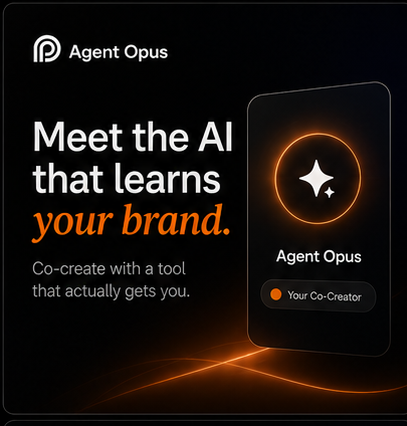
Although the names are closely connected, the products have different roles.
OpusClip is best known for editing and repurposing existing video footage, such as turning a long interview, webinar, or podcast into shorter clips.
Agent Opus focuses on creating videos from ideas, scripts, audio, articles, links, and brand materials. The platform can help assemble the script, visuals, voiceover, pacing, and other production elements into a finished video.
Possible formats include product advertisements, explainers, educational videos, promotional content, social media posts, and brand stories.
Brand Intelligence adds reusable brand context to that process.
What Does Brand Intelligence Do?
According to the product announcement, users can give Agent Opus a website or product link. The platform then attempts to collect the brand information already available on that page.
This may include:
Logos
Product photographs
Website images
Brand colors
Visual style
Information about the business
Its likely target audience
The message the brand wants to communicate
Agent Opus uses that information to create a brand brief and custom visual direction.
Once the profile is saved, the user can select it when generating a new video. The goal is to avoid repeatedly uploading the same logo, attaching the same product images, and explaining the same visual preferences for every project.
That may sound like a small improvement. For anyone creating content every week, however, repeated setup can become a significant source of friction.
Three Ways to Create a Brand Profile
Agent Opus gives users three ways to add a brand to its Brand Library.
Share a Website or Product Link
The first method is the most automated.
A user provides a website URL or product page, and Agent Opus gathers the available visual and written information.
For an online shop, that page may already contain product photographs, colours, descriptions, customer language, and key selling points. Instead of organising those materials into a separate creative brief, the website becomes the starting point.
This approach could be useful for small businesses that have a functioning website but no formal brand document.
Describe the Brand in Plain Language
The second option allows users to explain the brand in their own words.
A creator might describe the business as warm, modern, encouraging, and designed for first-time entrepreneurs. A sustainable product company might explain that its communication should feel calm, trustworthy, and grounded in nature.
This information can add context that may not be obvious from a website alone.
A homepage can show what a company sells. It does not always explain how the brand wants people to feel.
Enter the Information Manually
The third method gives the user direct control over the brand brief.
This may suit businesses with detailed guidelines, strict visual rules, several product categories, or specific language requirements.
Manual setup is also useful when a website contains outdated assets or when the identity used for one campaign differs from the company's general appearance.
These three methods acknowledge a practical reality: not every business has the same level of brand organisation. Some have a complete style guide. Others have only a website and an idea of how they want to be perceived.
Why Does Consistency Remain Difficult With AI Video?
AI video tools are often evaluated by the quality of a single generation.
Does the motion look natural? Is the voice convincing? Are the visuals sharp? Does the video hold attention?
Those questions matter, but brands face another challenge: what happens across the next ten, twenty, or fifty videos?
One generation may be minimal and elegant. Another may use bright colours and energetic graphics. A third may introduce a completely different tone. Each video can look professional on its own while the collection feels inconsistent.
That weakens recognition.
People rarely remember a brand after seeing one piece of content. Familiarity develops when the same visual language, message, and personality appear repeatedly.
For a small business, maintaining that consistency can require a surprising amount of manual work. Someone must choose the images, check the colours, review the script, correct the tone, and confirm that every visual belongs to the same identity.
A saved brand profile could reduce part of that workload by giving the AI a stable reference for each new project.
A Website Can Become a Creative Brief
One of the most interesting ideas behind Brand Intelligence is the use of a website URL as an input.
A traditional video project usually begins with a creative brief. The document may contain logos, approved colours, audience information, product photographs, campaign goals, and key messages.
Creating that brief takes time, and many independent creators or small companies do not have one.
They often have the necessary information, but it is distributed across product pages, an About section, social profiles, and folders of visual assets.
Agent Opus is attempting to convert the website itself into a structured starting point.
One link could lead to a collection of visual assets, a colour palette, audience assumptions, and a reusable brand profile. That profile could then inform advertisements, explainers, social videos, and other content formats.
The idea is compelling because it works with material a business may already have.
It also reveals an important limitation: the quality of the profile will depend on the quality of the source.
If a website contains old photographs, inconsistent colours, unclear messaging, or products that are no longer available, the AI may begin with the wrong information.
Automation can organise what it finds. It cannot decide whether the material still represents the business accurately.
Brand Identity Goes Beyond Logos and Colours
Brand Intelligence appears to focus on both visual and strategic information, but a brand is difficult to reduce to a collection of assets.
Identity also comes from point of view, language, values, customer experience, cultural context, and the reasons people trust a business.
Two companies can use similar colours and still feel completely different.
An AI system may identify a logo, extract a palette, and summarise a target audience. Understanding the emotional qualities of a brand is a harder task.
A company might want to sound confident without becoming aggressive, playful without feeling careless, or luxurious without appearing inaccessible. These distinctions are subtle, and they are not always visible on a product page.
That is why human review remains necessary.
The generated brand profile should be treated as a working interpretation. Businesses still need to check whether the AI has understood their audience, values, and message correctly.
What This Could Mean for Creators and Small Businesses
For large companies, branding is often supported by designers, strategists, editors, and detailed guidelines.
Independent creators and small businesses may have to manage all of those responsibilities themselves.
They are expected to publish consistently, create video content, maintain a recognisable identity, and adapt that content for several platforms. At the same time, they may also be handling sales, customer support, product development, and administration.
Repeated creative decisions create fatigue.
Which logo file should be used? Which shade of green is correct? Which product photograph is current? How should the message sound? Who is the video intended to reach?
A reusable brand profile could answer some of those questions before production begins.
A skincare company could create several product videos that use the same visual atmosphere. A consultant could turn written ideas into educational videos with a recognisable style. A software company could produce feature explainers that feel connected to the rest of its marketing.
Different videos could serve different purposes while still belonging to the same brand.
From One-Off Tools to AI Systems With Memory
Brand Intelligence also points to a broader direction in creative AI.
Early tools operated mainly through isolated prompts. A user entered an instruction, received an output, and started again for the next task.
That model works for experimentation. It becomes inefficient when AI is part of an ongoing business workflow.
People do not want to explain their company from the beginning every time they create a video. They want the system to retain useful context: the audience, approved visuals, tone, products, and communication style.
Persistent context may become one of the most valuable differences between a novelty generator and a practical creative system.
The more accurately an AI tool can remember the rules around the work, the less time the user spends rebuilding the same foundation.
The Questions That Will Determine Its Value
The announcement presents an interesting concept, but its practical value will depend on how the feature performs with real businesses and imperfect websites.
Several questions remain:
How accurately can it interpret different website structures?
Can users easily correct a mistaken brand profile?
How well can it understand tone of voice?
Can it separate several product lines on the same website?
Does the visual identity remain consistent across different video formats?
How does it handle detailed or restrictive brand guidelines?
What happens when the source website contains conflicting information?
These questions are not criticisms of the idea. They describe the difficult work involved in turning brand identity into usable AI context.
The strongest version of this feature would not simply copy colours and images. It would give users a clear, editable profile and enough control to correct what the AI misunderstands.
What Comes Next for Branded AI Content?
The first stage of generative AI focused on whether machines could create text, images, music, and video.
The next stage is becoming more personal and contextual.
Can an AI system remember the user? Can it understand a business? Can it apply the same identity across different pieces of content without making everything feel repetitive?
Agent Opus Brand Intelligence is one response to those questions.
Its promise is not limited to faster video production. The more meaningful possibility is that AI-generated content could feel less generic and more connected to the person or company publishing it.
Whether the feature achieves that consistently will depend on accuracy, control, and the quality of its output. But the direction is significant.
Businesses increasingly need AI tools that understand whose story they are helping to tell.
About the Creator
Oana Matei
Digital marketer & AI consultant with a Google Digital Marketing & E-commerce Certificate.
I explore the intersection of technology, artificial intelligence, and business strategy — turning complex ideas into clear, actionable insights.
Enjoyed the story? Support the Creator.
Subscribe for free to receive all their stories in your feed.
Comments
There are no comments for this story
Be the first to respond and start the conversation.