
What a Trader Saw When He Stopped Chasing the Tape
Leo Carter built the perfect AI infrastructure map—until the market left every model behind.
In November of last year, Leo Carter slammed his half‑empty bourbon, no ice, onto the oak bartop. Bourbon splashed onto the brass coaster. He said to his colleague Max, “Victor Hartman is an idiot.” Max didn’t answer. He just stared at Nvidia’s intraday chart on the TV behind the bar. The line had been flat for six straight weeks, like a dead snake.
Leo’s reasoning was solid at the time: you couldn’t call a top just by reading depreciation games off a few financial reports and dusting off some Pets.com jokes from the dot‑com bubble. It was too early. He’d run over a dozen field visits to San Jose and Austin. He’d seen row after row of racks still being populated, the busbars feeding those GPUs not yet too hot to touch. And the market had validated him. After that pullback, the Nasdaq went sideways right alongside Nvidia. Leo felt his judgment was confirmed. He even wrote a line in his Christmas client memo: “The bubble theorists lack on‑the‑ground feel.” When he cc’d the distribution list, he deliberately skipped Victor Hartman’s name.
By mid‑January, things started coming apart at the bone.
It began with the optical stocks and memory chips. People with their eyes burned red by FOMO shoved Coherent and Broadcom straight up. Leo cursed at his screen that day, then turned around and opened more AI infrastructure longs. He built those positions with an almost retaliatory precision: in connectivity, he took Lumentum, Credo, Semtech; on the PCB side, TTM Technologies; for liquid cooling, Comfort Systems; on the power side, he cut into GE Vernova and Vertiv, with Bloom Energy already sitting quietly in the green from an earlier entry. He also bet on the power‑semiconductor names Monolithic Power and Navitas, and even layered in the more obscure Rockwell Automation—he called this his “AI factory” bucket. Together with AMD and TSMC, the whole portfolio was showing over fifty percent in unrealized gains before the U.S.–Iran conflict sell‑off hit in late January.
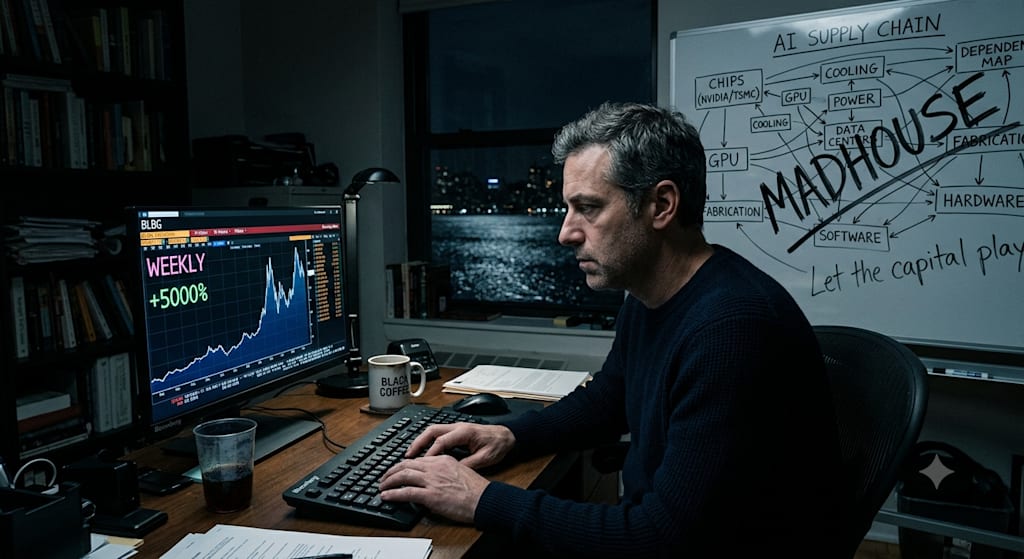
Leo was in good shape during those weeks. He ran every day. His trading journal was restrained and specific. The whiteboard in his office held a dependency map of the AI infrastructure value chain, every link annotated, from copper foil to cold plates to full racks. He didn’t want a single name to spike violently because of a supply shortage. He wanted the whole chain to rise together, like a tide. When he dipped a light test position into Lumentum, he thought the valuation was already stretched. He put on just a test sliver, planning to add on a pullback. Lumentum never gave him one. It doubled in six weeks.
Leo stood in front of his Bloomberg terminal, his right thumb jabbing the page‑down key, zooming Lumentum’s daily chart out, then in, then out again. Finally, he let go of the keyboard. His thumb had pressed a white crease into the knuckle of his index finger. He didn’t add. He didn’t chase. After the close that day, he wiped the Lumentum row off his whiteboard and wrote a single word next to it in marker: Madhouse.
What made him decide to walk away, really walk away, was the move in SanDisk after April. SanDisk had done one‑seventy from the start of the year through late February. From April through late June, it did another three hundred percent. At its highs for the year, it was up eight‑fifty from January. Measured from last August, less than a year, it was up five thousand percent. Leo saw that number at two in the morning on a Wednesday. He was sitting in his home study, the cold light of the screen on his face, a mug of coffee gone completely cold at his elbow. He dragged SanDisk’s weekly chart from end to end three times, then closed the trading software and opened Word. He started composing the liquidation notes to his clients, one by one.
He wasn’t angry. He wasn’t panicked. It felt closer to a model whose training set had been polluted by noise. He knew that if he kept running his own parameters would drift beyond recognition. He could hand the short‑term scalping to the execution‑agent scripts he’d written long ago. But a human brain couldn’t force decisions in this kind of tape—that was how you rotted from the inside. From mid‑April into early May, he cleaned out his AI positions linked to the Dell supply chain one after another: GE Vernova at a swing high, Credo during the week of peak volume, and he didn’t even leave the core position in Rockwell. After the last fill confirmed, he added another line next to Madhouse on the whiteboard. The handwriting was faint, like something meant only for himself: Let the capital play.
From that day on, he found himself standing on the same side as Victor Hartman.
Hartman began adding to his short in mid‑June. When Leo saw the position disclosure on his terminal, his first instinct wasn’t mockery. Instead, he pulled up Hartman’s last three investor letters and read them, word for word. Hartman’s core logic was practically the same set of arguments Leo had been pulling apart in his own Substack column: AI infrastructure was barreling down one road with the pedal floored, while AI adoption was still darting around like Meta’s R&D teams, scrambling in every direction with no clear vector. That mismatch couldn’t support current prices. What unsettled Leo even more was the so‑called physical AI: robotics, embodied intelligence. The very areas that should have been accelerating were instead getting squeezed to the margins by the black‑hole capex of the datacenter supply chain, not pushed forward.
By June, the semiconductor market was already sending signals of technical fragility—several historic single‑day swings like stress fractures before the break. Leo stared at the intraday volatility table of the Philadelphia Semiconductor Index for a long time. Then he sent Max a message: “They can’t squeeze him this time.” Max replied with a question mark. Leo didn’t explain further.
Where the tape had arrived, in his view, had nothing left to do with trading. From the president to tech CEOs to the million‑follower accounts on X, everyone was pumping, everyone was shilling. Every single one of them, if you opened their mental ledger, was angling for their own exit liquidity. Leo didn’t want a cut of it. He just wanted the market to return to a state where a trader could breathe normally again.
He thought about Meta’s capex guidance from this year, and then the numbers Microsoft, Google, and Amazon had piled on top of it. His fingers tapped the desk twice, very lightly, like knocking on a failing hard drive. The way these giants were torching capital, they were borrowing against a future credit line. A portion of that money was his, too, from participants like Leo Carter, flowing in silently through ETFs, through pensions, through the whole circulatory system of the financial system.
On the first Monday of July, Leo walked into his office. The Hudson River outside the window had been hammered into broken tin foil by the morning light. He glanced at the whiteboard on the wall. Madhouse and that faint line were still there. He picked up the eraser. He didn’t wipe anything away. Instead, in the lower‑left corner, he added a small line in green marker: Short aligned to Hartman position, not exceeding 4% of total portfolio. Then he sat back down at his desk, opened the Bloomberg, and pulled up the PDF of Victor Hartman’s latest 13F filing. He flipped to the last page and circled a small line with his cursor: AI capex payback period. Next to it, a handwritten annotation. A single word: eventually.
Leo raised his first black coffee of the morning. No sugar, no milk. He touched the rim of his mug against that line on the screen, a soft clink of ceramic against the monitor’s edge, a short, muffled sound—like a circuit breaker closing somewhere in the distance.
About the Creator
Jin
Writer of reamstories
https://reamstories.com/jin
Enjoyed the story? Support the Creator.
Subscribe for free to receive all their stories in your feed. You could also become a paid subscriber, letting them know you appreciate their work.
Comments
There are no comments for this story
Be the first to respond and start the conversation.