
Waterjet Cutting Machine Market Set to Reach USD 1.38 Billion by 2033 as Precision Manufacturing Drives Global Demand
Heat-free cutting technology, automation, sustainability initiatives, and growing industrial applications are accelerating growth across aerospace, automotive, electronics, and metal fabrication industries worldwide.

The global manufacturing landscape is undergoing a profound transformation. As industries seek greater precision, sustainability, and efficiency, advanced cutting technologies have become essential tools in modern production facilities. Among these technologies, waterjet cutting machines have emerged as one of the most versatile and reliable solutions for processing a wide variety of materials.
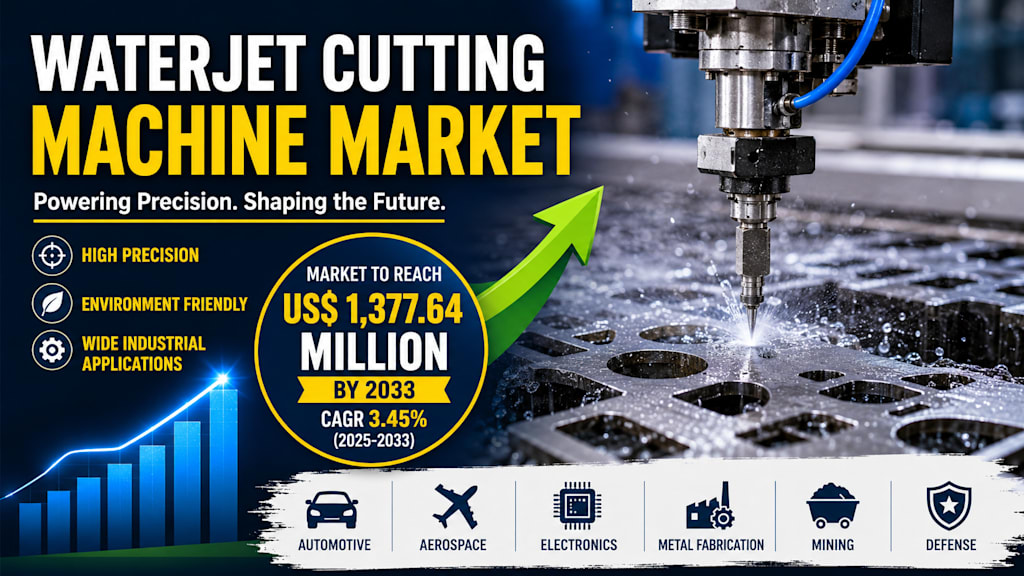
According to Renub Research, the global Waterjet Cutting Machine Market is projected to grow from US$ 1,015.22 million in 2024 to US$ 1,377.64 million by 2033, expanding at a CAGR of 3.45% during the forecast period from 2025 to 2033.
The steady growth reflects rising industrialization, increasing demand for precision manufacturing, and continuous technological advancements that are making waterjet systems more efficient, automated, and environmentally sustainable.
Understanding Waterjet Cutting Technology
Waterjet cutting machines utilize highly pressurized streams of water, sometimes combined with abrasive materials, to cut through various substances. Unlike traditional cutting methods that generate significant heat, waterjet technology performs cutting without thermal distortion.
This capability makes waterjet cutting particularly valuable when working with heat-sensitive materials such as aluminum, titanium, composites, glass, ceramics, plastics, and specialty metals.
The technology offers manufacturers several advantages:
Exceptional cutting precision
No heat-affected zones
Minimal material wastage
Capability to cut intricate shapes
Compatibility with multiple materials
Environmentally friendly operation
These benefits have positioned waterjet cutting as a preferred solution in industries requiring high-quality finishes and strict dimensional tolerances.
Industrial Expansion Creating New Opportunities
The rapid pace of global industrialization remains one of the strongest growth drivers for the waterjet cutting machine market.
Emerging economies continue investing heavily in manufacturing infrastructure, industrial parks, and production facilities. As factories modernize their operations, demand for advanced machining technologies continues to rise.
Industrial sectors increasingly require cutting systems capable of processing diverse materials while maintaining high productivity standards. Waterjet cutting machines fulfill these requirements by delivering flexibility, speed, and accuracy.
The expansion of smart factories and Industry 4.0 initiatives has further strengthened demand for intelligent cutting solutions integrated with digital manufacturing systems.
Automotive Industry Accelerates Adoption
The automotive sector represents one of the most important end-use industries for waterjet cutting technology.
Vehicle manufacturers utilize waterjet machines for producing:
Brake discs
Gaskets
Interior components
Structural parts
Decorative trims
Composite materials
Electric vehicle components
Modern vehicles require increasingly complex designs and lightweight materials to improve fuel efficiency and performance. Waterjet cutting machines provide manufacturers with the flexibility needed to process these advanced materials without compromising quality.
The rise of electric vehicles is expected to create additional opportunities, as EV production often involves lightweight composites and specialized materials that benefit from heat-free cutting processes.
Aerospace Industry Demands Precision
Aerospace manufacturers operate under some of the most stringent quality requirements in the world.
Aircraft components frequently involve expensive materials such as titanium alloys, carbon fiber composites, and specialized metals. Any thermal damage or dimensional inaccuracy can result in costly losses.
Waterjet cutting technology addresses these challenges by enabling precise cuts without altering material properties.
Applications include:
Turbine components
Jet engine parts
Aircraft structural elements
Composite panels
Defense equipment
Missile components
Spacecraft assemblies
As global air travel expands and defense budgets increase, demand for precision manufacturing solutions is expected to remain strong.
Growing Importance of Heat-Free Cutting
One of the most compelling advantages of waterjet cutting technology is its cold-cutting process.
Traditional cutting methods such as plasma, laser, and oxy-fuel cutting generate heat that may alter material properties. Heat can create warping, discoloration, microcracks, and structural weaknesses.
Waterjet cutting eliminates these concerns.
Manufacturers working with delicate materials increasingly prefer waterjet systems because they preserve the original characteristics of the workpiece while maintaining excellent surface quality.
This benefit becomes especially important in industries where performance, safety, and reliability are critical.
Environmental Sustainability Becomes a Competitive Advantage
Environmental responsibility is becoming a major factor influencing industrial purchasing decisions.
Governments worldwide continue introducing stricter regulations regarding emissions, waste generation, and energy efficiency. Manufacturers are therefore seeking production technologies that support sustainability objectives.
Waterjet cutting offers several environmental benefits:
Reduced material waste
Minimal airborne contaminants
Lower chemical usage
Recyclable water systems
Reusable abrasive materials
Reduced post-processing requirements
As corporate sustainability programs become more important, environmentally friendly manufacturing technologies are likely to experience greater adoption.
Technological Innovation Reshaping the Industry
Continuous innovation remains a defining characteristic of the waterjet cutting machine market.
Manufacturers are introducing advanced systems featuring:
Robotic Waterjet Cutting
Robotic integration enables automated cutting operations with greater flexibility and efficiency. Robots can handle complex geometries while reducing manual intervention.
3D Waterjet Cutting
Three-dimensional cutting capabilities allow manufacturers to process intricate components used in aerospace, automotive, and industrial applications.
Micro Waterjet Cutting
Micro waterjet systems deliver ultra-high precision for electronics, medical devices, and advanced manufacturing applications.
Smart Manufacturing Integration
Modern machines increasingly incorporate:
CAD/CAM integration
Real-time monitoring
Predictive maintenance
Remote diagnostics
Artificial intelligence optimization
These advancements improve productivity while reducing downtime and operational costs.
Challenges Facing Market Growth
Despite strong growth prospects, the industry faces several challenges.
High Initial Investment
Waterjet cutting systems require significant capital expenditure.
Depending on specifications and capabilities, machine costs can range from approximately US$100,000 to over US$350,000.
For small and medium-sized manufacturers, these investments may represent a substantial financial commitment.
Ongoing Operating Costs
Abrasives, maintenance components, replacement parts, and energy consumption contribute to operational expenses.
Companies must carefully evaluate total ownership costs when considering waterjet technology adoption.
Maintenance Requirements
Regular maintenance is essential to ensure optimal performance.
Components such as nozzles, seals, pumps, and intensifiers require periodic servicing to prevent productivity losses and unexpected downtime.
Effective maintenance programs remain crucial for maximizing equipment lifespan and operational efficiency.
Regional Market Outlook
North America
North America continues to dominate the global waterjet cutting machine market due to its advanced manufacturing ecosystem.
Strong aerospace, automotive, defense, and metal fabrication industries support consistent demand for precision cutting technologies.
The United States remains the largest regional contributor, benefiting from ongoing investments in industrial automation and advanced manufacturing.
Europe
Europe maintains a significant market share driven by Germany, France, Italy, and the United Kingdom.
The region's emphasis on engineering excellence, sustainability, and industrial innovation supports steady adoption of waterjet technologies.
German manufacturers, in particular, continue investing in advanced cutting solutions to maintain global competitiveness.
Asia-Pacific
Asia-Pacific represents one of the fastest-growing regional markets.
China, India, Japan, and South Korea continue expanding their manufacturing capabilities, generating substantial demand for efficient cutting technologies.
Government initiatives promoting industrial modernization and domestic manufacturing further strengthen regional growth prospects.
Middle East and Africa
Industrial diversification efforts in countries such as the United Arab Emirates and Saudi Arabia are creating new opportunities for advanced manufacturing equipment providers.
Infrastructure development and growing industrial activity are expected to contribute to future market expansion.
Future Outlook
The future of the waterjet cutting machine industry appears promising.
Manufacturers increasingly require technologies capable of delivering precision, flexibility, and sustainability simultaneously. Waterjet systems meet these demands while supporting the broader transition toward smart manufacturing environments.
The combination of industrial growth, technological innovation, environmental awareness, and rising demand for advanced materials processing is expected to create favorable conditions for continued market expansion through 2033.
As automation and digitalization reshape global manufacturing, waterjet cutting machines will likely play an increasingly important role in helping companies achieve greater efficiency, product quality, and operational competitiveness.
10 Recent Developments by Leading Companies
1. WECJet – July 2024
WECJet introduced a new Mach 500 waterjet cutting machine featuring advanced 90,000 PSI dynamic head technology, significantly enhancing cutting speed and precision.
2. WAZER – November 2023
WAZER partnered with TriMech to expand distribution of its desktop CNC waterjet cutter, bringing industrial-grade cutting technology to smaller manufacturers and educational institutions.
3. Hypertherm
Hypertherm continued expanding automation capabilities across its cutting solutions portfolio, focusing on integrated manufacturing environments.
4. Lincoln Electric Holdings
Lincoln Electric strengthened its advanced fabrication solutions strategy through investments in automated cutting and manufacturing technologies.
5. KMT GmbH
KMT enhanced high-pressure pump technologies aimed at improving efficiency and reliability in industrial waterjet applications.
6. Jet Edge Inc.
Jet Edge expanded its precision cutting solutions portfolio to address growing demand from aerospace and heavy industrial sectors.
7. Dardi International Corporation
Dardi continued introducing advanced abrasive waterjet systems designed for improved productivity and operational efficiency.
8. Koike Aronson Inc.
Koike Aronson expanded its manufacturing solutions portfolio with enhanced cutting technologies targeting metal fabrication industries.
9. A. Innovative International Limited
The company increased focus on customized waterjet cutting systems to support diverse industrial applications globally.
10. Colfax Corporation
Colfax maintained investments in industrial engineering solutions, supporting technological advancements across precision manufacturing markets.
Final Thoughts
Waterjet cutting technology has evolved from a niche manufacturing solution into a critical component of modern industrial production. Its ability to deliver unmatched precision while preserving material integrity positions it as one of the most valuable cutting technologies available today.
With the global market expected to surpass US$1.37 billion by 2033, supported by aerospace expansion, automotive innovation, industrial automation, and sustainability initiatives, waterjet cutting machines are poised to remain at the forefront of advanced manufacturing for years to come.
About the Creator
Enjoyed the story? Support the Creator.
Subscribe for free to receive all their stories in your feed.
Comments
There are no comments for this story
Be the first to respond and start the conversation.