
Water & Wastewater Treatment Market Set for Strong Expansion as Utilities, Industry, and Governments Accelerate Upgrades
From membrane filtration and smart monitoring to stricter discharge rules and water scarcity pressures, the global water & wastewater treatment industry is moving from a compliance story to a long-term infrastructure growth story.

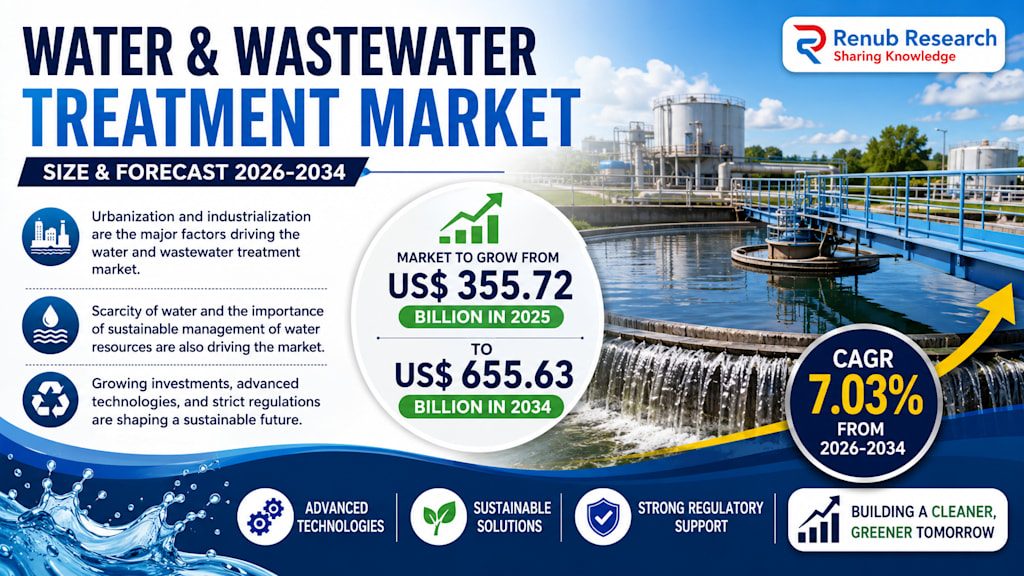
The global water & wastewater treatment market is entering a decisive growth phase. According to Renub Research, the market is projected to rise from US$ 355.72 billion in 2025 to US$ 655.63 billion by 2034, expanding at a CAGR of 7.03% from 2026 to 2034. That scale of growth reflects a market that is no longer driven by a single factor, but by a powerful combination of urbanization, industrial expansion, water scarcity, sustainability pressure, and the need for modern treatment infrastructure.
Market Outlook
At its core, the market is being shaped by a simple reality: clean water is becoming harder to secure, while wastewater volumes continue to rise. The report notes that half the world’s population may live in water-scarce regions as early as 2025, with severe scarcity capable of displacing around 700 million people and extremely high water stress affecting one in four children globally by 2040. That backdrop is pushing governments, utilities, and industries to invest more aggressively in treatment, recycling, and reuse systems.
Growth Drivers
The opportunity is also being reinforced by tighter environmental regulation. Governments and international bodies are increasingly requiring industries and municipalities to treat wastewater before discharge, while also responding to emerging contaminants such as microplastics and pharmaceuticals. In other words, water treatment is no longer only about availability; it is also about compliance, environmental responsibility, and long-term resilience.
Technology is adding a second layer of acceleration. The report highlights membrane bioreactors, reverse osmosis, UV treatment, IoT-based monitoring, and AI-enabled digital water tools as major enablers of efficient and lower-cost water management. These systems are helping cities address leakage, reduce losses, and improve operational visibility, while also making treatment plants more precise and sustainable.
Challenges
The challenge, however, is that this is an expensive business. Advanced systems such as desalination plants, membrane filtration units, and smart monitoring platforms require heavy upfront investment, and operating costs can rise further with energy price volatility. This is why many developing countries still struggle to modernize infrastructure quickly enough, even though demand is rising faster than ever.
Market Segmentation
From a product perspective, the market is broad and layered. The chemicals side includes pH conditioners, coagulants, flocculants, disinfectants, biocides, scale and corrosion inhibitors, and antifoam chemicals. The equipment side includes membrane separation, biological treatment, disinfection, sludge treatment, and other systems. On the demand side, municipal and industrial applications both matter, but the municipal segment is especially important because city growth continues to increase pressure on potable water supply and sewage management.
Among the technology categories, membrane separation continues to stand out because it delivers high-quality water output in a compact footprint with lower chemical dosing requirements. Biological treatment remains attractive as well because it is cost-effective, sustainable, and well suited to sewage disposal and industrial wastewater management. Together, these two approaches are central to the next phase of treatment plant upgrades worldwide.
Regional Insights
Regionally, the market story looks different in each major geography. In the United States, the opportunity is tied to strict regulation, aging infrastructure, PFAS concerns, and the need for modernization. In the United Kingdom, the story is shaped by high environmental standards, carbon reduction targets, and a clear shift toward digital water management. India is growing rapidly because of water scarcity, industrial wastewater pressures, and public investment in sanitation and recycling. Saudi Arabia stands out because of severe water shortage, desalination dependence, and rising reuse demand for agriculture and industry.
The United States continues to be a strong upgrade market. The report points to strict water-quality regulation, aging assets, and industry adoption across oil and gas, pharmaceuticals, and manufacturing. It also mentions California American Water’s screen replacement project at the Carmel Valley Ranch wastewater treatment plant, a practical example of how utilities are using targeted upgrades to improve efficiency and reduce energy costs.
The United Kingdom is seeing a similar, but more regulation-led, transition. Utility providers are under pressure to meet stricter discharge rules and improve environmental performance, which is why digital monitoring and membrane-based systems are gaining importance. The report’s example of United Utilities choosing DuPont Water Solutions for MemCor membrane bioreactor systems underlines how expansion projects are becoming a direct route to market growth.
India’s trajectory is especially compelling because it combines public policy, industrial growth, and decentralization. The brief highlights demand from textiles, chemicals, and pharmaceuticals, along with a growing trend toward cost-effective decentralized wastewater systems for rural and semi-urban areas. The BWSSB initiative in Bengaluru also signals a wider shift: utilities are beginning to open treatment assets to startup-led recycling innovation.
Saudi Arabia represents a different growth model altogether. Water scarcity is so severe that desalination remains foundational, while wastewater reuse is becoming strategically important for agriculture and industry. The report’s mention of GI Aqua Tech preparing to export an industrial wastewater treatment plant using nanotechnology shows how the region is leaning into advanced treatment methods to solve a structural water challenge.
Recent Company Developments and Watchpoints
KETOS and Siemens joined forces in January 2025 to improve water-quality solutions and strengthen water management practices across municipal and industrial markets.
California American Water completed a screen replacement project at the Carmel Valley Ranch wastewater treatment plant, a move aimed at lowering energy bills and improving plant efficiency.
United Utilities selected DuPont Water Solutions in February 2026 to supply MemCor membrane bioreactor systems for three wastewater treatment plant expansions. The objective is higher capacity, tighter discharge compliance, and better effluent quality.
BWSSB opened its wastewater treatment plants to startups in November 2025 under the Brand Bengaluru initiative, creating a testbed for advanced water recycling technologies.
Veolia is likely to remain a key beneficiary of municipal upgrade cycles, given the report’s emphasis on infrastructure modernization, sustainability, and treatment expansion across developed markets. This is an inference based on the company’s inclusion among the report’s key players and the market’s stated drivers.
Ecolab should continue to gain from chemical-treatment demand, especially in pH conditioning, scale inhibition, and process-water optimization, because the report identifies these chemical categories as important market segments. This is an inference from the segment structure.
Xylem and Pentair are well positioned around smart water management, since the report highlights IoT monitoring, leak reduction, and digital transformation as major market drivers. This is an inference rather than a dated announcement.
3M and DuPont remain closely linked to membrane filtration demand, which is one of the report’s strongest technology themes thanks to water reuse, desalination, and industrial wastewater treatment. This is an inference grounded in the report’s membrane separation discussion.
Aquatech International and Parkson are likely to benefit from industrial and sludge-treatment projects, because the market is expanding across both municipal and industrial applications and the report includes sludge treatment as a core equipment category. This is an inference based on the brief’s segment structure.
Calgon Carbon and The Dow Chemical Company should see steady relevance in advanced treatment chemistry, especially where activated carbon, disinfection support, and corrosion control are needed to meet stricter discharge and reuse standards. This is an inference derived from the report’s chemical-treatment emphasis and regulatory backdrop.
The competitive landscape also looks well defined. The report names Ecolab, Veolia, 3M, Pentair, The Dow Chemical Company, Aquatech International, Calgon Carbon, Xylem, DuPont, and Parkson as key players covered in the study, which suggests a market where chemicals, membranes, digital controls, and municipal infrastructure all intersect. That breadth matters because no single vendor category can solve the treatment challenge alone.
What makes this market especially interesting is that growth is not being driven by hype; it is being driven by necessity. Cities need more potable water. Industries need better wastewater handling. Governments need compliance. And investors need infrastructure that can scale. The result is a market with unusually durable demand, even if project timelines remain long and capital costs stay high.
Final Thoughts
The water & wastewater treatment market is moving into a phase where sustainability, compliance, and technology are converging. The numbers from Renub Research point to a market that is large today and still expanding rapidly through 2034. But the deeper story is structural: water scarcity is rising, regulations are tightening, and utilities plus industries are being forced to modernize. That creates a long runway for membrane systems, biological treatment, chemical additives, and smart water platforms. In a market defined by essential demand, the winners will be the companies that can deliver efficient treatment, lower lifecycle costs, and scalable infrastructure across both municipal and industrial use cases.
About the Creator
Enjoyed the story? Support the Creator.
Subscribe for free to receive all their stories in your feed.
Comments
There are no comments for this story
Be the first to respond and start the conversation.