
Washing Machine Market Expands as Smart Technology and Urban Lifestyles Drive Global Demand
Rising urbanization, growing disposable incomes, and increasing adoption of smart home appliances are fueling steady growth in the global washing machine industry.

In today's fast-paced world, convenience has become a major factor influencing consumer purchasing decisions. As urban populations continue to grow and households become increasingly busy, consumers are seeking appliances that simplify everyday tasks while improving efficiency and comfort. Among the most essential household appliances supporting modern lifestyles is the washing machine.
What was once considered a luxury appliance has now become a necessity in homes, apartments, hotels, hospitals, and commercial establishments worldwide. Advances in technology have transformed washing machines from basic cleaning devices into intelligent appliances capable of delivering highly efficient, customized, and energy-saving laundry experiences.
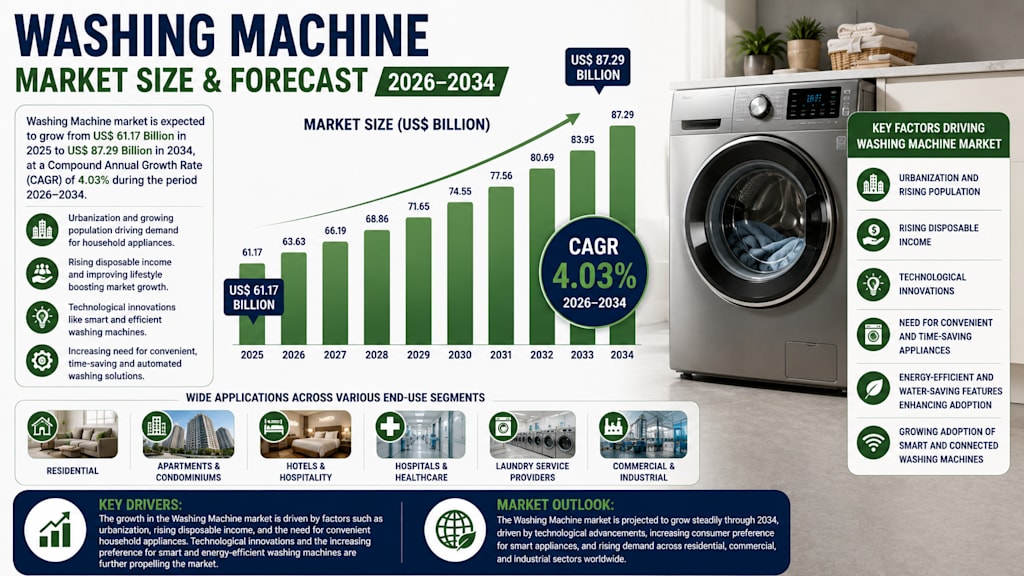
Growing awareness of hygiene, rising adoption of smart home technologies, and continuous product innovation are creating significant opportunities for manufacturers across global markets. According to Renub Research, the global Washing Machine Market is projected to grow from US$ 61.17 billion in 2025 to US$ 87.29 billion by 2034, expanding at a compound annual growth rate (CAGR) of 4.03% between 2026 and 2034. This growth reflects the increasing importance of automated household solutions in modern living.
Washing Machines Have Become Essential Household Appliances
A washing machine is an automated appliance designed to clean clothes, fabrics, and other washable materials by using water, detergent, and mechanical motion. The machine removes dirt, stains, and odors through rotating or agitating actions that clean garments efficiently.
Modern washing machines are available in several configurations, including top-loading, front-loading, semi-automatic, and fully automatic models. Each type offers varying levels of convenience, efficiency, and functionality to meet different consumer needs.
Beyond residential use, washing machines play a crucial role in commercial operations such as hotels, hospitals, laundromats, and large-scale laundry facilities. Their ability to save time, reduce physical effort, and deliver consistent cleaning performance has made them indispensable across numerous environments.
As lifestyles continue becoming busier and more technology-driven, washing machines remain one of the most widely adopted household appliances worldwide.
Urbanization Is Driving Market Growth
One of the most significant factors fueling the expansion of the washing machine market is rapid urbanization.
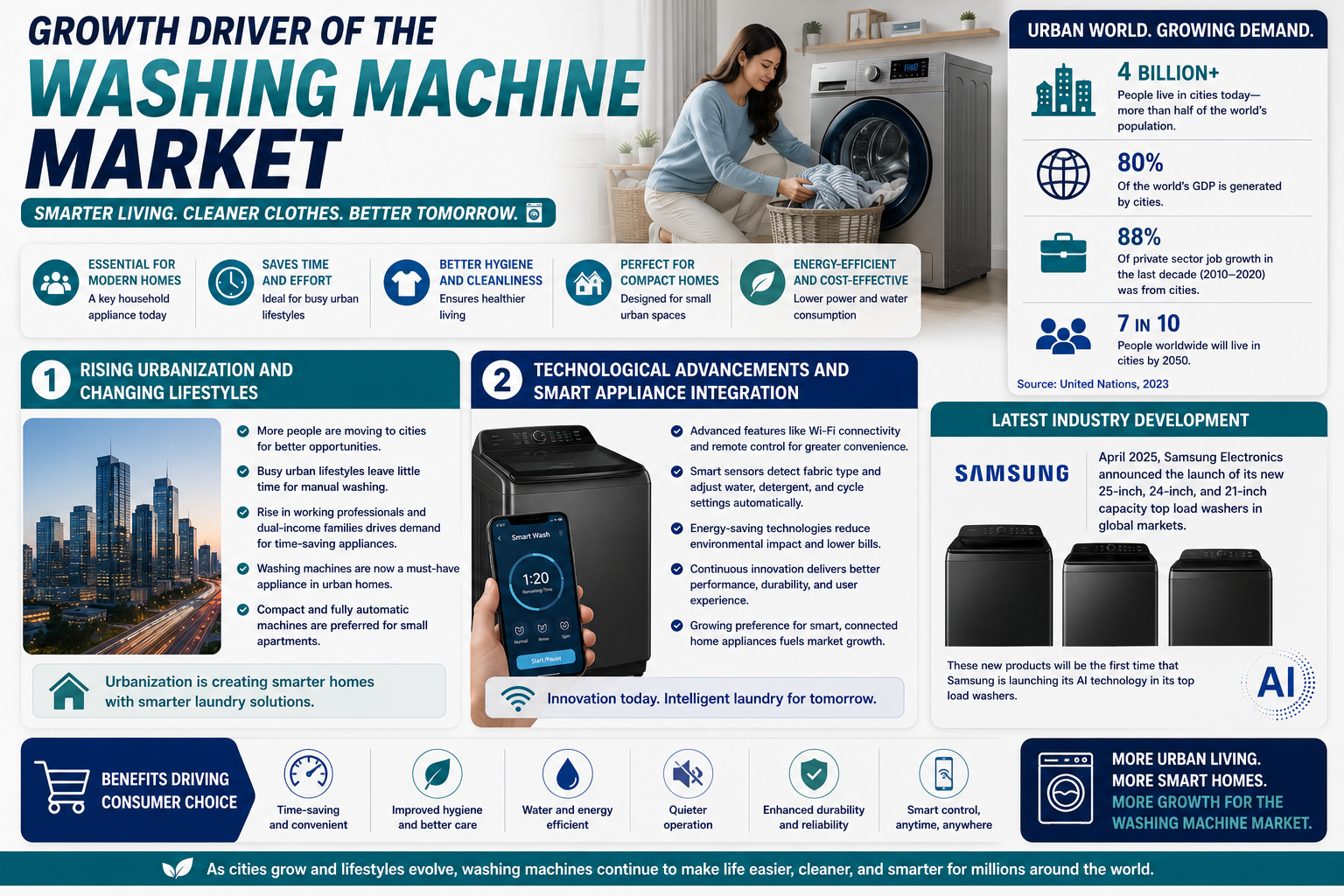
Today, more than half of the global population resides in urban areas, and this trend is expected to continue accelerating over the coming decades. Cities generate a substantial share of global economic activity and attract millions of people seeking employment opportunities and improved living standards. By 2050, nearly seven out of every ten people worldwide are expected to live in urban environments.
Urban lifestyles often involve demanding work schedules, longer commuting times, and increased reliance on convenience-oriented products. As a result, consumers increasingly seek household appliances that reduce time spent on routine chores.
Washing machines address this need by automating laundry tasks and enabling consumers to focus on work, family responsibilities, and leisure activities. Their ability to simplify daily life makes them particularly attractive to urban households.
As urban populations continue growing, demand for modern laundry appliances is expected to increase steadily.
Changing Lifestyles Support Increased Adoption
Modern lifestyles are creating strong demand for appliances that enhance convenience and efficiency.
The rise of dual-income households and working professionals has significantly reduced the amount of time available for manual household tasks. Consumers increasingly value products that automate repetitive activities and improve overall quality of life.
Washing machines have become essential tools for maintaining cleanliness and hygiene without requiring extensive effort. Compact living spaces, especially in urban apartments, have also encouraged adoption of advanced appliances designed to maximize convenience while minimizing space requirements.
Manufacturers are responding by offering compact, multifunctional, and highly efficient washing machines tailored to contemporary living environments.
As consumer expectations continue evolving, convenience-driven purchasing behavior is expected to remain a key growth driver for the market.
Smart Technology Is Transforming Laundry Appliances
Technological innovation is playing a major role in reshaping the washing machine industry.
Modern appliances increasingly feature advanced capabilities such as Wi-Fi connectivity, smartphone integration, artificial intelligence, and automated washing programs. These innovations allow users to monitor and control laundry cycles remotely while optimizing performance.
Smart washing machines can analyze fabric types, load sizes, and washing requirements to automatically adjust water levels, detergent usage, and cycle settings. These capabilities improve cleaning efficiency while reducing resource consumption.
Manufacturers continue introducing intelligent solutions designed to enhance user experiences. For example, Samsung announced the integration of artificial intelligence technology into its top-load washing machine lineup, demonstrating the growing importance of AI-powered appliances within the industry.
As smart home ecosystems expand globally, connected washing machines are expected to become increasingly popular among consumers.
Growing Hygiene Awareness Is Strengthening Demand
The rising focus on personal hygiene and cleanliness is another important factor supporting market growth.
Consumers today place greater emphasis on maintaining clean clothing, bedding, towels, and household fabrics, particularly in households with children, elderly family members, or individuals with health concerns.
Washing machines play a critical role in ensuring effective sanitation by providing thorough and consistent cleaning. This importance extends beyond residential settings to commercial environments such as hospitals, hotels, and laundromats, where hygiene standards are especially critical.
The heightened awareness of cleanliness following recent global health challenges has reinforced consumer interest in appliances that support healthy living environments.
As health consciousness continues increasing worldwide, demand for reliable and efficient laundry solutions is expected to remain strong.
Fully Automatic Machines Lead Market Demand
The fully automatic washing machine segment remains one of the most popular categories within the market.
These appliances perform the entire washing process—from washing and rinsing to spinning—without requiring manual intervention. Their ability to deliver maximum convenience makes them particularly attractive to busy consumers.
Fully automatic machines are available in both front-load and top-load configurations, providing flexibility for different household preferences and space requirements.
In addition to convenience, these machines often incorporate advanced features such as energy-saving technologies, intelligent sensors, and customizable washing programs.
As consumers increasingly prioritize automation and efficiency, fully automatic washing machines are expected to maintain their dominant position within the market.
Smart Connected Washing Machines Gain Momentum
Smart connected washing machines represent one of the fastest-growing segments in the industry.
These appliances integrate with home networks and mobile applications, allowing users to remotely control and monitor laundry activities. Consumers can start cycles, receive completion notifications, adjust settings, and track appliance performance through smartphone interfaces.
Some smart machines also incorporate advanced sensors capable of detecting load sizes and fabric types, enabling automatic optimization of water and detergent usage.
The growing popularity of smart homes and connected devices is creating favorable conditions for increased adoption of intelligent laundry appliances.
As consumers become more comfortable with connected technologies, demand for smart washing machines is expected to accelerate further.
Commercial Applications Continue Expanding
The commercial washing machine segment plays a crucial role within the broader market.
Hotels, hospitals, laundromats, residential complexes, and industrial laundry facilities depend on high-capacity machines capable of handling large volumes of laundry efficiently. Commercial machines are designed for durability, continuous operation, and superior cleaning performance.
The growth of service-oriented industries, particularly hospitality and healthcare, is creating substantial opportunities for commercial washing machine manufacturers.
These organizations require reliable laundry solutions to maintain hygiene standards and support daily operations, ensuring continued demand for commercial-grade equipment.
Hospitality Sector Creates Significant Opportunities
The hospitality industry remains a major end-user of washing machine technology.
Hotels, resorts, guest houses, and other accommodation providers process large quantities of linens, towels, uniforms, and guest laundry every day. Efficient washing machines are essential for maintaining cleanliness, guest satisfaction, and operational efficiency.
As global tourism continues expanding, hospitality businesses increasingly invest in advanced laundry equipment capable of delivering faster processing times and superior cleaning results.
The continued growth of the hospitality sector is expected to contribute significantly to future market expansion.
Retail and E-Commerce Channels Strengthen Accessibility
Distribution channels have evolved considerably, making washing machines more accessible to consumers.
Traditional retail chains continue providing opportunities for customers to compare brands, features, and pricing before making purchasing decisions. Many retailers also offer financing options, warranties, and promotional discounts that encourage appliance purchases.
Meanwhile, e-commerce platforms have expanded consumer access by enabling online product research, comparison, and purchasing from virtually any location.
The combination of physical retail and digital commerce is helping manufacturers reach broader customer bases while enhancing purchasing convenience.
As online shopping continues growing globally, distribution innovations will remain important contributors to market development.
Regional Markets Continue Expanding
United States
The United States remains one of the world's largest washing machine markets. Strong consumer purchasing power, widespread adoption of smart home technologies, and ongoing demand for energy-efficient appliances continue driving growth. Consumers increasingly favor fully automatic and connected washing machines equipped with advanced features and sustainability benefits.
United Kingdom
The United Kingdom market is growing steadily as consumers seek compact, efficient, and environmentally friendly appliances suitable for modern living spaces. Energy efficiency and smart functionality remain important purchasing considerations.
India
India represents one of the fastest-growing washing machine markets globally. Rising urbanization, expanding middle-class populations, increasing disposable incomes, and growing awareness of modern appliances are contributing to strong demand across urban and semi-urban areas.
Saudi Arabia
Saudi Arabia's market is expanding due to improving living standards, rising household incomes, and increasing adoption of modern home appliances. Growth in hospitality and residential sectors is further supporting demand for advanced washing machines.
Challenges Facing the Market
Despite positive growth prospects, the washing machine market faces several challenges.
One major obstacle is the relatively high cost of advanced washing machines. Models equipped with smart technologies, energy-efficient systems, and automated features often carry higher upfront prices, which may limit adoption in price-sensitive markets.
Water and energy consumption also remain important concerns. Although manufacturers continue improving efficiency, consumers and regulators increasingly expect appliances to minimize resource usage while maintaining strong performance.
Meeting stricter environmental standards requires ongoing investment in research and development, creating additional challenges for manufacturers.
Addressing affordability and sustainability concerns will remain critical for long-term market success.
Market Forecast: Steady Growth Through 2034
According to Renub Research, the global Washing Machine Market is expected to grow from US$ 61.17 billion in 2025 to US$ 87.29 billion by 2034, reflecting a CAGR of 4.03% during the forecast period from 2026 to 2034. Growth will be supported by increasing urbanization, technological advancements, rising hygiene awareness, expanding smart home adoption, and continued demand for convenience-oriented household appliances.
The market's outlook highlights the growing role of intelligent and energy-efficient appliances in modern homes and commercial environments.
Final Thoughts
The washing machine industry continues evolving as technological innovation, urban lifestyles, and consumer expectations reshape household appliance markets worldwide. What began as a basic cleaning device has transformed into a sophisticated, connected appliance capable of delivering convenience, efficiency, and sustainability.
With Renub Research forecasting growth from US$ 61.17 billion in 2025 to US$ 87.29 billion by 2034, the market remains well-positioned for continued expansion. Smart technologies, automated features, and energy-efficient designs will play increasingly important roles in shaping future product development.
As consumers continue prioritizing convenience, hygiene, and sustainability, washing machines will remain indispensable components of modern living for years to come.
Source: Renub Research – Washing Machine Market Size and For
About the Creator
Enjoyed the story? Support the Creator.
Subscribe for free to receive all their stories in your feed.
Comments
There are no comments for this story
Be the first to respond and start the conversation.