
Warehouse Automation Is No Longer Optional: It’s a Competitive Survival Imperative
The Autonomous Forklift Market is poised for significant transformation between 2026 and 2033, driven by rapid advancements in automation, robotics, and artificial intelligence within the material handling sector.

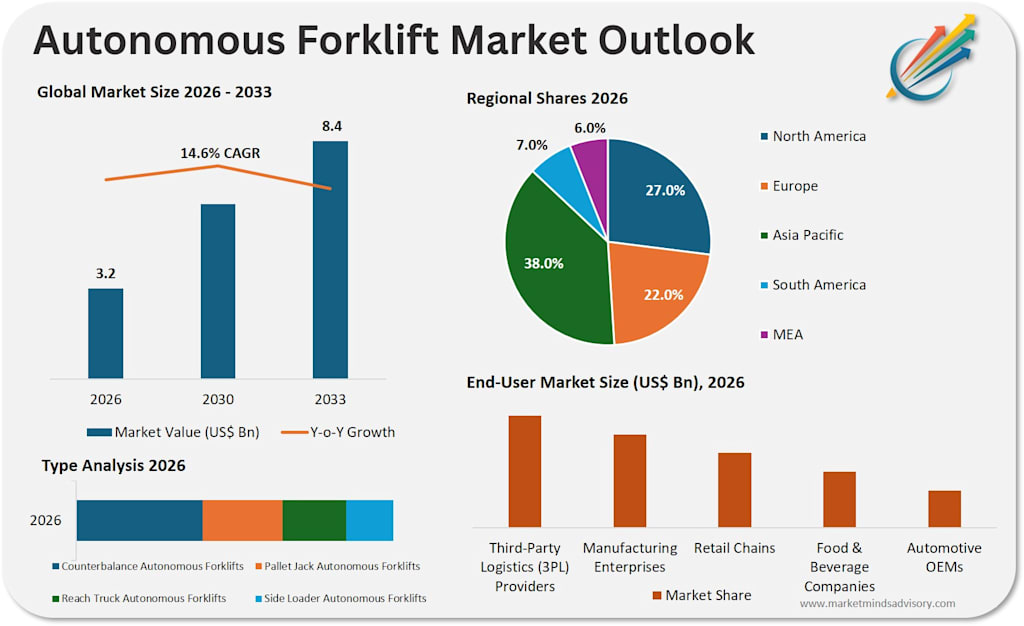
The labor crisis in logistics isn’t temporary, and the companies treating it as such are already falling behind. Across North America, Europe, and Asia-Pacific, warehouse operators face a structural shortage of forklift drivers that no wage increase can solve. Meanwhile, e-commerce fulfillment speeds have compressed from days to hours, and operational errors that once cost pennies now trigger customer defection. The autonomous forklift has shifted from experimental technology to strategic necessity, yet most industrial operators remain stuck in pilot purgatory while early movers capture disproportionate efficiency gains.
Why Inaction Today Compounds Tomorrow’s Disadvantage
The window for competitive advantage through warehouse automation is narrowing rapidly. Companies that deployed autonomous forklifts 18 months ago are now operating at 30-40% lower labor costs per pallet moved, with safety incident rates down by over 60%. These aren’t marginal improvements. They represent fundamental cost structure advantages that become nearly impossible to close once established.
What makes this moment particularly critical is the convergence of three forces: labor scarcity has become permanent in developed markets, lithium-ion battery economics have crossed the viability threshold for 24/7 operations, and fleet management software has matured to the point where autonomous units integrate seamlessly with existing warehouse management systems. The technology risk that justified waiting has largely evaporated, but the deployment learning curve remains steep. Every quarter of delay means falling further behind competitors who are already optimizing their second-generation implementations.
Structural Shifts Driving Irreversible Change
The Permanent Reconfiguration of Warehouse Labor Markets
Demographics have fundamentally altered the forklift operator talent pool. In the United States alone, the logistics sector faces a shortfall exceeding 400,000 qualified operators, a gap that immigration policy and wage inflation cannot bridge. Younger workers increasingly reject repetitive material handling roles, while experienced operators are aging out faster than replacements enter the pipeline. This isn’t a cyclical labor shortage. It’s a structural mismatch between available workforce preferences and operational requirements. Autonomous forklifts don’t just reduce headcount—they eliminate dependence on a talent pool that no longer exists at scale.
Operational Intensity Requirements That Human-Only Models Cannot Meet
Modern fulfillment economics demand operational tempos that exceed human physiological limits. Same-day delivery commitments require warehouses to process orders in 90-minute windows. Retail replenishment cycles have compressed to twice-daily frequencies. Automotive just-in-time manufacturing tolerates zero buffer inventory. These operational realities create utilization requirements of 20-22 hours daily, with sub-second decision cycles and zero-defect expectations. Autonomous systems don’t fatigue, don’t require shift changes, and maintain consistent performance across all operating hours. The performance gap isn’t incremental—it’s categorical.
Total Cost of Ownership Economics Have Crossed the Inflection Point
The financial equation has fundamentally shifted. Fully loaded labor costs for a three-shift forklift operation now exceed $180,000 annually when accounting for wages, benefits, training, turnover, and management overhead. Autonomous forklift systems, with improving battery technology and declining sensor costs, have reached acquisition and operating cost structures that deliver payback periods under 24 months in high-utilization environments. More critically, these systems provide cost certainty in an environment where labor costs remain volatile and upward-trending. CFOs can now model warehouse operations with predictable unit economics rather than exposure to wage inflation and turnover variability.
Where Strategic Value Concentrates
The highest-return deployment opportunities exist in environments where operational complexity intersects with labor scarcity. High-throughput distribution centers processing 50,000+ units daily see immediate ROI, particularly in temperature-controlled environments where human productivity degrades and turnover accelerates. Automotive and aerospace manufacturing facilities with strict just-in-time protocols cannot tolerate the variability inherent in human-operated material flows. Third-party logistics providers serving multiple clients face the dual pressure of razor-thin margins and unpredictable volume spikes that make fixed labor models economically unviable.
The technology has also matured beyond simple point-to-point movement. Modern autonomous forklifts handle mixed pallet configurations, navigate dynamic environments with human workers present, and integrate with automated storage and retrieval systems. The strategic opportunity isn’t replacing forklifts—it’s redesigning entire material flow architectures around autonomous capabilities that enable warehouse layouts and processes impossible with human operators.
The Competitive Landscape Is Bifurcating Rapidly
Early market dynamics suggested autonomous forklifts would remain a premium segment dominated by established material handling equipment manufacturers. That assumption is collapsing. Technology-first entrants with robotics and AI capabilities are capturing share by offering superior fleet management software and faster deployment cycles. Traditional forklift manufacturers are responding through acquisitions and partnerships, but integration challenges persist.
For buyers, this creates both opportunity and risk. The expanding vendor landscape provides negotiating leverage and accelerates innovation, but it also introduces integration complexity and vendor viability questions. More strategically, the market is splitting between companies selling autonomous forklifts as capital equipment and those offering robotics-as-a-service models with operational performance guarantees. This business model divergence will reshape procurement strategies and total cost of ownership calculations over the next 18 months.
The Compounding Cost of Delayed Deployment
Organizations postponing autonomous forklift adoption face consequences that extend well beyond foregone efficiency gains:
Competitive cost structure disadvantage that becomes permanent as early movers optimize operations around autonomous capabilities
Talent acquisition crisis intensification as the remaining operator pool shrinks and wage demands escalate beyond economic viability
Customer service degradation as competitors using autonomous systems achieve faster, more reliable fulfillment
Capital allocation inefficiency from over-investing in conventional equipment that depreciates into obsolescence
Safety and liability exposure from continued reliance on human operators in high-risk material handling environments
Organizational learning deficit as competitors accumulate years of deployment experience and process optimization
The most insidious cost is organizational. Companies that delay develop institutional antibodies to automation, entrenching processes and mindsets that make future transformation exponentially harder.
About the Creator
Sanjay Vane
At Market Minds Advisory, we’re more than just consultants—we’re partners in your journey to growth and success.
Enjoyed the story? Support the Creator.
Subscribe for free to receive all their stories in your feed.
Comments
There are no comments for this story
Be the first to respond and start the conversation.