
Wang Xingxing Says GPT-7 Will Break Embodied AI. Here’s What It Can’t Break.
Wang Xingxing Says GPT-7 Will Break Embodied AI. Here’s What It Can’t Break.
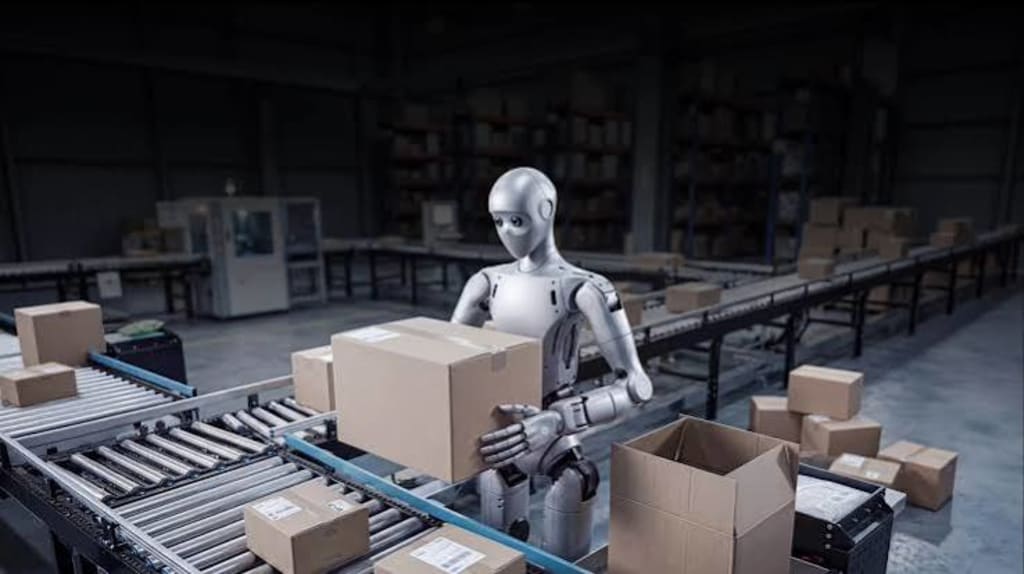
Wang Xingxing’s Timetable
On October 12, 2026, at the opening of the China International Industry Fair, Wang Xingxing, founder of Unitree Robotics, gave a judgment: the tipping point for embodied AI may arrive in as little as one to two years, “because when GPT-7 comes out next year, it may directly break through the embodied AI problem.”
This is not the first time he has given a timeline. In August 2025, at the World Robot Conference, he said, “If things go smoothly, one to two or two to three years; at the slowest, three to five years.” In August 2026, at the same event, his wording became “two to three years at the fastest, five to ten years at the slowest.” Two months later, at the Industry Fair, it became “one to two years.”
Three statements, with a range that has both expanded and contracted. This is not a continuously accelerating prediction curve. It looks more like an immediate response to technological progress. After GPT-6 was released, Unitree deployed it on various robots for task tests, and the feedback was “very good.” That feedback pushed the timetable forward one notch.
Wang Xingxing’s optimism has concrete evidence. Real-machine tests by the independent evaluation organization Robocurve showed that on the task of “picking up a block and putting it into a bowl,” GPT-6 Astra achieved a 95% success rate, while the previous-generation model Claude Fable 5.1 achieved only 40%. Testing by Xu Huazhe, founder of Poke Robotics, found that GPT-6 can already complete operations requiring fine posture adjustment, such as picking up chopsticks, rotating them, and handing them over: “It recognizes things on the table, and it also moves toward the correct position.”
These results show that general-purpose models are absorbing part of what was originally exclusive to robots: spatial understanding, object recognition, and basic grasp planning. Wang Xingxing therefore asserts that the next generation, GPT-7, may conquer the current model’s last shortcoming: complex physical interaction.
But from “absorbing part of it” to “breaking through all of it,” what lies in between may be more than one model iteration.
Whether GPT-7 Can Arrive Next Year Is Itself an Unverified Premise
Wang Xingxing’s timetable is built on one assumption: GPT-7 will be released “next year,” in 2027.
This assumption currently lacks evidentiary support. Prediction market data shows that the market prices the probability of “GPT-7 released before March 2027” at about 8%, with Kalshi’s implied probability at 12%. Longer-dated contracts show that the market expects GPT-7 to be released before June 30, 2027, with a probability of about 36%, and before December 31, 2027, with a probability of about 88%. Mainstream expectations point to mid-to-late 2027.
As of October 2026, there is no sign that GPT-7 has been officially announced or recorded. OpenAI’s current flagship is still GPT-6 Astra, released on September 3, 2026. Its most recent update was GPT-6.1 Sol, launched at DevDay on September 29, a point release within the GPT-6 family. TIME reported that the next-generation model was paused in August 2026 for safety reasons and is under extended review. GPT-7 is expected to land only in mid-to-late 2027.
If GPT-7 is delayed until the second half of 2027, the basis for Wang Xingxing’s inference that “the tipping point will arrive within one to two years” will loosen. The technological direction may still be right. The time anchor has changed.
Physical Interaction: GPT-6’s Capability Boundary Draws the Core of the Problem
Even if GPT-7 arrives on schedule, the bottleneck it needs to “break through” is harder than spatial understanding.
Xu Huazhe divides embodied tasks into three dimensions: semantic generalization, spatial generalization, and physical generalization. GPT-6 performs strongly on the first two, but is “relatively weak” on physical generalization. It can let a robot pick up chopsticks, but it cannot complete tasks involving complex physical contact, such as using chopsticks to push objects, stacking boxes, or folding clothes. “Complex physical interaction remains the last bastion for embodied AI companies.”
The weight of this sentence needs to be understood at the technical level. The place where embodied AI is stuck is not “seeing” and “approaching,” but the moment contact occurs. When the gripper closes, will the object shift? After it is picked up, will it slip? How much force is needed so it is neither crushed nor dropped? These questions depend on tactile feedback, and touch is the weakest link in robot learning.
A 2026 review stated: “The paradigm shift from simulation to reality has already been achieved in robot locomotion, but it has not yet appeared in contact-rich manipulation. Its main bottleneck is tactile sensing: a modality that is crucial for manipulation but difficult to simulate.”
The problem lies in the fundamental difficulty of simulation. Modeling tactile shear force requires tracking the path-dependent deformation history between the sensor membrane and the object, capturing complex behaviors such as static friction, sliding, and hysteresis. Although the finite element method is accurate, its computational cost is too high to support large-scale reinforcement learning training. Fast approximation methods based on penalty terms can only estimate based on instantaneous penetration and velocity, and cannot capture the “shadow effect” of touch: the bias caused by sensor imprecision and signal degradation.
The empirical result is this: even with the most advanced tactile simulation methods, the sim-to-real performance drop remains between 20 and 50 percentage points. These losses are concentrated in several types of signals: contact and material behavior, real sensor characteristics, unmodeled human behavior, and failure modes no one anticipated.
Another data point: an analysis of 1,228 VLA-related papers found that 123 of them did not involve tactile work at all. No matter how strong a general-purpose model is in visual-spatial reasoning, it still lacks sufficient data and modeling foundations in the dimension of force sensing and tactile feedback. There is currently no evidence to support whether GPT-7 can cross this chasm. If the object of “breaking through” is touch and contact dynamics, the requirement is another way of understanding the physical world, not stronger language reasoning ability. The data sources, modeling paths, and validation methods for that way are still in early exploration.
Three Engineering Thresholds: Cost, Real-Time Performance, and Precision
Even assuming GPT-7 achieves a leap in physical generalization, there are still three hard thresholds between “can operate” and “can be used.”
Cost. In the DrivingBench test, letting GPT-6 Astra control a real car for 134.7 meters on a closed road consumed about 6.6 million tokens in a single run, costing about $7.74, or tens of dollars per kilometer. General-purpose models are billed by token, while actions in the physical world are continuous and dense. Every grasp and every adjustment requires massive token consumption. This bill can be ignored in a demo, but it cannot be avoided in mass production.
Real-time performance. In the same test, the vehicle controlled by GPT-6 Astra had an average speed of only 0.42 meters per second, with a reaction cycle measured in seconds. Real robot operations require millisecond-level responses. This includes maintaining balance, which requires control frequencies above 50 Hz, and handling force feedback during contact. Stanford’s HomeBody project confirmed that GPT-6 Astra’s inference latency creates pauses between every skill switch. There is an inherent contradiction between the inference frequency of a cloud-based brain and the high-frequency demands of the physical world.
Precision. Galbot’s evaluation showed that without a dedicated policy model, GPT-6 Astra’s success rate in high-precision contact and stable grasping drops off a cliff. Stanford’s explanation in its report is blunt: HomeBody’s navigation is based on 2D target points in map coordinates, with units in meters. Meter-level precision means it only knows “roughly where to go.” It can handle navigation in enclosed scenarios, but it cannot perform centimeter-level high-precision contact and stable grasping.
These three thresholds cover all the dimensions that embodied AI must cross for mass-production deployment: cost billed by token, real-time performance stuck at the second level, and precision stuck at the meter level. Improvements in general-purpose model capabilities may alleviate these problems in some dimensions. There is no reason to believe they will disappear at the same time as the release of GPT-7.
Deepening Division of Labor, Not Replacement
If the progress of general-purpose models cannot be understood as “breaking through” everything, what is it more likely to bring? The answer is a deepening division of labor. This trend has already been quantitatively verified in 2026 research.
A study on industrial manipulation tasks gave a precise boundary condition. On six industrial tasks, specialized policies achieved a 96.4% success rate, while a fine-tuned 7B VLA model achieved 88.6%. Specialized policies also cost 24% less per successful cycle, and their adaptation compute was only one-tenth that of the VLA. But when task mixture entropy exceeds about 2.4 bits, meaning task types are sufficiently diverse, general-purpose models begin to win. In a scenario with 40 variants, the general-purpose model reached an 83.0% success rate, while specialized policies fell to 61.4%.
This “break-even point” illustrates a key fact: general-purpose models and specialized policies divide labor along clear boundaries. They are not replacements for each other. In industrial scenarios with clear task boundaries and limited variety, specialized policies are superior in success rate, cost, and efficiency. In service scenarios with many task types and highly variable environments, the generalization ability of general-purpose models shows its value. Even if GPT-7 is much stronger than GPT-6, this boundary will not disappear. It will only move.
Harness VLA, released by Professor Yu Chao’s team at Tsinghua University, introduces the Harness Layer from digital intelligence into embodied AI. It allows a frozen VLA to focus on what it does best, contact-rich manipulation, while a Harness layer learns when and how to invoke it, and how to reset after VLA failure. Generalist AI’s GEN-1 model demonstrates another path. In some tests, it achieved comparable performance with about one-tenth the specialized training data. General-purpose models can reduce the data requirements of action models rather than replace them. Teams no longer need to train all capabilities from scratch, and can instead focus their energy on fine-tuning physical interaction.
Zhong Ziming, an embodied AI researcher at Huawei, used a scenario to explain why layering is necessary. You tell a robot, “Help me cook.” It should first plan the steps, then find the spatula. If the spatula is not in the current view, it should interrupt the task of “getting the spatula” and change it to “go find the spatula.” Current embodied models basically do not have this kind of scheduling capability. Once the spatula falls or is taken away, the robot needs to judge and replan. This is the kind of error-correction loop that large models are good at.
The upper layer handles seeing, judging, and scheduling. The lower layer handles moving stably. This division of labor will not disappear because GPT-7 is stronger. It will only become more efficient as general-purpose model capabilities improve.
Redefining the Question
Wang Xingxing’s optimism is essentially a reasonable expectation of the capability spillover effect of general-purpose models. GPT-6 has already proven that part of what was originally exclusive to robots is being absorbed by general-purpose models. This path is real and deserves serious consideration.
But he equates “capability spillover” with “bottleneck breakthrough,” and gives a “one to two years” judgment that depends on a specific release timing. Both steps in the reasoning have problems. Whether GPT-7 will be released next year is an unverified premise. Even if it is released, the physical interaction bottleneck it needs to break through, including tactile simulation, contact dynamics, and force feedback, is different in technical nature from the spatial understanding bottleneck that GPT-6 has already conquered.
A more persuasive framework is to track a set of observable metrics. After the next model upgrade, can the same robot achieve stable improvements in physical interaction tasks with less data and adaptation? Does the success rate continue to improve after changing scenarios? Can failures be recovered autonomously? How much human intervention is needed? How high is the cost of continuous operation? Is the proportion of human evaluation declining?
If these metrics repeatedly improve across different robots and different tasks, then the tipping point will have a solid basis. If they do not change with the release of GPT-7, it means the root of the bottleneck is not the intelligence level of language models, but the complexity of the physical world itself. The latter requires another research path, another data system, and another evaluation standard.
Wang Xingxing said that the biggest mistake of the past decade or so was “not believing in AI enough.” That statement itself may be correct. But believing in AI does not mean believing that the next-generation model can solve all problems. The path to trust is continuous verification, repeated iteration, and narrowing the gap between the physical world and digital intelligence. That path matters whether it requires GPT-7 or GPT-8.
About the Creator
Jin
Writer of reamstories
https://reamstories.com/jin
Enjoyed the story? Support the Creator.
Subscribe for free to receive all their stories in your feed. You could also become a paid subscriber, letting them know you appreciate their work.
Comments
There are no comments for this story
Be the first to respond and start the conversation.