
Voice Biometrics Market Poised for Rapid Expansion as Secure Authentication Becomes a Global Priority
Rising Cybersecurity Threats, Digital Banking Growth, and AI-Powered Innovations Are Driving the Future of Voice-Based Identity Verification

As the digital economy continues to expand, organizations are facing a growing challenge: how to provide secure and seamless authentication without creating friction for users. Traditional methods such as passwords, PINs, and security questions are increasingly vulnerable to cyberattacks, phishing schemes, and identity theft. Consumers, meanwhile, expect fast and convenient access to digital services.
This changing landscape has created significant opportunities for voice biometrics, a technology that uses the unique characteristics of a person's voice to verify identity. Once considered a niche security tool, voice biometrics is now becoming a mainstream authentication solution across industries including banking, telecommunications, healthcare, government, and automotive services.
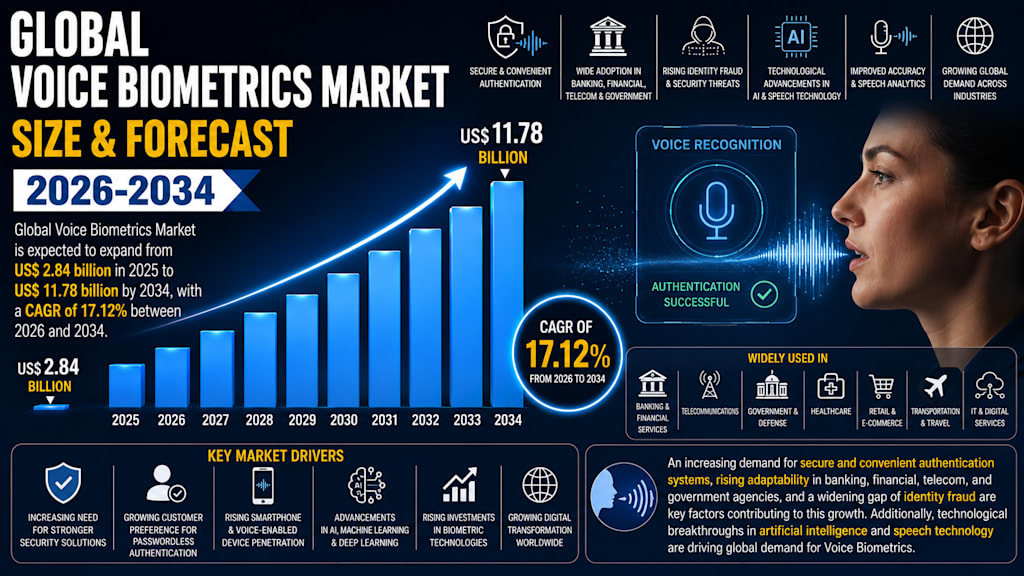
According to Renub Research, the global Voice Biometrics Market is expected to grow from US$ 2.84 billion in 2025 to US$ 11.78 billion by 2034, registering a robust compound annual growth rate (CAGR) of 17.12% between 2026 and 2034. The rapid growth reflects increasing demand for secure authentication systems, rising concerns about fraud prevention, and continuous advancements in artificial intelligence and speech analytics technologies.
What Is Voice Biometrics?
Voice biometrics is a biometric authentication technology that identifies or verifies individuals based on the unique characteristics of their voice. Unlike traditional voice recognition systems that focus on the words being spoken, voice biometrics analyzes how a person speaks.
Factors such as pitch, tone, rhythm, pronunciation patterns, and vocal tract characteristics combine to create a unique voiceprint. This voiceprint serves as a digital identifier that can be used to authenticate users securely.
The technology enables password-free and hands-free authentication, making it an attractive solution for organizations seeking to improve both security and customer experience. Whether customers are accessing mobile banking apps, contacting customer service centers, or logging into digital platforms, voice biometrics offers a convenient alternative to conventional authentication methods.
As remote services and digital interactions become increasingly common, organizations are recognizing the value of secure and frictionless identity verification solutions.
Why Demand for Voice Biometrics Is Growing
The global surge in cybercrime and identity fraud is one of the strongest drivers behind the growing adoption of voice biometrics.
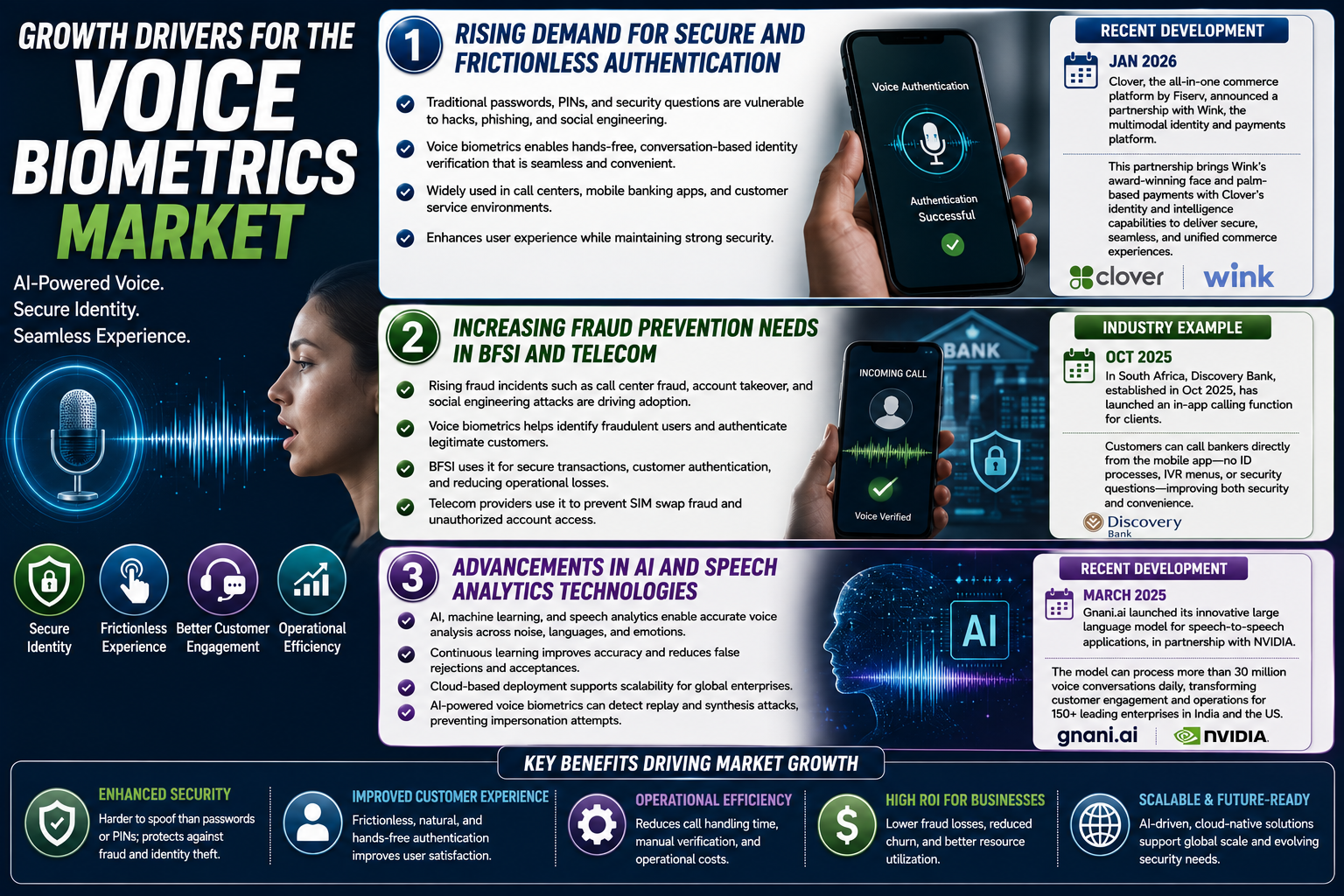
Traditional authentication methods have become vulnerable to sophisticated attacks. Passwords can be stolen, PIN numbers can be guessed, and security questions can often be answered using publicly available information. As a result, organizations are searching for more reliable forms of identity verification.
Voice biometrics addresses these concerns by leveraging biological characteristics that are significantly harder to replicate. Unlike passwords, a voiceprint cannot easily be forgotten, shared, or compromised through common cyberattack techniques.
The growing popularity of digital banking, online customer service, and remote work environments has further accelerated demand for voice-based authentication systems. Consumers increasingly expect secure access without lengthy verification processes, creating an ideal environment for voice biometrics adoption.
Organizations benefit from improved security while customers enjoy a faster and more convenient experience.
Financial Services Industry Leads Adoption
The banking, financial services, and insurance sector remains one of the largest adopters of voice biometrics technology.
Financial institutions face constant pressure to protect customer information, prevent fraud, and comply with evolving regulatory requirements. At the same time, they must maintain a smooth customer experience across digital channels.
Voice biometrics helps address both challenges.
Banks use voice authentication to verify customer identities during phone calls, mobile banking sessions, and online interactions. Instead of answering multiple security questions, customers can simply speak naturally, allowing the system to verify their identity within seconds.
The technology has proven particularly effective in preventing account takeover attacks, call-center fraud, and social engineering schemes that target financial institutions.
As digital banking continues to expand worldwide, financial organizations are expected to remain among the largest investors in voice biometric solutions.
Fraud Prevention Is Becoming a Major Growth Driver
Fraud continues to be a costly challenge for businesses across industries. Cybercriminals are becoming increasingly sophisticated, utilizing social engineering tactics, stolen credentials, and impersonation techniques to gain unauthorized access to sensitive information.
Voice biometrics offers an effective defense against these threats.
By analyzing voiceprints in real time, systems can identify known fraudsters and detect suspicious behavior patterns during customer interactions. This capability is especially valuable in contact centers, where identity verification has traditionally relied on less secure methods.
Telecommunications providers are also adopting voice biometrics to combat SIM-swap fraud, unauthorized account access, and customer impersonation attempts.
As fraud risks continue to evolve, organizations are investing heavily in advanced authentication technologies capable of adapting to new threats. Voice biometrics is increasingly viewed as an essential component of comprehensive fraud prevention strategies.
Artificial Intelligence Is Transforming Voice Authentication
One of the most significant developments in the voice biometrics industry is the integration of artificial intelligence and machine learning technologies.
Modern voice biometric systems are far more advanced than their predecessors. AI-powered platforms can accurately analyze voice patterns even in challenging environments where background noise, language variations, and emotional changes might otherwise affect performance.
Machine learning algorithms continuously improve system accuracy by learning from new interactions and adapting to changing voice characteristics over time.
This advancement has significantly reduced false acceptance and false rejection rates, making voice biometrics more reliable for enterprise applications.
AI is also helping organizations combat emerging threats such as synthetic voices and deepfake technologies. Advanced voice authentication systems can detect signs of manipulation and distinguish genuine users from artificially generated voices.
As artificial intelligence continues to evolve, the effectiveness and sophistication of voice biometric solutions are expected to increase further.
Contact Centers Are Embracing Voice Biometrics
Customer service centers represent one of the most promising applications for voice biometrics technology.
Traditional call-center authentication processes often require customers to answer multiple security questions before receiving assistance. This approach can be time-consuming and frustrating for both customers and service representatives.
Voice biometrics streamlines the process by verifying customer identities automatically during natural conversation.
The benefits are substantial. Organizations can reduce average call handling times, improve customer satisfaction, lower operational costs, and strengthen security simultaneously.
Many enterprises are incorporating passive voice biometrics into their contact center operations. Unlike active systems that require customers to repeat specific phrases, passive systems authenticate users continuously throughout the conversation without interrupting the customer experience.
This seamless approach is driving widespread adoption across customer service operations worldwide.
Active and Passive Voice Biometrics Continue to Evolve
The voice biometrics market consists primarily of two authentication approaches: active and passive voice biometrics.
Active voice biometrics requires users to speak a specific phrase that the system analyzes for verification purposes. This method offers high accuracy and is commonly used in banking, government services, and high-security applications.
Passive voice biometrics, on the other hand, operates in the background during natural conversations. Users do not need to perform any additional actions, making the process more convenient and less intrusive.
Both approaches offer unique advantages, and organizations often select solutions based on their security requirements, customer experience goals, and operational needs.
As technology improves, both active and passive systems are becoming more accurate, efficient, and resistant to spoofing attempts.
Cloud-Based Solutions Are Expanding Accessibility
Cloud technology is playing a critical role in making voice biometrics accessible to organizations of all sizes.
Traditionally, advanced authentication systems required substantial infrastructure investments and dedicated technical resources. Cloud-based deployment models have significantly reduced these barriers.
Organizations can now implement voice biometric solutions quickly without extensive hardware investments. Cloud platforms also provide scalability, flexibility, and simplified maintenance, making them particularly attractive for growing businesses.
At the same time, industries with strict regulatory requirements continue to favor on-premises deployments that provide greater control over sensitive voice data.
As organizations balance security, compliance, and operational efficiency, hybrid deployment models are becoming increasingly popular.
Challenges Facing the Voice Biometrics Industry
Despite strong growth prospects, the voice biometrics market faces several challenges.
Privacy concerns remain one of the most significant obstacles. Voice data is considered highly sensitive personal information, and organizations must ensure that collected data is stored, processed, and protected responsibly.
Regulatory frameworks such as GDPR have increased compliance requirements for organizations using biometric technologies. Meeting these requirements often involves additional investments in security infrastructure and governance processes.
Another challenge involves accuracy under varying conditions. Factors such as illness, aging, emotional stress, poor microphone quality, and background noise can sometimes affect system performance.
Perhaps the most pressing concern is the rise of deepfake technology and synthetic voice generation. Cybercriminals are increasingly using artificial intelligence to create realistic voice replicas capable of impersonating legitimate users.
To address these threats, technology providers are investing heavily in anti-spoofing mechanisms, liveness detection tools, and advanced AI-driven security features.
Regional Markets Show Strong Potential
The United States remains one of the most mature voice biometrics markets due to strong adoption across banking, healthcare, telecommunications, and government sectors.
The United Kingdom is experiencing steady growth driven by fraud prevention initiatives, regulatory compliance requirements, and widespread use of voice authentication in financial services.
India represents one of the fastest-growing markets globally. The country's expanding digital banking ecosystem, large customer service industry, and multilingual population create favorable conditions for voice biometrics adoption.
Saudi Arabia is also emerging as a promising market as part of broader digital transformation and cybersecurity initiatives. Government agencies, financial institutions, and telecommunications providers are increasingly investing in advanced authentication technologies to support secure digital services.
The Future of Voice Biometrics
The future of voice biometrics extends far beyond simple authentication.
As organizations continue to invest in artificial intelligence, behavioral analytics, and digital identity management, voice biometrics is expected to become an integral component of broader security ecosystems.
Emerging applications in connected vehicles, smart homes, healthcare systems, and digital government services are creating new opportunities for growth. Voice authentication may soon become a standard feature across many aspects of daily life.
The integration of voice biometrics with multimodal authentication systems that combine facial recognition, fingerprint scanning, and behavioral analysis will further enhance security and user convenience.
Final Thoughts
Voice biometrics is rapidly transforming the way organizations approach authentication and identity verification. In an era where cyber threats continue to evolve and customer expectations continue to rise, businesses require solutions that deliver both security and convenience.
By leveraging the unique characteristics of human speech, voice biometrics offers a powerful alternative to traditional authentication methods. The technology reduces fraud risks, improves customer experiences, and supports the growing demand for seamless digital interactions.
With the global Voice Biometrics Market projected to grow from US$ 2.84 billion in 2025 to US$ 11.78 billion by 2034, the industry is entering a period of remarkable expansion. As artificial intelligence, cloud computing, and digital services continue to advance, voice biometrics is poised to become one of the most important authentication technologies of the next decade.
About the Creator
Enjoyed the story? Support the Creator.
Subscribe for free to receive all their stories in your feed.
Comments
There are no comments for this story
Be the first to respond and start the conversation.