
Virtual Reality Market Set for Explosive Growth as Immersive Technologies Transform Entertainment, Healthcare, and Business
Rapid technological innovation, growing enterprise adoption, and increasing demand for immersive digital experiences are positioning virtual reality as one of the fastest-growing technology markets worldwide.

For decades, virtual reality existed largely in the realm of science fiction. Movies, books, and futurists envisioned a world where people could step inside digital environments, interact with virtual objects, and experience entirely new realities. Today, that vision is rapidly becoming a reality.
Virtual Reality (VR) has evolved from an experimental technology into a transformative force impacting industries ranging from gaming and entertainment to healthcare, education, manufacturing, and real estate. What was once considered a niche innovation is now becoming an essential tool for training, collaboration, simulation, and immersive experiences.
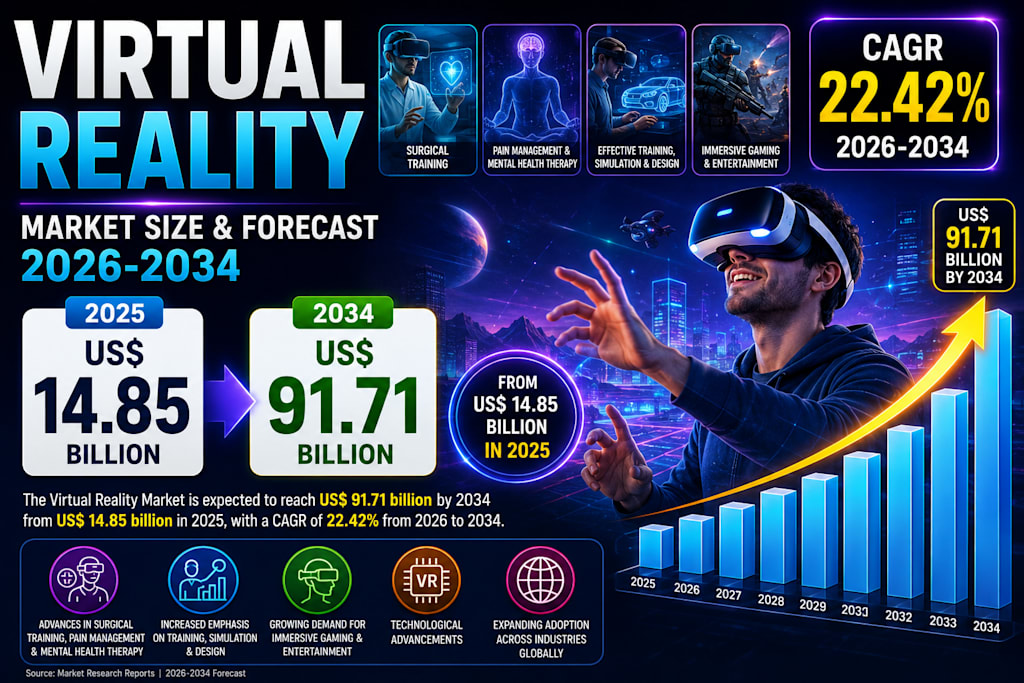
According to Renub Research, the Virtual Reality Market is expected to grow from US$14.85 billion in 2025 to US$91.71 billion by 2034, registering an impressive CAGR of 22.42% between 2026 and 2034. This remarkable growth reflects increasing adoption across multiple sectors, continuous hardware advancements, and rising consumer demand for immersive digital experiences.
Understanding the Virtual Reality Revolution
Virtual reality is a technology that creates computer-generated, three-dimensional environments that users can interact with in real time. Through specialized hardware such as head-mounted displays, motion sensors, controllers, and haptic devices, users experience a powerful sense of presence within virtual environments.
Unlike traditional digital experiences viewed through a screen, VR immerses users directly into interactive worlds. Whether exploring a virtual city, attending a digital concert, practicing a surgical procedure, or participating in a business simulation, VR creates experiences that feel more engaging and realistic.
The technology's ability to combine visual, auditory, and physical interaction has made it one of the most promising innovations of the digital age.
As hardware becomes more advanced and accessible, VR is moving beyond entertainment and establishing itself as a critical tool for businesses, educators, healthcare professionals, and governments worldwide.
Gaming Continues to Lead the Market
Gaming remains the largest and most influential segment of the virtual reality industry.
VR gaming offers experiences that traditional gaming platforms simply cannot replicate. Instead of controlling characters through a screen, players become active participants inside digital worlds, interacting with environments through movement, gestures, and spatial awareness.
Modern VR games provide unprecedented levels of immersion, making players feel physically present within virtual spaces. From action adventures and racing simulators to sports competitions and social experiences, VR has fundamentally changed how games are designed and experienced.
The growing popularity of immersive gaming has encouraged major technology companies and developers to invest heavily in VR hardware, software, and content creation.
As younger generations increasingly seek interactive and engaging entertainment experiences, VR gaming is expected to remain a primary driver of market growth.
Entertainment Is Expanding Beyond Traditional Boundaries
Virtual reality is transforming entertainment far beyond gaming.
Consumers are increasingly participating in virtual concerts, immersive movie experiences, digital exhibitions, and social VR platforms. These experiences allow users to interact with content and other participants regardless of physical location.
Virtual events became especially important during periods when physical gatherings were restricted, demonstrating VR's potential to create meaningful shared experiences across geographical boundaries.
Artists, musicians, sports organizations, and media companies are now exploring VR as a new channel for audience engagement and content delivery.
As consumers continue embracing immersive experiences, entertainment companies are expected to increase investments in VR platforms and content development.
Healthcare Is Discovering New Possibilities
One of the most impactful applications of virtual reality is emerging within healthcare.
Medical professionals increasingly use VR for surgical training, allowing students and practitioners to simulate complex procedures in safe and controlled environments. These simulations improve skill development while reducing training risks and costs.
VR is also proving effective in pain management, rehabilitation, and mental health treatment. Patients can use immersive environments to reduce anxiety, manage chronic pain, and participate in therapeutic exercises.
Mental health professionals are utilizing virtual reality for exposure therapy, helping patients address phobias, post-traumatic stress disorder, and anxiety-related conditions.
As healthcare providers continue exploring innovative treatment approaches, VR is becoming an increasingly valuable clinical tool.
Education Is Becoming More Interactive
Traditional learning methods are being enhanced through virtual reality technologies.
VR enables students to explore historical events, visit distant locations, conduct scientific experiments, and engage with complex concepts through immersive experiences. Instead of reading about a topic, learners can experience it firsthand within virtual environments.
This experiential approach improves engagement, knowledge retention, and understanding.
Educational institutions are increasingly integrating VR into classrooms, laboratories, and training programs to create more effective learning experiences.
As educational technology continues to evolve, virtual reality is expected to play a larger role in shaping future learning environments.
Businesses Are Embracing Virtual Training
Companies across industries are discovering the benefits of VR-based training and simulation.
Traditional employee training can be expensive, time-consuming, and sometimes risky. Virtual reality offers a safer and more cost-effective alternative by allowing employees to practice skills within realistic digital environments.
Industries such as manufacturing, aviation, healthcare, energy, and defense are using VR simulations to train workers, improve safety procedures, and enhance operational efficiency.
Employees can learn complex tasks, respond to emergency scenarios, and practice technical procedures without exposing themselves or equipment to real-world risks.
As organizations seek innovative methods to improve workforce development, demand for enterprise VR solutions continues to grow.
Technological Advancements Are Accelerating Adoption
The rapid pace of technological innovation remains one of the strongest drivers of market expansion.
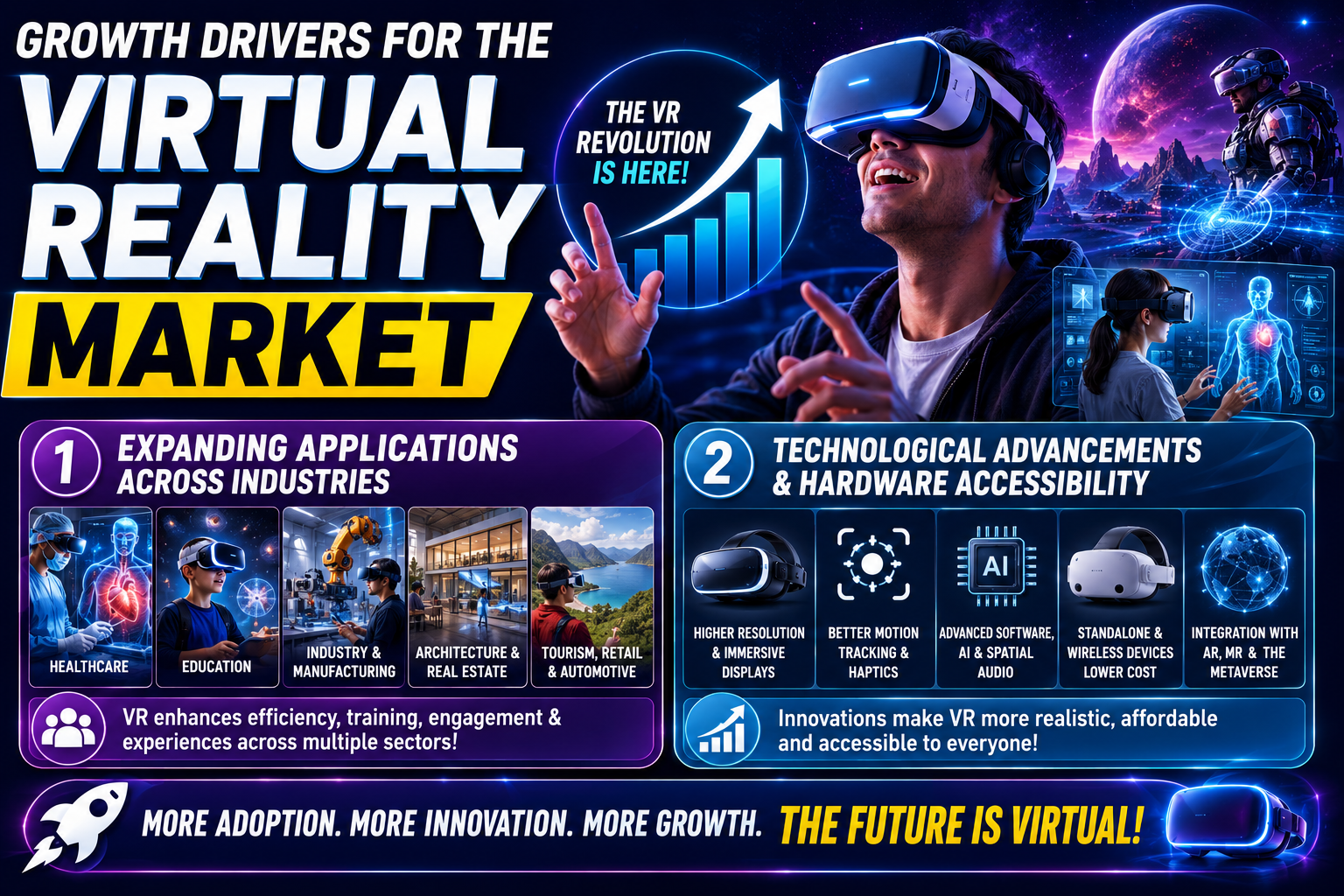
Modern VR systems offer significantly better performance than earlier generations. Improvements in display resolution, field of view, motion tracking, processing power, and refresh rates have enhanced realism while reducing discomfort.
Advancements in haptic feedback technology allow users to experience physical sensations within virtual environments, increasing immersion and interaction.
Artificial intelligence is also contributing to more dynamic and realistic virtual experiences by improving character behavior, environmental responsiveness, and personalization.
These innovations are making VR more practical, comfortable, and appealing to both consumers and businesses.
Standalone Headsets Are Making VR More Accessible
One of the biggest barriers to VR adoption has historically been cost and complexity.
Early VR systems often required expensive computers, gaming consoles, and extensive setup procedures. Today's standalone VR headsets have significantly reduced these barriers.
Modern standalone devices integrate processing power, displays, sensors, and tracking systems into a single wireless unit. Users can enjoy immersive experiences without purchasing additional hardware.
This accessibility has expanded the potential customer base and accelerated market adoption.
As manufacturers continue reducing costs and improving performance, VR is becoming increasingly accessible to mainstream consumers.
The Rise of the Metaverse and Extended Reality
The growing interest in the metaverse has created additional momentum for virtual reality adoption.
Many technology companies view VR as a foundational technology for future digital ecosystems where people work, socialize, learn, and entertain themselves within interconnected virtual environments.
The integration of virtual reality with augmented reality (AR), mixed reality (MR), artificial intelligence, and cloud computing is creating entirely new possibilities for digital interaction.
These developments are expanding VR's role beyond standalone experiences and positioning it as a key component of future computing platforms.
As investments in extended reality technologies continue increasing, the market is expected to experience significant long-term growth.
The United States Remains a Global Leader
The United States represents one of the largest and most influential virtual reality markets globally.
Strong consumer demand, advanced technological infrastructure, and substantial investment activity have established the country as a center for VR innovation.
American companies are leading advancements in hardware development, software creation, content production, and enterprise applications. The country also benefits from a thriving startup ecosystem and strong venture capital support.
Healthcare, education, entertainment, manufacturing, and real estate sectors throughout the United States continue adopting VR technologies at increasing rates.
This combination of innovation, investment, and adoption ensures the country's continued leadership in the global VR industry.
India Emerges as a Fast-Growing Market
India is becoming one of the most promising virtual reality markets in the world.
Rapid smartphone adoption, increasing internet penetration, and growing digital literacy are creating favorable conditions for VR expansion. The country's large youth population is particularly receptive to immersive technologies and interactive entertainment.
Beyond gaming, Indian businesses and educational institutions are exploring VR applications in training, healthcare, real estate, and professional development.
Government-led digital transformation initiatives and growing investments from technology companies are further supporting market development.
Although challenges related to affordability and infrastructure remain, India's long-term growth potential remains substantial.
Challenges Still Need to Be Addressed
Despite strong growth prospects, several challenges continue to impact the virtual reality industry.
Cost remains one of the most significant barriers. Premium VR hardware, accessories, and software solutions can be expensive, limiting accessibility for some consumers and organizations.
Motion sickness and user discomfort continue to affect portions of the user population, particularly during extended VR sessions. Although technological improvements have reduced these issues, further advancements are still needed.
Content availability also remains a challenge. Developing high-quality VR experiences requires significant investment, specialized expertise, and technical resources.
Additionally, compatibility issues between platforms and ecosystems can create complexity for users and developers.
Addressing these challenges will be essential for achieving broader adoption and sustaining long-term market growth.
Recent Industry Developments Signal Strong Momentum
Recent developments demonstrate the industry's rapid pace of innovation.
In October 2025, Apple introduced the Vision Pro featuring the M5 chip, combining advanced environment mapping and hardware-accelerated rendering capabilities.
Samsung and Google launched Android XR, an open operating system designed specifically for extended reality devices, with new hardware expected to reach the market in 2026.
Meta and Microsoft expanded collaboration by integrating Microsoft 365 productivity tools into Quest headsets, strengthening enterprise-focused VR applications.
Meanwhile, Qualcomm advanced development of Snapdragon XR3 reference designs, aiming to support more affordable professional-grade VR devices.
These developments highlight ongoing investments and increasing competition among major technology companies seeking leadership within the VR ecosystem.
Final Thoughts
Virtual reality is no longer an emerging technology waiting for its moment—it is rapidly becoming a fundamental component of the digital future.
Its ability to create immersive, interactive, and highly engaging experiences is transforming industries ranging from entertainment and healthcare to education, manufacturing, and enterprise collaboration.
With the market projected to grow from US$14.85 billion in 2025 to US$91.71 billion by 2034, virtual reality stands among the fastest-growing technology sectors globally.
As hardware becomes more affordable, software becomes more sophisticated, and applications continue expanding across industries, VR is poised to reshape how people learn, work, communicate, and experience the world around them.
For consumers, businesses, educators, and innovators alike, the virtual reality revolution is only just beginning.
About the Creator
Enjoyed the story? Support the Creator.
Subscribe for free to receive all their stories in your feed.
Comments
There are no comments for this story
Be the first to respond and start the conversation.