
Verify Real-Time Moisture Sensing Before Approving Any Asphalt Hot Mix Plant Purchase
Before approving an asphalt hot mix plant purchase, how do we verify that the infrared moisture sensors on the continuous feed conveyor adjust the heavy-oil burner intensity in real-time to prevent stripping and premature thermal fatigue of the drum flights?

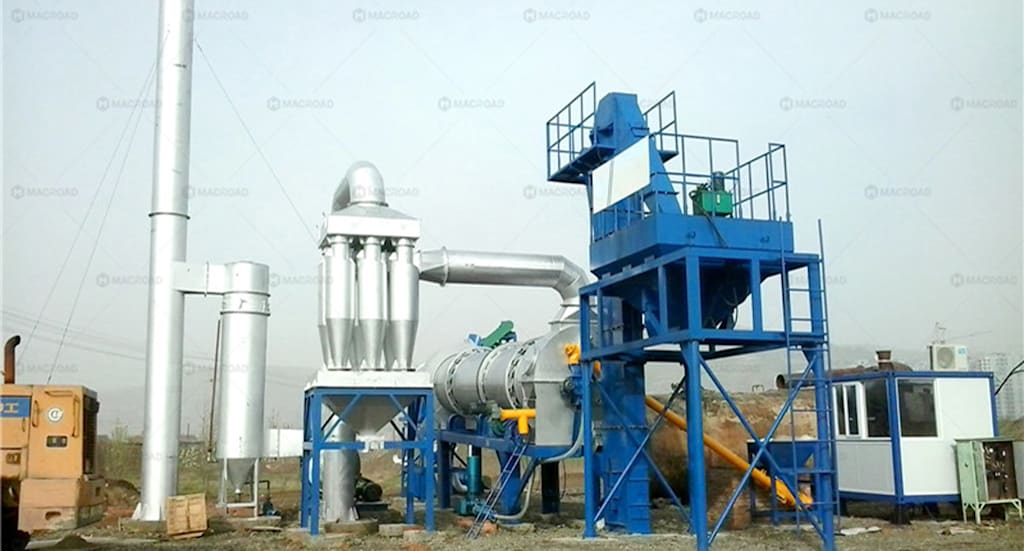
Sudden monsoon downpours do not raise aggregate moisture uniformly — they create uneven spikes across the feed conveyor that a manually adjusted burner cannot track in time. An asphalt hot mix plant without verified real-time moisture sensing and closed-loop burner control responds to these spikes after the damage is already occurring: stripped aggregate surfaces, thermally fatigued drum flights, and off-specification mix that cannot be placed without quality risk. Verifying that the infrared moisture sensing system genuinely closes the loop between conveyor feed and burner intensity is therefore a procurement requirement, not a commissioning detail to resolve after delivery.

How Infrared Moisture Sensors Function in a Drum Asphalt Mixing Plant
Infrared moisture sensors mounted on the continuous feed conveyor measure surface moisture of aggregate in motion by detecting the absorption signature of water at specific wavelengths. In a drum asphalt mixing plant, this reading must be continuous, high-frequency, and representative of the full conveyor cross-section — not a spot measurement at the belt centerline that misses moisture variation across the aggregate width. Specifically, request the sensor coverage width and sampling frequency from every asphalt hot mix plant supplier under evaluation. A sensor that samples too slowly or covers too narrow a belt width will miss the sharp moisture fronts that monsoon downpours create between dry and saturated aggregate loads arriving in sequence.
Sensor calibration against your specific aggregate type is equally critical. Infrared moisture measurement accuracy varies with aggregate color, mineralogy, and surface texture — a sensor calibrated on limestone aggregate will produce systematic errors on basalt or granite without recalibration. Any drum asphalt mixing plant supplier who cannot confirm field calibration protocols for your aggregate type is offering a sensing system that may be technically present but operationally unreliable under your site conditions.

Closed-Loop Burner Control and Its Protection Against Drum Flight Fatigue
The moisture sensor reading has no protective value unless it is wired into a closed-loop control architecture that adjusts burner firing rate within a response window short enough to prevent thermal damage. In a drum asphalt mixing plant processing aggregate at high throughput, the time between a moisture spike entering the drum and that material reaching the bitumen injection point is measured in seconds. The burner control response must operate within that window — increasing firing rate as wet aggregate enters and reducing it as moisture normalizes — to maintain consistent drum exit temperature without overheating flights during low-moisture periods.
In light of this, request the control loop response time specification from every asphalt hot mix plant manufacturer. A system with a response lag exceeding the drum residence time of the aggregate is reacting to conditions that have already passed through the production zone. Conversely, a well-engineered drum asphalt mixing plant with a fast-response closed-loop integrates moisture sensor data, burner modulation, and conveyor feed rate into a single control algorithm that anticipates thermal demand rather than chasing it.
Flight fatigue under monsoon conditions is a cumulative mechanical failure, not a sudden event. Repeated thermal cycling — burner intensity rising sharply for wet aggregate then dropping for dry material — stresses flight steel at weld attachment points through differential expansion and contraction. An asphalt hot mix plant with stable closed-loop moisture control dramatically reduces this cycling amplitude, extending flight service life across a full monsoon paving season.
Conclusion
Approving an asphalt hot mix plant purchase for monsoon-exposed operations without verifying infrared sensor coverage width, calibration protocols, and closed-loop burner response time is accepting operational risk that will surface as stripped mix, fatigued drum flights, and unplanned maintenance on the tightest production shifts. A drum asphalt mixing plant that genuinely manages moisture-driven thermal variability documents all three of these parameters without hesitation — and any supplier who cannot should be replaced on the shortlist before the contract is signed.
About the Creator
Macroad Asphalt Plant
Macroad, a global leading manufacturer in asphalt mixing plants, offers a wide range of specifications to meet diverse project needs. Its high-quality, efficient equipment is widely applied in road construction.
Enjoyed the story? Support the Creator.
Subscribe for free to receive all their stories in your feed.
Comments
There are no comments for this story
Be the first to respond and start the conversation.