
Vacuum Insulation Panel Market to Reach US$ 15.72 Billion by 2034, Driven by Energy Efficiency and Cold Chain Expansion
Rising Demand for Sustainable Insulation Solutions Accelerates Global Market Growth

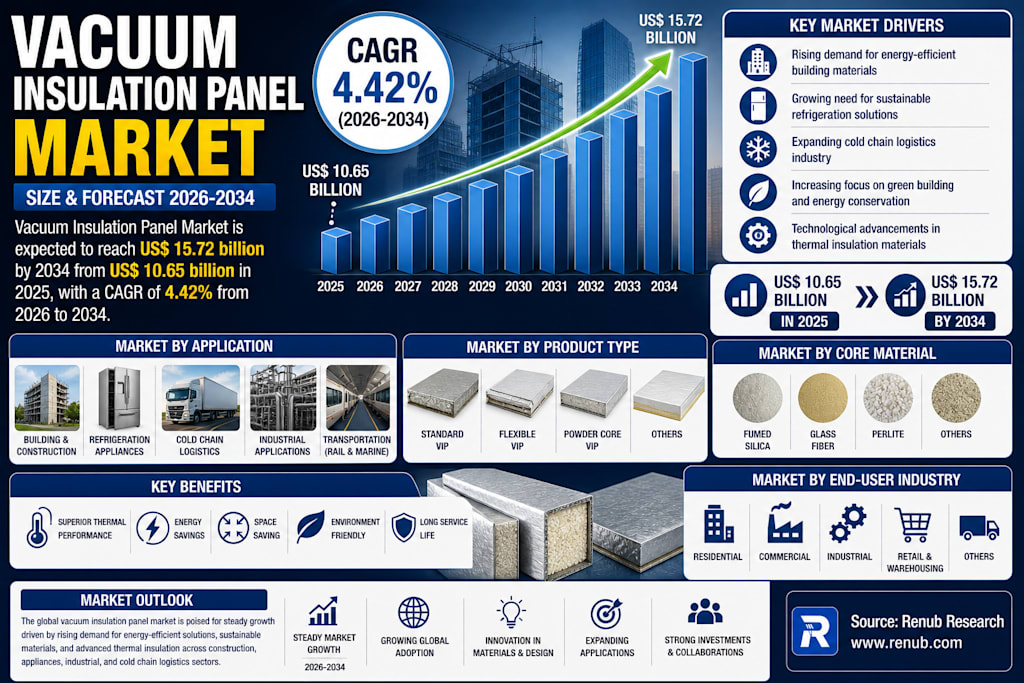
The global Vacuum Insulation Panel (VIP) market is witnessing a steady and transformative expansion, fueled by the increasing global emphasis on energy efficiency, sustainability, and advanced thermal insulation technologies. According to recent insights, the market is projected to grow from US$ 10.65 billion in 2025 to US$ 15.72 billion by 2034, registering a compound annual growth rate (CAGR) of 4.42% from 2026 to 2034.
This growth trajectory reflects a broader shift in industries such as construction, refrigeration, logistics, and appliances toward high-performance insulation materials that offer superior thermal resistance while optimizing space.
Understanding Vacuum Insulation Panels: A Technological Breakthrough
Vacuum insulation panels represent one of the most advanced insulation technologies available today. Unlike traditional materials such as fiberglass or polyurethane, VIPs consist of a core material enclosed within an airtight envelope, from which air is evacuated to create a vacuum. This structure drastically reduces heat transfer, resulting in exceptionally low thermal conductivity.
The outcome is clear: thinner insulation layers with significantly higher performance. This makes VIPs particularly valuable in applications where space constraints and thermal efficiency are equally critical.
Industries such as building construction, cold storage, pharmaceuticals, and transportation are increasingly adopting VIPs to meet modern energy standards and operational efficiency requirements.
Market Growth Drivers
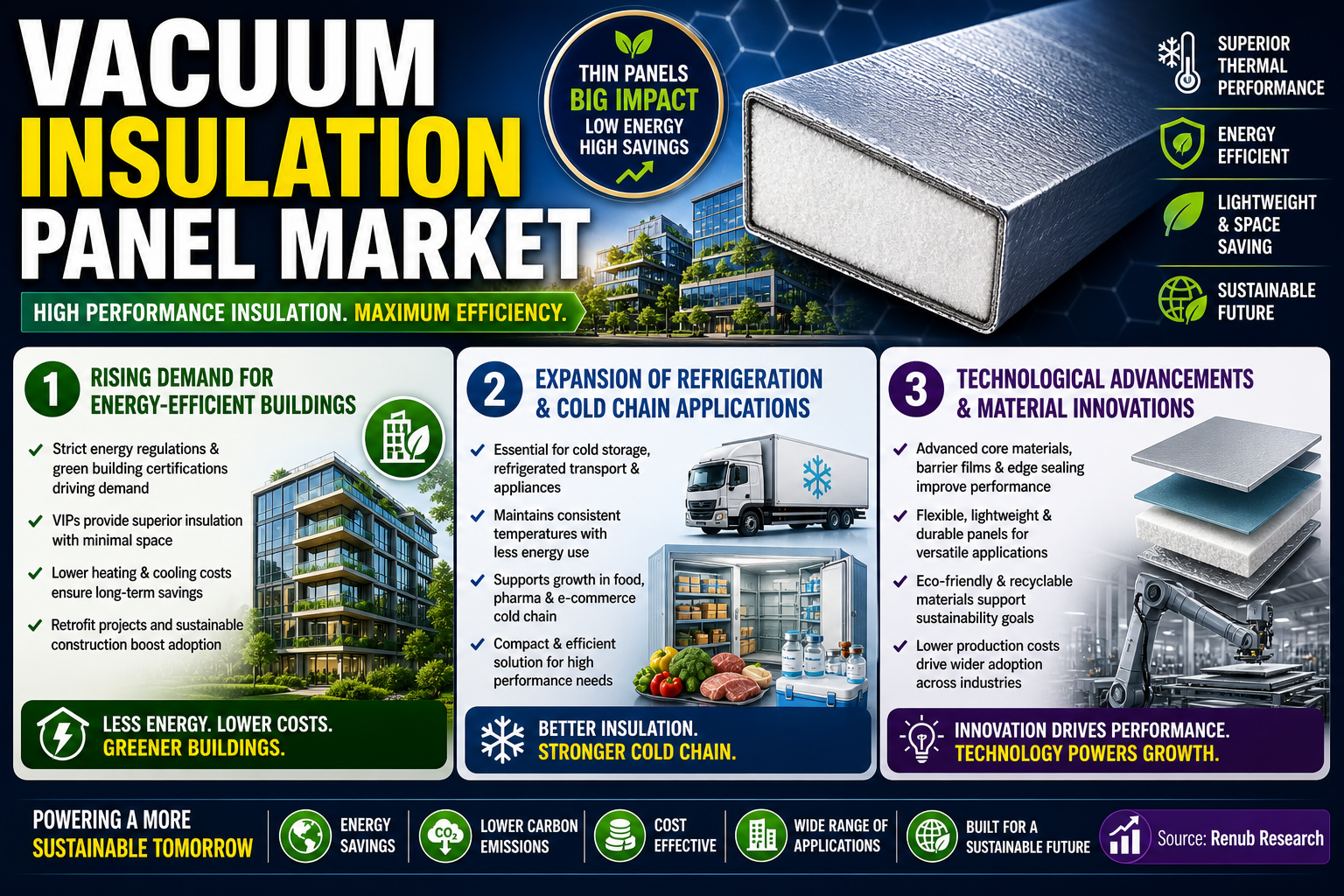
1. Increasing Demand for Energy-Efficient Buildings
One of the most powerful drivers of the VIP market is the global push toward energy-efficient infrastructure. Governments worldwide are implementing strict building codes and carbon reduction targets, compelling developers to adopt advanced insulation technologies.
VIPs offer a unique advantage: they deliver superior insulation performance without increasing wall thickness, making them ideal for both new constructions and retrofitting projects. As green building certifications become more mainstream, the demand for such high-performance materials continues to rise.
Additionally, long-term cost savings from reduced heating and cooling requirements are encouraging both residential and commercial sectors to invest in VIP technology.
2. Expansion of Refrigeration and Cold Chain Logistics
The rapid growth of e-commerce, food delivery services, and pharmaceutical distribution has significantly increased the need for efficient cold chain logistics. Maintaining consistent temperatures during storage and transportation is critical, and VIPs provide a highly effective solution.
Their ability to deliver excellent insulation in compact spaces allows for:
- Increased storage capacity
- Reduced energy consumption
- Enhanced temperature stability
From refrigerated trucks to vaccine transport systems, VIPs are becoming indispensable in modern cold chain infrastructure.
3. Technological Advancements and Material Innovation
Continuous innovation in VIP manufacturing is further accelerating market growth. Improvements in:
- Core materials
- Barrier films
- Edge sealing technologies
have enhanced durability, flexibility, and cost-efficiency.
Research into lightweight and flexible panels is expanding the use of VIPs into new sectors such as portable refrigeration, appliances, and industrial insulation. Moreover, the development of eco-friendly and recyclable materials aligns with global sustainability goals, making VIPs more attractive to environmentally conscious industries.
Key Challenges in the Market
High Manufacturing and Installation Costs
Despite their advantages, VIPs remain relatively expensive compared to conventional insulation materials. The production process requires advanced technology and precision, leading to higher capital costs.
Additionally, installation demands skilled labor to prevent damage, further increasing overall expenses. This cost barrier limits adoption, particularly in price-sensitive markets.
Durability and Sensitivity Issues
VIPs are highly sensitive to physical damage. Even minor punctures can compromise the vacuum, significantly reducing insulation performance.
Challenges include:
- Risk during transportation and handling
- Vulnerability during installation
- Exposure to extreme environmental conditions
These factors necessitate careful handling and robust quality control measures, adding complexity to their deployment.
Regional Market Insights
United States
The United States remains a major market for VIPs, driven by strong demand for energy-efficient construction and advanced refrigeration systems. The growing focus on green buildings and retrofitting projects is accelerating adoption.
Additionally, the expansion of cold chain logistics and high-efficiency appliances further strengthens the market outlook in the region.
Germany
Germany is at the forefront of sustainable construction, supported by stringent energy regulations and government incentives. The adoption of VIPs is increasing across residential, commercial, and industrial sectors.
The country’s commitment to reducing energy consumption and carbon emissions continues to drive demand for advanced insulation solutions.
China
China’s rapid urbanization and industrial growth are major contributors to the VIP market. Government initiatives promoting energy efficiency and green building practices are accelerating adoption.
The booming e-commerce and food delivery sectors are also fueling demand for cold chain solutions, where VIPs play a critical role.
Saudi Arabia
In Saudi Arabia, harsh climatic conditions and rising energy costs are driving the need for high-performance insulation. Government initiatives focused on sustainability and energy efficiency are supporting market growth.
The expansion of cold storage and logistics infrastructure further boosts demand for VIPs in the region.
Competitive Landscape and Key Players
The global VIP market is moderately competitive, with several key players focusing on innovation, partnerships, and expansion strategies. Prominent companies include:
- Avery Dennison Corporation
- BASF SE
- Kingspan Group plc
- Etex Group
- Panasonic Corporation
- Morgan Advanced Materials
- Knauf Insulation
- Evonik Industries AG
These companies are investing heavily in research and development to enhance product performance, reduce costs, and expand application areas.
Recent Developments in the VIP Market
Hutchinson SA & va-Q-tec AG (March 2023)
Announced a strategic collaboration to develop scalable VIP solutions for thermal management in electric mobility.
NEVEON (March 2022)
Expanded VIP production with a fully automated facility in the Czech Republic.
Recticel (February 2022)
Acquired Trimo to strengthen its insulation portfolio.
Kingspan Group plc
Increased investment in high-performance insulation technologies to support global sustainability goals.
BASF SE
Continued R&D efforts to develop advanced core materials for improved VIP efficiency.
Panasonic Corporation
Integrated VIP technology into next-generation refrigeration appliances.
Evonik Industries AG
Focused on innovative silica-based core materials for enhanced thermal performance.
Knauf Insulation
Expanded its sustainable insulation product line, including VIP solutions.
Morgan Advanced Materials
Invested in advanced materials to improve durability and efficiency of VIPs.
Avery Dennison Corporation
Enhanced barrier film technologies to improve panel longevity and performance.
Market Segmentation Overview
The VIP market is segmented based on:
By Type
- Flat Panels
- Special Shape Panels
By Raw Material
- Plastics
- Metals
By Core Material
- Silica
- Fiberglass
- Others
By Application
- Construction
- Cooling & Freezing Devices
- Logistics
- Others
By Region
- North America
- Europe
- Asia-Pacific
- Latin America
- Middle East & Africa
This diverse segmentation highlights the wide applicability of VIP technology across industries and geographies.
Future Outlook: A Market Driven by Sustainability
The future of the vacuum insulation panel market looks promising, with sustainability and energy efficiency at its core. As industries continue to prioritize reducing carbon footprints and operational costs, VIPs are expected to play a critical role.
Emerging trends include:
- Integration with smart building technologies
- Development of ultra-thin and flexible panels
- Increased adoption in electric vehicles and portable cooling systems
Moreover, advancements in manufacturing processes are likely to reduce costs, making VIPs more accessible to a broader range of applications.
Final Thoughts
The Vacuum Insulation Panel market stands at the intersection of innovation, sustainability, and efficiency. With strong growth projections and expanding applications, VIPs are poised to become a cornerstone of modern insulation solutions.
While challenges such as high costs and durability concerns persist, ongoing technological advancements and increasing awareness are expected to address these barriers over time.
In a world increasingly focused on energy conservation and environmental responsibility, VIPs are not just an option—they are quickly becoming a necessity.
About the Creator
Enjoyed the story? Support the Creator.
Subscribe for free to receive all their stories in your feed.
Comments
There are no comments for this story
Be the first to respond and start the conversation.