
UPS Market Set to Reach US$ 14.48 Billion by 2034 as Data Centers, Healthcare, and Digital Infrastructure Drive Global Demand
Reliable Power Is No Longer Optional in a Hyperconnected World

Power outages may last only a few seconds, but in today's digital economy, those few seconds can cost organizations millions of dollars. From hospitals and banking institutions to cloud computing facilities and manufacturing plants, uninterrupted access to electricity has become one of the most critical requirements for modern operations.
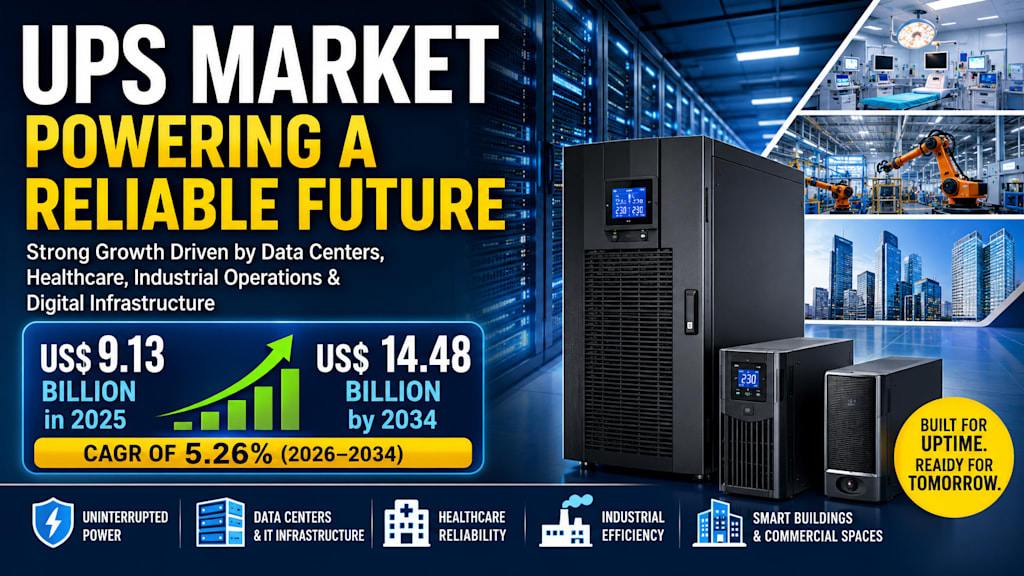
This growing dependence on continuous power is fueling remarkable expansion in the global Uninterruptible Power Supply (UPS) market. According to Renub Research, the global UPS Market is expected to increase from US$ 9.13 Billion in 2025 to US$ 14.48 Billion by 2034, expanding at a CAGR of 5.26% between 2026 and 2034. The market's growth is largely attributed to rising investments in data centers, increasing digitalization, expanding IT infrastructure, and growing concerns about power reliability worldwide.
Understanding the Importance of UPS Systems
An Uninterruptible Power Supply (UPS) system serves as a critical safeguard against power interruptions, voltage fluctuations, and electrical disturbances. Unlike generators that require startup time, UPS systems provide immediate backup power, ensuring that connected equipment continues operating without disruption.
Modern UPS systems consist of batteries, inverters, and sophisticated control mechanisms designed to maintain voltage stability and protect sensitive equipment from electrical anomalies.
Today, UPS systems are widely deployed across:
Data centers
Healthcare facilities
Telecommunications networks
Manufacturing plants
Commercial buildings
Educational institutions
Financial organizations
Residential applications
As organizations increasingly rely on digital platforms, cloud services, and automated systems, the need for dependable power protection solutions continues to grow.
Why the UPS Market Is Expanding Rapidly
Growing Need for Reliable Power Backup
One of the strongest growth drivers for the UPS market is the increasing demand for reliable power backup solutions.
Many regions continue to experience voltage fluctuations, unstable electrical grids, and occasional power outages. For industries that depend heavily on technology, even brief interruptions can result in equipment damage, production losses, and operational downtime.
Healthcare providers rely on continuous electricity for life-saving medical devices. Financial institutions require uninterrupted systems to process transactions. Manufacturing facilities depend on automated equipment that must remain operational around the clock.
As businesses strive to minimize risks associated with power failures, UPS systems have become an essential component of operational resilience.
Data Center Expansion Accelerates Demand
The explosive growth of cloud computing, artificial intelligence, big data analytics, and digital services is transforming the UPS market landscape.
Modern data centers process and store massive volumes of information every second. Even a momentary power interruption can lead to data corruption, service disruptions, and significant financial losses.
As hyperscale and enterprise data centers continue expanding globally, operators are investing heavily in advanced UPS solutions capable of supporting increasingly complex workloads.
The surge in AI-focused infrastructure is further strengthening demand for high-capacity UPS systems that can handle rapidly changing power loads while ensuring maximum uptime.
Industrial Automation and Smart Facilities
Industries worldwide are embracing automation technologies to improve productivity and operational efficiency.
Advanced manufacturing systems, robotic production lines, and smart factories require highly stable electrical power to operate effectively. Unexpected power disruptions can halt production processes, damage machinery, and create costly delays.
Similarly, commercial facilities such as shopping centers, office buildings, educational campuses, and airports depend on uninterrupted power for elevators, security systems, communication networks, and operational technologies.
The rise of smart buildings and connected infrastructure is creating additional opportunities for UPS manufacturers.
Challenges Facing the Industry
High Installation Costs
While UPS systems deliver substantial operational benefits, cost remains a significant challenge.
Large-capacity UPS installations often require considerable upfront investment. Organizations must purchase batteries, inverters, monitoring systems, and supporting infrastructure.
For small and medium-sized businesses, these initial costs can represent a major barrier to adoption.
In addition to acquisition expenses, organizations must budget for routine inspections, servicing, and battery replacements throughout the system's lifecycle.
Environmental Concerns and Battery Disposal
Battery management remains another important issue for the UPS industry.
Most UPS systems utilize lead-acid or lithium-ion batteries. Over time, these batteries require replacement to maintain performance and reliability.
Improper disposal can create environmental risks due to the presence of hazardous materials. Governments worldwide are implementing stricter regulations surrounding battery recycling and waste management.
As sustainability becomes a higher priority, manufacturers are investing in cleaner battery technologies, recycling programs, and environmentally responsible power solutions.
Key Market Segments Driving Revenue
0–100 kVA UPS Systems
Small and medium-capacity UPS systems represent a substantial portion of market demand.
These solutions are commonly used in:
Small businesses
Educational institutions
Retail stores
Network rooms
Commercial offices
Small data centers
Their affordability, compact size, and ease of installation make them attractive options for organizations seeking dependable power protection without large capital investments.
Standby UPS Systems
Standby UPS units remain popular among residential users and small businesses.
These systems provide basic power backup functionality and are commonly deployed for:
Personal computers
Home offices
Retail applications
Network equipment
Their simplicity and cost-effectiveness continue to support strong demand worldwide.
Line-Interactive UPS Solutions
Line-interactive UPS systems have gained popularity because they offer enhanced voltage regulation through Automatic Voltage Regulation (AVR) technology.
These systems are particularly valuable in environments where voltage fluctuations occur frequently.
Applications include:
Small and medium enterprises
Telecommunications equipment
Network servers
IT infrastructure
The growing need for reliable digital operations is expected to sustain demand for this segment throughout the forecast period.
Data Centers Remain the Largest Growth Opportunity
Among all application categories, data centers represent one of the most attractive opportunities for UPS vendors.
The continued expansion of:
Artificial intelligence platforms
Cloud services
Streaming applications
E-commerce ecosystems
Enterprise software platforms
is generating unprecedented demand for uninterrupted power infrastructure.
As organizations process increasingly large volumes of digital information, UPS systems will remain fundamental to maintaining operational continuity and protecting valuable data assets.
Healthcare Sector Continues to Invest
Healthcare organizations require absolute reliability when it comes to power supply.
Medical facilities depend on electricity to operate:
Ventilators
Imaging equipment
Monitoring systems
Diagnostic devices
Laboratory instruments
Power disruptions can jeopardize patient safety and interrupt critical medical procedures.
As healthcare infrastructure expands worldwide, investment in advanced UPS systems is expected to rise significantly.
Regional Market Outlook
United States
The United States remains one of the most advanced UPS markets globally.
Strong demand stems from:
Large-scale data centers
Financial institutions
Healthcare facilities
Industrial automation projects
Telecommunications infrastructure
The country's leadership in cloud computing and AI deployment continues to create substantial opportunities for UPS providers.
United Kingdom
The UK market benefits from increasing digital transformation initiatives and growing cloud infrastructure investments.
Organizations across banking, healthcare, telecommunications, and retail sectors continue investing in UPS technologies to maintain uninterrupted operations and improve power reliability.
India
India represents one of the fastest-growing UPS markets.
Rapid digitalization, increasing data center investments, expanding IT infrastructure, and ongoing concerns regarding power reliability are fueling adoption.
Growth in e-commerce, cloud computing, fintech, and healthcare services is further strengthening market demand.
Saudi Arabia
Saudi Arabia's digital transformation initiatives and infrastructure development projects are creating strong opportunities for UPS suppliers.
Investments in smart cities, industrial expansion, healthcare modernization, and data center construction continue to support market growth.
10 Recent Developments Shaping the Competitive Landscape
ABB introduced the AI-Ready MegaFlex UL UPS system for modern data centers in June 2025.
Advantech launched the IPC-610LMB-40BEA1 battery backup solution for semiconductor manufacturing applications in July 2025.
Vertiv introduced Vertiv Trinergy UPS systems designed for varying data center loads.
Vertiv launched Vertiv PowerNexus, integrating UPS and switchgear configurations.
UPS expanded healthcare logistics capabilities through its Hyderabad cross-docking facility in India.
UPS introduced Global Checkout to simplify international e-commerce purchases in March 2025.
Growing adoption of AI infrastructure is encouraging manufacturers to develop higher-capacity UPS systems.
Data center operators are increasingly deploying modular UPS architectures for scalability.
Manufacturers are accelerating investments in lithium-ion battery technologies to improve efficiency and sustainability.
Leading vendors are integrating intelligent monitoring and predictive maintenance capabilities into next-generation UPS platforms.
Leading Companies Operating in the Market
Major players shaping the global UPS market include:
Hitachi Ltd.
ABB Ltd.
General Electric Company
Emerson Electric Co.
Mitsubishi Electric Corporation
Toshiba Corporation
Delta Electronics Inc.
Schneider Electric SE
These organizations continue investing in innovation, energy efficiency, battery technologies, and intelligent power management systems to strengthen their competitive positions.
Final Thoughts
The modern economy runs on uninterrupted access to electricity. Whether powering artificial intelligence workloads, supporting life-saving medical equipment, protecting financial transactions, or enabling industrial automation, UPS systems have become indispensable infrastructure.
As digital transformation accelerates worldwide, the importance of reliable power protection will continue to increase. With the global UPS Market projected to grow from US$ 9.13 Billion in 2025 to US$ 14.48 Billion by 2034, the industry is poised for sustained expansion driven by data centers, healthcare facilities, industrial modernization, and growing digital dependency.
Organizations that prioritize resilience, uptime, and operational continuity are likely to remain major contributors to the next chapter of UPS market growth.
About the Creator
Enjoyed the story? Support the Creator.
Subscribe for free to receive all their stories in your feed.
Comments
There are no comments for this story
Be the first to respond and start the conversation.