
UPS Market Expands as Data Centers and Digital Infrastructure Drive Demand for Reliable Power Backup
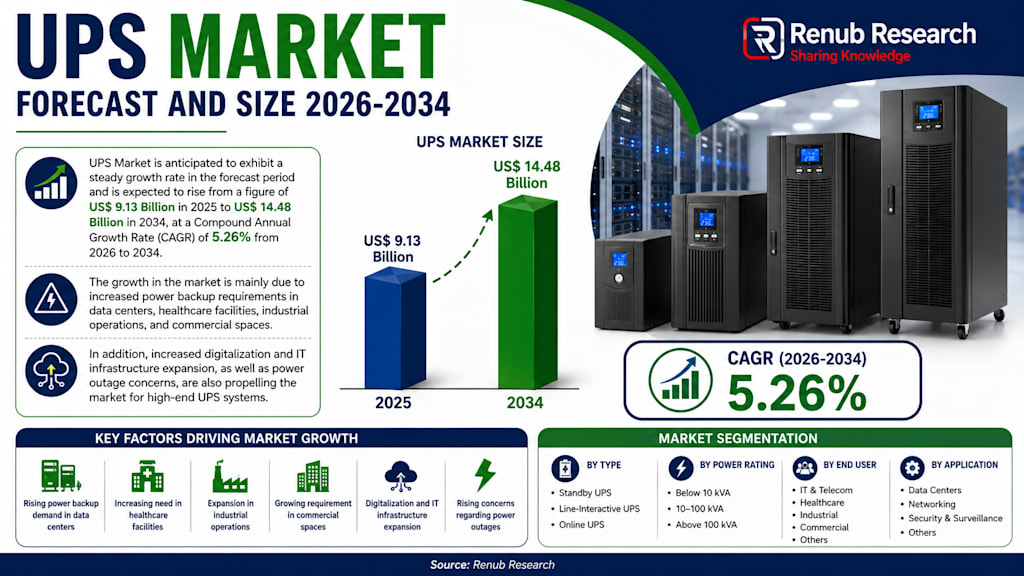
The global UPS market is projected to rise from US$ 9.13 billion in 2025 to US$ 14.48 billion by 2034, supported by rising digitalization, growing data centers, and increasing need for uninterrupted power supply.

Reliable power supply is becoming essential in a digital-first world
The modern world depends heavily on uninterrupted access to electricity. Businesses, hospitals, data centers, manufacturing facilities, telecommunications systems, and even homes now rely on digital technologies that cannot afford sudden power interruptions. As a result, Uninterruptible Power Supply systems, commonly known as UPS systems, have become critical components of modern infrastructure.
According to the latest market outlook, the global UPS market is expected to grow from US$ 9.13 billion in 2025 to US$ 14.48 billion by 2034, expanding at a CAGR of 5.26% during 2026–2034. The market’s growth is being fueled by rising power backup requirements across data centers, healthcare facilities, industrial operations, commercial buildings, and expanding IT infrastructure worldwide.
UPS systems provide immediate emergency power during voltage fluctuations or power failures. They help protect electronic devices, maintain voltage stability, and prevent operational disruptions that could lead to financial losses or equipment damage.
Digital transformation is increasing the need for UPS systems
One of the biggest reasons behind the growth of the UPS market is the increasing dependence on digital infrastructure. Businesses across industries are using cloud computing, artificial intelligence, big data analytics, automation systems, and digital communication technologies at an unprecedented scale.
These systems require a constant and stable power supply to operate efficiently. Even a short interruption can lead to data loss, operational downtime, financial damage, or equipment failure. UPS systems therefore act as a protective layer that keeps systems functioning during unexpected outages.
Industries such as healthcare, banking, telecommunications, manufacturing, and IT are especially dependent on reliable backup power solutions because uninterrupted operations are essential to their business continuity.
The increasing use of electronic devices in homes and offices has also boosted demand for smaller UPS systems that protect computers, routers, and communication equipment from sudden shutdowns and voltage fluctuations.
Data centers are becoming one of the biggest growth drivers
The rapid expansion of data centers worldwide is significantly contributing to the growth of the UPS industry. As businesses generate and store enormous amounts of digital data, the demand for secure and reliable power systems inside data centers continues to rise.
Cloud computing, artificial intelligence, e-commerce, online services, and digital transformation initiatives have accelerated the construction of hyperscale data centers globally. In these facilities, even a few seconds of power failure can result in severe operational disruptions and financial losses.
UPS systems play a vital role by providing immediate backup power while ensuring a smooth transition to generator systems during outages. The report highlights that ABB launched its AI-Ready MegaFlex UL UPS system in June 2025 to address the evolving power demands of modern data centers.
This demonstrates how UPS manufacturers are increasingly developing advanced intelligent systems tailored specifically for data-intensive operations.
Industrial automation is increasing demand for power stability
Manufacturing plants, factories, and industrial facilities are also becoming increasingly dependent on UPS systems. Modern industrial operations rely heavily on computerized machinery, automation systems, robotics, and digital monitoring equipment that require stable and uninterrupted electricity.
Unexpected power interruptions can stop production lines, damage expensive equipment, delay operations, and create financial losses. UPS systems reduce these risks by providing instant backup power and voltage regulation during disruptions.
Commercial buildings such as offices, shopping centers, educational institutions, and hospitals also depend on UPS systems to maintain critical operations during outages. Security systems, elevators, communication networks, and computer systems all require stable electricity to function properly.
The growth of smart buildings and automated infrastructure is further increasing the need for advanced UPS technologies capable of handling increasingly complex energy requirements.
Healthcare facilities rely heavily on UPS systems
Healthcare represents one of the most important application areas for UPS systems. Hospitals, diagnostic centers, clinics, and laboratories require uninterrupted electricity to power life-saving equipment such as ventilators, monitoring systems, diagnostic machines, and surgical devices.
In healthcare environments, even a brief power interruption can put patient safety at risk. UPS systems therefore serve as essential backup power solutions that protect sensitive medical equipment and maintain operational continuity.
As healthcare infrastructure expands worldwide and medical technologies become more advanced, demand for UPS systems in healthcare facilities is expected to continue growing steadily.
Standby and line-interactive UPS systems remain highly important
The UPS market includes several product categories designed for different power requirements and applications. Standby UPS systems are widely used in homes, offices, and small businesses because of their affordability, simple design, and ability to provide emergency backup during outages.
These systems are commonly used to support personal computers, home networks, and small electronic devices. As digital device usage increases globally, the demand for standby UPS systems continues to expand.
Line-interactive UPS systems represent another important segment because they provide enhanced voltage regulation and protection against minor fluctuations without constantly switching to battery mode.
These systems are widely used in small and medium-sized businesses, IT infrastructure, telecommunications equipment, and network servers. They offer better protection than traditional standby systems while remaining more affordable than large online UPS systems.
Small and medium businesses are supporting market expansion
UPS systems with capacities ranging from 0–100 kVA are becoming increasingly popular among small and medium businesses, educational institutions, retail stores, and smaller commercial facilities.
These systems are valued for their compact size, cost-effectiveness, and reliability. As small businesses continue adopting digital technologies and cloud-based operations, the need for dependable backup power solutions is rising steadily.
The growth of startups, IT-enabled services, and digital business models in developing countries is also creating strong demand for medium-capacity UPS systems.
Rising installation and maintenance costs remain a challenge
Despite strong market growth, the UPS industry faces several challenges. One of the biggest concerns is the high initial cost associated with purchasing and installing large-capacity UPS systems.
Large data centers and industrial facilities often require expensive batteries, inverters, grid integration, and maintenance systems. In addition to installation costs, UPS systems also require regular servicing, battery replacement, and technical inspections.
For smaller businesses, these operational costs can become a major financial burden, limiting adoption in some markets.
Environmental concerns are increasing around battery disposal
Battery management is another major issue affecting the UPS market. Most UPS systems rely on lead-acid or lithium-ion batteries, which require periodic replacement to maintain performance.
Improper disposal of used batteries can create environmental risks due to the presence of hazardous materials such as lead and acid. Governments and environmental agencies are therefore implementing stricter recycling and disposal regulations.
As sustainability becomes more important globally, UPS manufacturers are increasingly focusing on developing cleaner battery technologies, longer battery life cycles, and improved recycling solutions.
The United States remains one of the leading UPS markets
The United States represents one of the most developed UPS markets due to its advanced digital infrastructure and heavy dependence on cloud computing, artificial intelligence, and data analytics technologies.
The country has a large concentration of data centers, healthcare facilities, industrial automation systems, and smart buildings that require uninterrupted power supply solutions.
The report also highlights UPS Global Checkout, launched in March 2025, which simplifies international e-commerce purchases by clearly presenting duties and fees upfront to consumers. Although separate from the UPS power systems industry, it reflects broader investments in logistics and digital commerce infrastructure associated with technology-driven growth.
India is becoming a rapidly growing UPS market
India’s UPS market is expanding quickly due to increasing digitalization, rising IT infrastructure, and persistent power fluctuation issues in many regions. Businesses, hospitals, educational institutions, and households increasingly depend on UPS systems for backup power.
The growth of data centers, e-commerce platforms, cloud computing services, and digital businesses has further accelerated demand for UPS solutions in the country.
The report notes that UPS launched a specialized cross-docking healthcare facility in Hyderabad in October 2024 equipped with temperature-controlled freight forwarding capabilities for healthcare products. This reflects the broader expansion of infrastructure supporting healthcare and digital logistics operations in India.
Saudi Arabia is investing heavily in digital infrastructure
Saudi Arabia’s UPS market is also witnessing steady growth because of increasing investment in digital transformation, smart city projects, and infrastructure development. Industries such as oil and gas, telecommunications, healthcare, and data centers all require stable backup power systems to maintain operations.
The country’s focus on technological modernization and industrial diversification is expected to create further opportunities for advanced UPS systems in the coming years.
Major companies continue investing in innovation
The UPS market includes several major global companies focused on power management, industrial automation, and electrical infrastructure. Key players mentioned in the report include Hitachi Ltd., ABB Ltd., General Electric Company, Emerson Electric Co., Mitsubishi Electric Corporation, Toshiba Corporation, Delta Electronics Inc., and Schneider Electric SE.
Competition in the market is increasingly centered around energy efficiency, intelligent monitoring systems, battery innovation, scalability, and sustainability.
Manufacturers are investing heavily in AI-powered monitoring systems, modular UPS designs, and eco-friendly battery technologies to meet the evolving demands of modern industries.
Final thoughts
The UPS market is becoming increasingly important in a world driven by digital infrastructure, automation, cloud computing, and smart technologies. Reliable power backup is no longer optional for many industries; it is essential for maintaining operational continuity, protecting sensitive equipment, and preventing financial losses.
The projected increase from US$ 9.13 billion in 2025 to US$ 14.48 billion by 2034 highlights the growing dependence on uninterrupted power systems worldwide. As businesses continue investing in digital transformation and advanced infrastructure, demand for efficient and intelligent UPS systems is expected to remain strong.
The future of the industry will likely be shaped by innovations in battery technology, smart energy management, sustainability, and the growing need for resilient power infrastructure capable of supporting an increasingly connected global economy.
About the Creator
Enjoyed the story? Support the Creator.
Subscribe for free to receive all their stories in your feed.
Comments
There are no comments for this story
Be the first to respond and start the conversation.