
United States Wi-Fi Chipset Market Set for Strong Growth as Smart Devices and Wi-Fi 6 Demand Surge
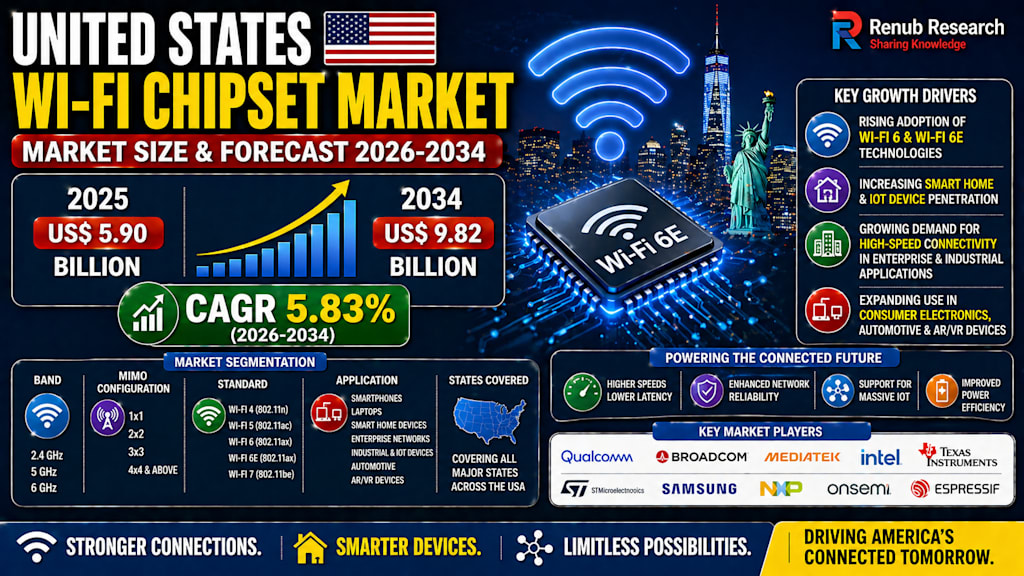
Renub Research forecasts the U.S. Wi-Fi Chipset Market to rise from US$ 5.90 Billion in 2025 to US$ 9.82 Billion by 2034, driven by next-generation connectivity needs.

The digital world runs on connectivity, and in the United States, that connectivity is becoming faster, smarter, and more essential than ever before. From remote work setups and streaming platforms to connected homes and industrial automation, wireless internet access has become the backbone of modern life. As demand for seamless performance grows, so does the market for the technology that powers it all: Wi-Fi chipsets.
According to Renub Research, the United States Wi-Fi Chipset Market is projected to expand from US$ 5.90 Billion in 2025 to US$ 9.82 Billion in 2034, growing at a CAGR of 5.83% from 2026 to 2034. This steady rise reflects the increasing importance of high-speed wireless communication in homes, businesses, and smart ecosystems across the country.
What Is a Wi-Fi Chipset and Why Does It Matter?
A Wi-Fi chipset is a semiconductor component that allows electronic devices to connect wirelessly to internet networks. It handles radio signals, manages data transfers, and supports Wi-Fi standards such as Wi-Fi 5, Wi-Fi 6, Wi-Fi 6E, and future technologies.
These chipsets are built into devices people use every day, including:
- Smartphones
- Laptops
- Routers
- Tablets
- Smart TVs
- Home appliances
- Security cameras
- Industrial systems
- IoT devices
Without advanced chipsets, the high-speed digital lifestyle Americans expect would not be possible.
Rising Adoption of Wi-Fi 6 and Wi-Fi 6E Fuels Growth
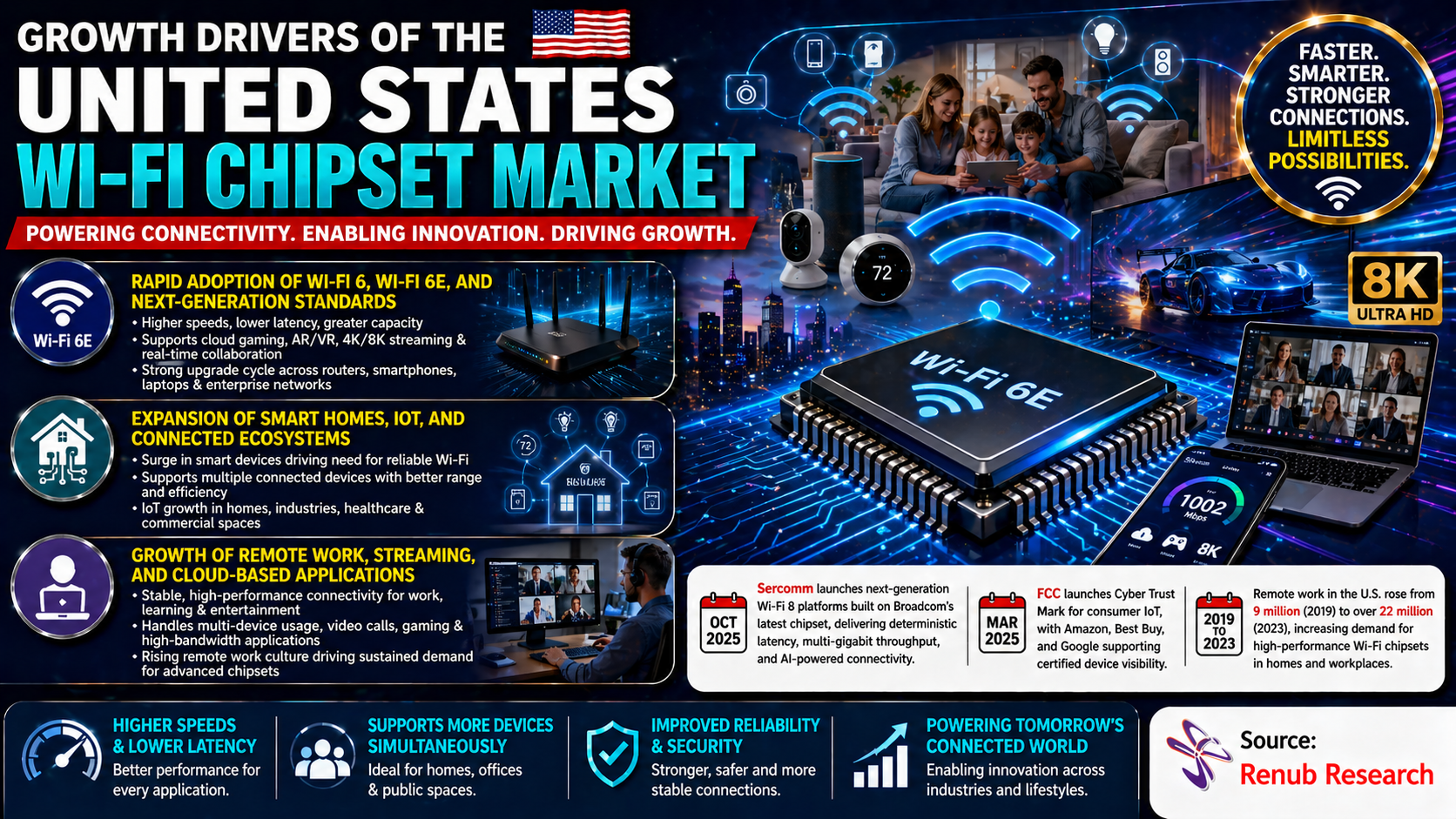
One of the biggest forces driving the U.S. Wi-Fi chipset market is the rapid shift toward Wi-Fi 6 and Wi-Fi 6E technologies.
These next-generation standards deliver:
- Faster internet speeds
- Lower latency
- Better performance in crowded environments
- Improved battery efficiency
- Stronger connectivity for multiple devices
This is especially important in households where several devices stream video, join meetings, game online, and run smart systems simultaneously.
Businesses are also upgrading their internal networks to support cloud applications, video conferencing, and hybrid work environments. As more routers, laptops, and mobile devices adopt these standards, chipset demand continues to rise.
Smart Homes and IoT Devices Create Massive Demand
The average American home is becoming smarter every year. Consumers now rely on connected thermostats, voice assistants, smart locks, lighting systems, surveillance cameras, and appliances.
Each of these products requires reliable wireless communication, making Wi-Fi chipsets a critical component.
At the same time, industrial IoT is expanding across sectors such as:
- Warehousing
- Logistics
- Healthcare monitoring
- Building automation
- Manufacturing
As the number of connected devices increases, chipset makers are focusing on efficiency, power savings, and stable multi-device performance.
Remote Work and Streaming Continue to Reshape Connectivity
Even after the pandemic era, remote and hybrid work models remain a lasting trend in the United States. Millions of Americans still work from home, relying on stable wireless networks for video calls, collaboration platforms, and cloud systems.
Streaming services are another major growth driver. Consumers expect flawless delivery of:
- 4K and 8K video
- Live sports streams
- Cloud gaming
- Online education platforms
All of these activities require advanced Wi-Fi chipsets with features such as MU-MIMO, OFDMA, and beamforming.
As digital habits become permanent, consumers and businesses alike continue upgrading devices and routers, boosting market demand.
Dual-Band and MU-MIMO Technologies Gain Popularity
Among product segments, dual-band chipsets remain highly popular. These chipsets support both 2.4 GHz and 5 GHz frequencies, offering better speed and less interference.
They are commonly used in:
- Smartphones
- Routers
- Laptops
- Smart televisions
Another key trend is the rise of MU-MIMO technology, which allows simultaneous communication with multiple devices. This is especially useful in offices, campuses, and family homes where dozens of devices may be connected at once.
As data traffic rises, these features are becoming standard rather than premium.
Smartphones and Laptops Lead Application Demand
Smartphones remain one of the largest users of Wi-Fi chipsets in the U.S. market. Consumers want faster downloads, better streaming quality, and smooth transitions between public and private networks.
Laptops also represent a major segment, especially with remote work, online learning, and mobile productivity needs continuing nationwide.
Manufacturers increasingly promote wireless performance as a selling point, making chipset quality central to device competition.
Regional Leaders: California, New York, Washington
Several U.S. states play a major role in market growth.
California remains the innovation center, home to semiconductor designers, networking firms, and technology giants. The state often leads adoption of new Wi-Fi standards.
New York drives demand through dense urban environments where strong wireless performance is essential in offices, apartments, and public venues.
Washington benefits from cloud computing infrastructure, enterprise campuses, and advanced digital transformation initiatives.
Together, these regions represent powerful engines for chipset innovation and adoption.
Challenges Facing the Industry
Despite strong growth prospects, the market still faces challenges.
Semiconductor Supply Constraints
Global chip shortages, manufacturing bottlenecks, and geopolitical uncertainty can delay production and raise prices.
Growing Complexity
Supporting multiple wireless standards, stronger security requirements, and faster speeds increases design costs and research investment.
Manufacturers must innovate quickly while keeping prices competitive.
Leading Companies in the Market
Several global semiconductor players are active in the U.S. Wi-Fi chipset market, including:
- Qualcomm Technologies Inc.
- Broadcom Inc.
- Intel Corporation
- MediaTek Inc.
- Texas Instruments Incorporated
These companies continue investing in speed, efficiency, AI integration, and next-generation wireless capabilities.
Final Thoughts
The United States Wi-Fi Chipset Market is no longer just about internet access—it is about powering the connected economy. Whether through smart homes, remote work, enterprise networking, or next-generation entertainment, demand for faster and more reliable wireless performance is accelerating.
With Renub Research projecting the market to nearly reach US$ 10 Billion by 2034, the future of wireless connectivity in America looks exceptionally strong. As technology evolves toward Wi-Fi 7 and beyond, chipset innovation will remain at the center of the nation’s digital transformation.
About the Creator
Enjoyed the story? Support the Creator.
Subscribe for free to receive all their stories in your feed.
Comments
There are no comments for this story
Be the first to respond and start the conversation.