
United States Watch Market to Reach US$ 28.49 Billion by 2034 as Smartwatch Innovation and Luxury Demand Accelerate Growth
Rising adoption of wearable technology, expanding luxury watch culture, and strong fashion influence are reshaping the United States watch industry

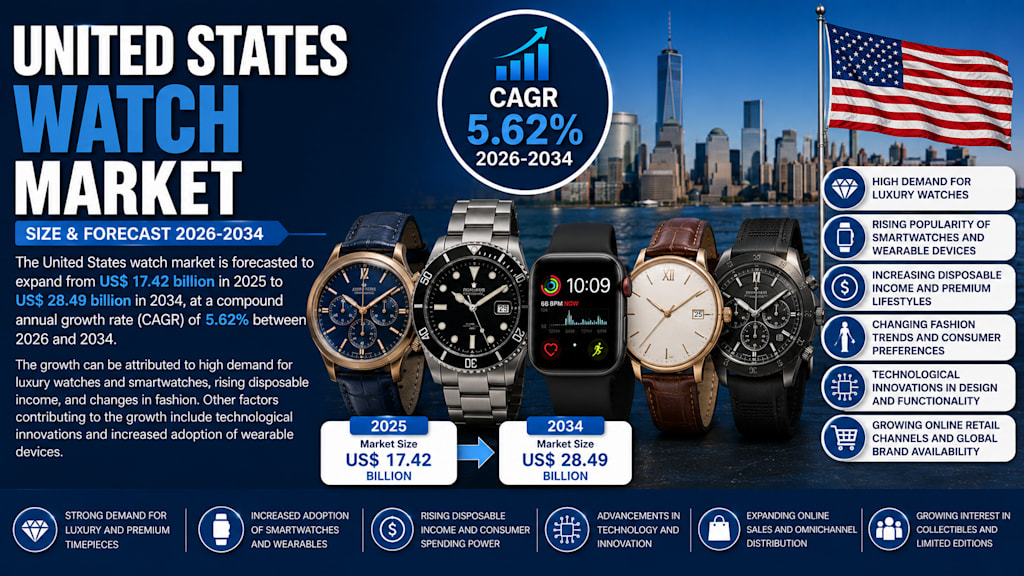
The United States watch market is expected to witness strong growth over the coming decade as technological innovation, fashion trends, and rising consumer purchasing power continue driving demand across multiple watch categories. According to Renub Research, the United States watch market is projected to grow from US$ 17.42 billion in 2025 to US$ 28.49 billion by 2034, registering a CAGR of 5.62% from 2026 to 2034. Increasing demand for smartwatches and luxury watches, rising disposable income, and expanding adoption of wearable technology are among the major factors supporting market growth across the country.
Watches have evolved far beyond their traditional role as timekeeping devices. In the modern U.S. market, watches are simultaneously viewed as fashion accessories, lifestyle products, status symbols, health-monitoring tools, and wearable technology devices. While mechanical and quartz watches continue maintaining strong popularity among collectors and luxury consumers, smartwatches are transforming the industry by integrating advanced digital functions such as fitness tracking, sleep monitoring, heart-rate measurement, GPS navigation, and smartphone connectivity.
This combination of fashion, technology, and personalization is creating a highly dynamic market environment across the United States.
Rising Demand for Smartwatches and Wearable Technology Is Fueling Growth
One of the strongest growth drivers in the United States watch market is the rapid adoption of smartwatches and wearable technology.
Consumers increasingly prefer multifunctional wearable devices that offer convenience, connectivity, and health-tracking capabilities beyond basic timekeeping. Smartwatches have become especially popular among younger consumers, professionals, and fitness-conscious individuals who seek integrated digital lifestyles.
Features such as:
- Heart-rate monitoring
- Sleep tracking
- Fitness measurement
- Smartphone notifications
- GPS tracking
- Voice assistant integration
have significantly expanded the practical value of watches in everyday life.
Growing awareness regarding health and wellness is another major factor driving smartwatch adoption. Consumers increasingly use wearable devices to monitor physical activity, track exercise goals, and manage overall health routines.
The report highlights a major development from February 2025, when OnePlus officially launched the next-generation OnePlus Watch 3 globally. The smartwatch features a titanium build, 1.5-inch LTPO AMOLED display, 2,200 nits brightness, and rotating crown functionality.
Such technological innovations continue attracting tech-savvy consumers and supporting long-term growth within the smartwatch segment.
Luxury and Premium Watches Continue Expanding Strongly
Despite rapid digitalization, the luxury watch market in the United States continues witnessing strong growth.
Luxury watches remain highly desirable because they symbolize prestige, craftsmanship, exclusivity, and personal success. High-income consumers increasingly purchase premium watches not only for functionality but also as status symbols and long-term collectible assets.
The luxury segment benefits from several factors, including:
- Rising disposable incomes
- Growing collector culture
- Gift-giving traditions
- Appreciation for craftsmanship
- Investment-oriented purchasing behavior
Limited-edition collections, heritage branding, and premium materials such as titanium, ceramics, gold, and sapphire crystal continue strengthening consumer interest in luxury watches.
The report highlights that in March 2025, Citizen introduced “Citizen Premiere,” a new luxury watch collection combining the Series8 and Attesa lines with classical craftsmanship and modern technology integration.
Luxury watch brands also increasingly use celebrity endorsements, social media campaigns, and digital storytelling to strengthen brand positioning among younger affluent consumers.
Fashion Trends and Brand Innovation Are Influencing Consumer Preferences
Fashion trends continue playing a major role in shaping the U.S. watch market.
Consumers increasingly view watches as essential fashion accessories that complement personal style, professionalism, and individuality. Brands continuously launch new designs, colors, materials, and customizable features in order to match changing consumer tastes.
Interchangeable straps, personalized watch faces, limited-edition collaborations, and minimalist luxury designs are becoming increasingly popular among younger consumers.
The report highlights a major innovation example from September 2024, when Apple launched the Apple Watch Series 10 featuring one of the company’s thinnest designs alongside a 30% brighter OLED display and improved off-angle viewing performance.
Collaborations with celebrities, fashion designers, and lifestyle influencers are also strengthening consumer engagement and brand visibility.
The market’s broad diversity allows brands to target multiple customer segments simultaneously, including:
- Luxury buyers
- Tech enthusiasts
- Fitness-focused consumers
- Fashion-conscious shoppers
- Budget-oriented buyers
This flexibility continues helping the industry maintain broad consumer relevance.
Electronic Watches and Smartwatches Are Transforming the Industry
The electronic watches segment is one of the fastest-growing categories within the U.S. watch market.
Digital watches and smartwatches equipped with advanced software, wireless connectivity, and health-monitoring features are attracting strong consumer demand across different age groups.
Millennials and Generation Z consumers especially favor electronic watches because they integrate seamlessly into modern digital lifestyles.
Key growth drivers for electronic watches include:
- Smartphone compatibility
- Mobile app integration
- Fitness tracking
- Wireless communication
- Customizable interfaces
- Software updates
Regular product upgrades and innovation cycles also encourage repeat purchases and brand loyalty.
Online retail platforms, electronics stores, and dedicated brand outlets continue expanding product accessibility nationwide.
As digital lifestyles continue evolving, electronic watches are expected to remain one of the most important long-term growth engines for the overall U.S. watch market.
Mechanical Watches Maintain Strong Appeal Among Collectors
Although smartwatches dominate technology-driven growth, the mechanical watch segment continues maintaining a stable and loyal customer base.
Mechanical watches appeal strongly to consumers who appreciate traditional craftsmanship, intricate engineering, and timeless design aesthetics.
Collectors and luxury buyers often view mechanical watches as long-term investments and symbols of heritage.
Automatic and manually wound mechanical movements remain highly valued because they reflect precision engineering and artisanal watchmaking traditions.
Limited-edition mechanical models and premium Swiss-inspired craftsmanship continue attracting affluent consumers despite growing digital competition.
Luxury boutiques and specialty retailers remain the primary distribution channels for high-end mechanical watches across the United States.
Men’s Watch Segment Continues Dominating the Market
The men’s watch market remains one of the largest consumer segments within the United States watch industry.
Watches are widely associated with professionalism, masculinity, achievement, and personal style among male consumers. The market includes a broad range of products, from affordable casual watches to premium luxury timepieces and advanced smartwatches.
Smartwatches are increasingly popular among men because of fitness tracking and connectivity features, while analog and luxury watches remain preferred for formal and professional occasions.
Manufacturers continue targeting male consumers through themes related to:
- Performance
- Adventure
- Luxury
- Technology
- Precision
- Durability
Rising disposable incomes and evolving fashion preferences continue supporting long-term growth in the men’s watch category.
Luxury Watches Continue Performing Strongly Despite Economic Uncertainty
The United States luxury watch market remains highly resilient even during periods of economic volatility.
Luxury watches are often perceived as durable assets and collectible items with long-term value retention. This investment-oriented perception helps maintain demand among affluent consumers.
Celebrity endorsements, social media influence, and luxury branding campaigns continue strengthening consumer aspiration toward premium watch ownership.
Exclusive retail experiences, flagship boutiques, and personalized customer service also contribute significantly to luxury watch sales performance.
Strong brand heritage and loyal customer bases help luxury watch manufacturers maintain pricing power and long-term market stability.
Convenience Store Distribution Supports Affordable Watch Sales
Convenience stores represent an important distribution channel for low-cost and practical watches in the United States.
Consumers often purchase affordable digital or analog watches through convenience stores as replacement products or impulse purchases.
This segment mainly focuses on:
- Budget-friendly watches
- Practical functionality
- Basic digital watches
- Entry-level analog products
Although convenience stores do not dominate premium watch sales, they continue serving consumers seeking affordable and easily accessible products.
Expansion of urban retail networks and suburban convenience outlets continues supporting this distribution segment.
Smartphones and Digital Devices Remain a Major Competitive Challenge
Despite strong growth prospects, the U.S. watch market faces intense competition from smartphones and other digital devices.
Many consumers increasingly rely on smartphones for timekeeping, reducing dependence on traditional watches for basic functionality.
This challenge is especially significant for low-cost analog and quartz watch segments that lack differentiated features.
Smartwatches have partially solved this problem by offering unique functions unavailable on traditional watches alone. However, classic watches still face competitive pressure from multifunctional mobile devices.
Manufacturers increasingly focus on emotional value, craftsmanship, fashion identity, and wearable technology integration in order to maintain relevance.
Market Saturation and Intense Competition Are Increasing Pressure
The United States watch market is highly saturated with numerous domestic and international brands competing across all price segments.
Luxury brands, fashion watches, smartwatches, and affordable mass-market products all compete aggressively for consumer attention.
Key competitive challenges include:
- Price competition
- Constant product innovation
- Changing fashion trends
- Heavy marketing expenses
- Counterfeit products
- Brand differentiation pressure
Established brands benefit from strong consumer recognition and retail presence, making market entry difficult for smaller companies and new entrants.
Counterfeit luxury watches also remain a serious challenge affecting profitability and brand reputation.
Companies must continuously innovate while balancing design quality, technology integration, and competitive pricing.
California Leads Through Technology and Fashion Influence
California represents one of the largest and most dynamic watch markets in the United States.
The state’s strong technology ecosystem, especially around Silicon Valley, significantly supports smartwatch adoption and wearable technology innovation.
Fashion-conscious consumers and high-income populations also contribute to strong demand for luxury and designer watches.
Fitness culture and outdoor lifestyles continue boosting smartwatch sales because consumers increasingly use wearable devices for activity tracking and wellness monitoring.
Sustainability awareness is also influencing purchasing decisions, encouraging stronger demand for environmentally responsible watch products.
Texas Market Benefits from Population Growth and Lifestyle Demand
Texas continues experiencing stable watch market growth due to its large population base and rising middle-class purchasing power.
Cities such as Houston, Dallas, and Austin show strong demand for both smartwatches and traditional fashion watches.
Young professionals increasingly prefer smartwatches, while traditional watches remain popular in formal and business environments.
Gift-giving culture, rising income levels, and expanding retail accessibility continue supporting market expansion throughout the state.
New York Remains a Luxury Watch Hub
New York is one of the most important luxury watch markets in the United States due to its global reputation for fashion, finance, and luxury retail.
Consumers in New York place strong emphasis on premium brands, status symbols, and sophisticated design.
Luxury boutiques, flagship stores, and high-end department retailers play a major role in watch sales throughout the city.
At the same time, the city’s fast-paced lifestyle supports strong demand for smartwatches and multifunctional wearable devices.
Tourism activity and affluent consumer demographics continue making New York a central hub for luxury watch consumption.
Florida Watch Market Benefits from Tourism and Active Lifestyles
Florida’s watch market continues growing steadily because of tourism activity, diverse demographics, and strong retail infrastructure.
Luxury and designer watch sales are especially strong in coastal shopping destinations and tourist-heavy regions.
The state’s warm climate and active lifestyle culture also support strong demand for fitness-focused smartwatches and wearable health devices.
At the same time, local residents continue purchasing affordable and mid-range watches through mainstream retail channels.
Florida’s combination of tourism, fashion, and active lifestyles continues supporting a diversified watch market environment.
Key Companies Operating in the United States Watch Market
Major companies operating in the United States watch market include Fossil Group, Titan Company, LVMH, Apple, Compagnie Financière Richemont, The Swatch Group, Citizen Watch, and Seiko Group.
These companies compete through wearable technology innovation, luxury craftsmanship, fashion collaborations, premium branding, and omnichannel retail strategies.
Final Thoughts
The United States watch market is entering a period of strong transformation driven by the convergence of technology, fashion, wellness, and luxury lifestyle trends.
Smartwatches are reshaping consumer expectations through advanced digital functionality and health-monitoring capabilities, while luxury and mechanical watches continue maintaining strong emotional and investment value among affluent consumers.
According to Renub Research, the U.S. watch market is projected to reach US$ 28.49 billion by 2034, reflecting strong long-term growth potential across both digital and traditional watch categories.
However, the industry must continue navigating intense competition, market saturation, and changing consumer behavior influenced by smartphones and rapidly evolving fashion trends. Companies that successfully combine innovation, craftsmanship, personalization, and strong brand identity are likely to lead the next phase of growth in the United States watch industry.
About the Creator
Enjoyed the story? Support the Creator.
Subscribe for free to receive all their stories in your feed.
Comments
There are no comments for this story
Be the first to respond and start the conversation.