
United States Renewable Energy Market to Surpass 1,002 GW by 2033 as Solar, Wind, and Clean Energy Investments Accelerate
Strong policy support, declining technology costs, corporate sustainability commitments, and large-scale renewable projects are reshaping America's energy landscape through 2033.

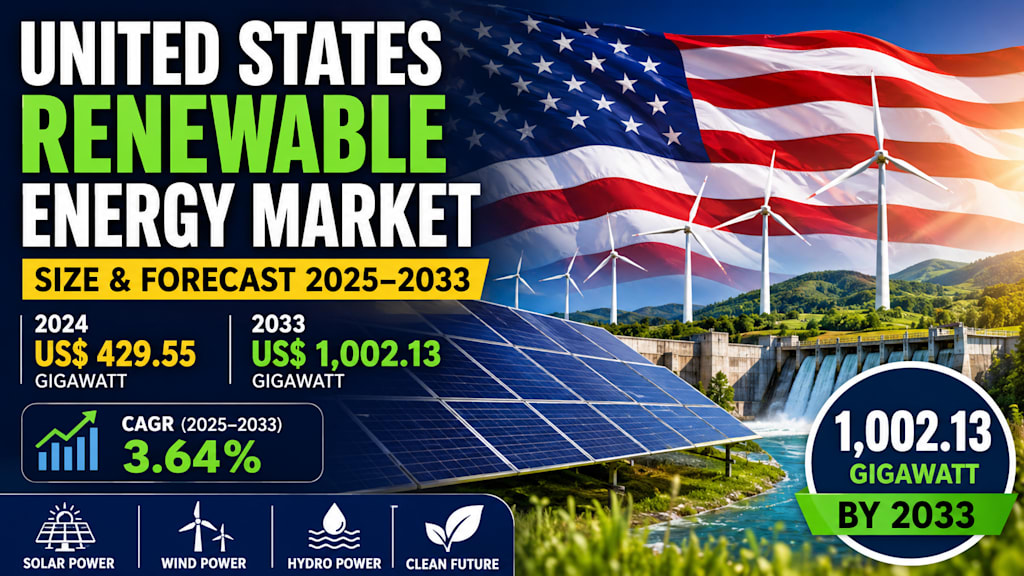
United States Renewable Energy Market Size and Forecast 2025–2033
The United States renewable energy market is entering a transformative decade, driven by ambitious climate goals, favorable government policies, technological innovation, and increasing demand for sustainable energy solutions. According to Renub Research, the United States Renewable Energy Market is expected to reach US$ 1,002.13 Gigawatt by 2033, rising from US$ 429.55 Gigawatt in 2024, growing at a CAGR of 3.64% during 2025–2033.
As the country continues its transition away from fossil fuel dependence, renewable energy sources such as solar, wind, hydroelectric power, and bioenergy are becoming central to the nation’s energy strategy. Investments from both public and private sectors are creating new opportunities across generation, storage, transmission, and smart-grid technologies.
Renewable Energy Becomes a Cornerstone of U.S. Energy Security
Over the last decade, renewable energy has evolved from a supplementary power source into a critical pillar of the U.S. energy ecosystem. Federal initiatives, state-level clean energy mandates, and growing environmental awareness have accelerated the deployment of renewable energy infrastructure nationwide.
Today, utilities, technology companies, manufacturers, investors, and consumers are actively participating in the renewable energy transition. The push toward decarbonization has increased investments in utility-scale solar farms, offshore wind developments, battery storage projects, and grid modernization initiatives.
In addition to reducing greenhouse gas emissions, renewable energy offers long-term benefits including energy independence, job creation, and greater resilience against fuel price volatility. As technological innovation continues to improve efficiency and lower costs, renewable energy is becoming increasingly competitive with traditional fossil-fuel-based power generation.
Solar Energy Emerges as the Fastest-Growing Segment
Solar energy remains one of the strongest growth drivers within the U.S. renewable energy market. Rapid improvements in photovoltaic technology, declining equipment costs, and supportive federal incentives have contributed to unprecedented expansion.
The United States currently has nearly 188 GW of installed solar capacity, demonstrating the sector's remarkable growth trajectory. Utility-scale projects have played a major role in this expansion, adding approximately 22.5 GW of capacity, while residential solar adoption continues to rise as hundreds of thousands of homeowners install rooftop systems each year.
Industry projections suggest that the United States plans to add approximately 30 GW of solar capacity annually through 2025, with annual installations potentially increasing to 60 GW between 2025 and 2030. If achieved, cumulative solar capacity could reach 673 GW by 2034, enough to power more than 100 million American homes.
One of the most notable examples of this momentum is the Edwards & Sanborn Solar + Energy Storage Project, launched by Terra-Gen and Mortenson in early 2024. The project spans approximately 4,600 acres and includes 1.9 million solar panels supplied by First Solar. With solar generation capacity of 875 MWdc and approximately 3.3 GWh of energy storage, it represents one of the largest integrated renewable energy projects in the country.
Government Incentives Continue to Fuel Market Expansion
Public policy remains one of the most influential factors driving renewable energy growth across the United States.
Federal incentives such as the Investment Tax Credit (ITC) and Production Tax Credit (PTC) have significantly improved project economics by reducing capital costs and encouraging long-term investment. More recently, the Inflation Reduction Act has provided additional support for renewable energy deployment, manufacturing expansion, clean hydrogen development, and battery production.
At the state level, Renewable Portfolio Standards (RPS) and clean energy mandates are compelling utilities to increase renewable energy procurement. Many states have established aggressive carbon reduction goals and timelines for achieving 100% clean electricity generation.
These policy mechanisms reduce investment risks, improve financing conditions, and create a stable environment for renewable energy developers. As a result, billions of dollars continue to flow into renewable infrastructure projects across the nation.
Technological Advancements Are Driving Cost Reductions
Technology innovation remains a major catalyst for renewable energy adoption.
Solar panels today generate more electricity with higher efficiency than previous generations, while modern wind turbines capture energy more effectively through larger rotor diameters and advanced blade designs. These improvements have significantly reduced the levelized cost of electricity (LCOE) from renewable sources.
Battery energy storage systems are also undergoing rapid advancements. Enhanced storage capabilities allow renewable power generated during peak production periods to be stored and delivered when demand increases. This capability addresses one of the most significant challenges associated with intermittent energy generation.
Additionally, smart grids, digital monitoring systems, predictive analytics, and artificial intelligence are improving energy management and grid reliability. These technologies enable utilities to integrate larger volumes of renewable electricity while maintaining system stability.
As economies of scale continue to grow and manufacturing processes become more efficient, renewable technologies are expected to become even more affordable throughout the forecast period.
Corporate Sustainability Commitments Accelerate Demand
Businesses are playing an increasingly important role in renewable energy adoption.
Major corporations across sectors including technology, retail, manufacturing, telecommunications, and finance have announced ambitious carbon neutrality and net-zero commitments. To achieve these objectives, companies are increasingly signing long-term power purchase agreements (PPAs) with renewable energy providers.
Corporate renewable procurement not only supports sustainability goals but also helps businesses stabilize long-term electricity costs. Large technology companies, in particular, are investing heavily in renewable power to support energy-intensive operations such as data centers and cloud infrastructure.
Meanwhile, consumers are becoming more environmentally conscious and actively seeking renewable energy options. Residential solar systems, community solar programs, and green energy subscriptions are attracting growing participation from households seeking lower utility bills and reduced environmental impact.
Together, corporate and consumer demand are creating a strong market foundation for continued renewable energy expansion.
Challenges Facing the U.S. Renewable Energy Market
Despite impressive growth, several challenges remain.
Grid Infrastructure Limitations
The existing electrical grid was largely designed around centralized fossil fuel generation and faces increasing pressure as renewable capacity expands.
Many regions experience transmission bottlenecks that prevent renewable energy from reaching population centers efficiently. Delays in transmission line construction and interconnection approvals can slow project deployment significantly.
Grid modernization investments are therefore becoming increasingly important. Utilities and regulators must continue investing in advanced transmission systems, smart grid technologies, and energy storage solutions to support higher levels of renewable integration.
Regulatory and Permitting Complexities
Renewable energy developers often face lengthy permitting processes and regulatory uncertainties.
Large utility-scale solar projects, offshore wind farms, and transmission infrastructure frequently require extensive environmental reviews and stakeholder consultations. These processes can delay construction timelines and increase development costs.
Differences between federal, state, and local regulations can further complicate project approvals. Streamlining permitting frameworks while maintaining environmental protections will be essential for accelerating renewable energy deployment.
State-Level Renewable Energy Market Analysis
California
California remains the nation's renewable energy leader. Aggressive climate policies, abundant sunshine, and strong consumer demand have enabled the state to build one of the most advanced renewable energy markets globally.
The state has committed to achieving 100% clean electricity by 2045 and continues to invest heavily in solar power, battery storage, geothermal energy, and grid modernization. California's proactive approach continues to serve as a model for renewable energy adoption nationwide.
Texas
Texas leads the United States in wind energy capacity and is rapidly expanding its solar energy footprint. Its vast geography, favorable wind resources, and competitive electricity market have made the state a renewable energy powerhouse.
While challenges such as transmission capacity and weather resilience persist, Texas continues to attract significant renewable energy investment due to its strong resource base and market-oriented energy policies.
New York
New York is aggressively pursuing its clean energy transformation through the Climate Leadership and Community Protection Act. The state aims to generate 70% of its electricity from renewable sources by 2030 and achieve net-zero emissions by 2050.
Offshore wind development, solar installations, hydroelectric power, and energy storage projects are central to New York's strategy. State agencies and private investors are working together to build a modern and sustainable energy system.
Market Segmentation
By Renewable Source
Hydro Power
Wind Power
Solar Power
Bioenergy
Others
By End User
Industrial
Residential
Commercial
By States
California
Texas
New York
Florida
Illinois
Pennsylvania
Ohio
Georgia
Washington
New Jersey
Rest of United States
Competitive Landscape
The United States renewable energy market is highly competitive and characterized by innovation, strategic partnerships, manufacturing expansion, and large-scale project development. Companies are focusing on advanced technologies, energy storage integration, and supply chain localization to strengthen their market positions.
Major industry participants include General Electric Company, First Solar Inc., Sunrun Inc., NextEra Energy Inc., Vestas Wind Systems A/S, Mitsubishi Heavy Industries Ltd., Siemens Gamesa Renewable Energy SA, Canadian Solar Inc., Trina Solar Co. Ltd., and JinkoSolar Holding Co. Ltd.
10 Recent Company Developments
First Solar Inc. expanded domestic solar manufacturing capacity in the United States to meet growing demand driven by clean energy incentives.
NextEra Energy Inc. continued investing in utility-scale solar and battery storage projects across multiple states.
Sunrun Inc. strengthened its residential solar and home battery offerings to support distributed energy adoption.
General Electric Company advanced renewable technology solutions through innovations in onshore and offshore wind turbine platforms.
Vestas Wind Systems A/S secured additional wind turbine supply agreements for major U.S. renewable energy projects.
Siemens Gamesa Renewable Energy SA accelerated offshore wind technology deployment and service capabilities in North America.
Canadian Solar Inc. expanded utility-scale solar project development and energy storage operations within the U.S. market.
Trina Solar Co. Ltd. introduced higher-efficiency photovoltaic modules aimed at improving project economics.
JinkoSolar Holding Co. Ltd. increased shipments of advanced solar panels to support large-scale renewable installations.
Mitsubishi Heavy Industries Ltd. continued developing clean energy technologies focused on renewable integration and sustainable power generation.
Future Outlook
The future of the U.S. renewable energy market appears exceptionally promising. Strong government support, technological progress, growing corporate sustainability commitments, and rising consumer awareness are expected to sustain long-term growth.
As solar, wind, hydro, and bioenergy continue expanding, renewable energy will play an increasingly important role in achieving national energy security and climate objectives. Continued investments in energy storage, grid modernization, and transmission infrastructure will further strengthen the sector's ability to support America's evolving energy needs.
With capacity expected to surpass 1,002 GW by 2033, the United States is positioned to remain one of the world's most influential renewable energy markets and a global leader in the transition toward a cleaner and more sustainable energy future.
About the Creator
Enjoyed the story? Support the Creator.
Subscribe for free to receive all their stories in your feed.
Comments
There are no comments for this story
Be the first to respond and start the conversation.