
United States Payment Gateway Market Set for Steady Expansion Through 2034
A secure, faster, and more connected payments ecosystem is reshaping how American businesses accept money online, on mobile, and across channels.

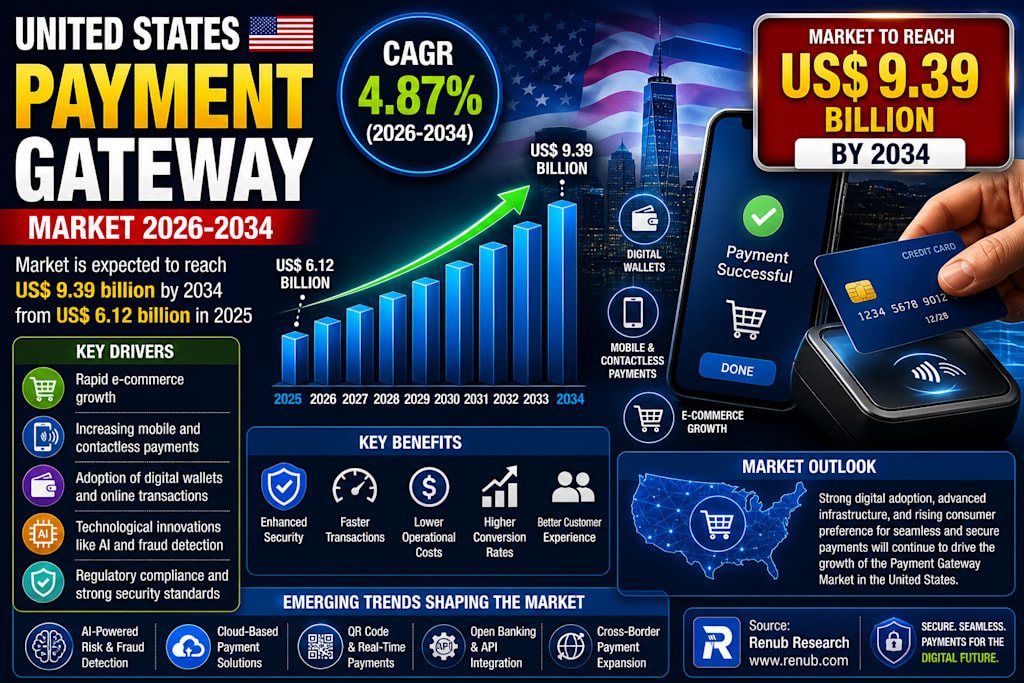
The United States payment gateway market is entering a phase of steady, technology-led expansion. According to Renub Research, the market is expected to rise from US$ 6.12 billion in 2025 to US$ 9.39 billion by 2034, expanding at a CAGR of 4.87% from 2026 to 2034. The growth story is being driven by the rapid rise of e-commerce, wider use of mobile and contactless payments, stronger adoption of digital wallets, and the growing need for fraud detection and regulatory compliance in digital transactions.
At the heart of this market is a simple shift in behavior: consumers now expect checkout to be fast, secure, and nearly invisible. Payment gateways sit between merchants, customers, and financial institutions, making sure transactions are authorized, processed, and settled smoothly across cards, wallets, bank transfers, and newer digital payment methods. As online commerce, subscription platforms, and omnichannel retail continue to scale, gateways have become less of a back-end utility and more of a strategic business layer.

What makes the U.S. market especially dynamic is the speed at which innovation is reshaping it. Cloud-based and API-driven gateways are making integration easier for merchants, while AI and machine learning are improving fraud monitoring and risk management. Tokenization, encryption, and 3D Secure are also raising the security bar, helping businesses build trust with shoppers who are increasingly cautious about where and how they pay online.
Cross-border commerce is another major force behind growth. U.S. merchants are selling into more markets than ever before, which increases demand for multi-currency support, international payment methods, and real-time currency conversion. Payment gateways that can simplify global checkout and reduce failed transactions are becoming essential for merchants looking to scale beyond domestic sales.
The regulatory environment is also pushing the market forward. Compliance with PCI DSS and broader data protection expectations is no longer optional, especially as fraud risks rise and consumers demand stronger safeguards. In practice, compliance is doing more than reducing risk; it is also accelerating adoption because merchants are more willing to invest in systems that protect both revenue and reputation.
Regionally, the market outlook is broad-based, but a few states stand out. California benefits from its fintech density and Silicon Valley innovation base. Texas is gaining ground through expanding digital commerce and a strong business environment. New York remains a financial powerhouse with strong merchant adoption and fintech activity, while Florida is seeing steady demand across tourism, retail, and service sectors. These state-level ecosystems help show how the U.S. market is not moving in one direction only; it is evolving through multiple regional growth engines.
The competitive landscape is equally important. The market includes established financial institutions, global fintech platforms, and fast-growing specialists such as PayPal Holdings, Amazon Pay, Adyen, JPMorgan Chase & Co., Stripe, BitPay, Braintree, and WePay. Each of these players brings a different strength to the table, whether that is global reach, merchant servicing, fraud protection, embedded finance, or developer-friendly APIs. That variety is one reason the market is both competitive and innovative.
There are, however, real challenges beneath the optimism. High competition is pressuring providers to differentiate through pricing, speed, uptime, and user experience. At the same time, technical integration remains a common pain point for merchants that run across multiple platforms, apps, and point-of-sale systems. In other words, the market is growing, but the winners will be the companies that make complexity disappear for the merchant.
Why the market still has room to run
The long-term case for payment gateways is not just about more online shopping. It is about the normalization of digital money movement across every customer touchpoint. Payments are now embedded into marketplaces, software platforms, subscription businesses, mobile apps, and even in-person retail environments. That means gateways are no longer confined to one transaction type or one channel. They are becoming the connective tissue of modern commerce.
This is also why features such as account-to-account payments, embedded checkout, wallet interoperability, and real-time settlement are gaining momentum. Businesses want lower friction. Consumers want choice. Regulators want control. Payment gateway providers are being asked to satisfy all three at once, which is a difficult brief, but also a lucrative one.
recent developments in the payment gateway space
Dwolla launched Open Banking Services for account-to-account payments in April 2024, giving businesses a single API approach to simplify A2A implementation and speed up launch timelines.
Stripe partnered with URBN in April 2024 to power online and in-store retail transactions for brands including Urban Outfitters, Anthropologie Group, Free People, and FP Movement.
PayPal introduced a new Agent Toolkit in April 2025, designed to make it easier to connect PayPal commerce functions with AI agent workflows for orders, invoices, and subscriptions.
Worldpay announced a partnership with Yabie in May 2025, linking payment capabilities with business tools for merchants through a point-of-sale-focused collaboration.
Square expanded its banking tools in April 2025, offering sellers faster access to cash flow and a simpler way to manage earnings through its payments and banking application flow.
Block said in May 2025 that it would roll out bitcoin payments on Square, enabling merchants to accept bitcoin directly through Square hardware and the Square Point of Sale app.
PayPal announced PayPal World in July 2025, a global platform intended to connect major payment systems and digital wallets, starting with interoperability between PayPal and Venmo.
PayPal said in September 2025 that it would support the Agent Payments Protocol (AP2), which is aimed at creating a standard for agent-driven payments across interoperable systems.
Square released a major platform expansion for restaurants in October 2025, adding tools such as voice ordering, cost control features, smarter AI, and bitcoin-related business capabilities.
Stripe unveiled 288 launches on 29 April 2026, including a partnership with Google that allows businesses to sell inside AI Mode and the Gemini app, along with wallets for agents and support for AI-native business models.
Market outlook: what matters most now
The next phase of growth will likely reward payment gateway companies that combine speed, security, and flexibility. Retailers want smoother checkout. SaaS firms want embedded payments. Marketplaces want global coverage. And all of them want fewer failed transactions, lower fraud exposure, and less technical overhead. That is why cloud-native gateways, AI-based risk tools, and API-first architectures are becoming the default expectation rather than the premium add-on.
Another important trend is the shift toward multi-function platforms. The winning providers are not just processing payments; they are helping businesses manage authorization rates, analytics, cash flow, banking, fraud controls, and even customer retention. This platform approach is especially attractive in a crowded market because it turns a commodity service into a business operating system.
The forecast itself suggests a healthy, durable market rather than a short-lived surge. Growth at a 4.87% CAGR may not sound explosive, but in a payments sector shaped by high transaction volumes and recurring usage, even moderate growth can translate into significant revenue expansion over time. More importantly, the underlying demand drivers are structural: commerce is becoming more digital, more mobile, and more global.
Final thoughts
The United States payment gateway market is not just expanding; it is maturing into a more intelligent, integrated, and competitive ecosystem. The market’s projected climb from US$ 6.12 billion in 2025 to US$ 9.39 billion by 2034 shows that secure digital payments are now a core part of U.S. commerce, not a supporting feature. As e-commerce grows, fraud protection tightens, and payment experiences become more embedded across devices and platforms, gateways will remain one of the most important enablers of digital trade.
For merchants, the message is clear: payment infrastructure is no longer a back-office decision. It is part of the customer experience, the growth strategy, and the trust equation. For providers, the challenge is just as clear: simplify the complex, secure every transaction, and keep adapting as commerce keeps moving. That is where the next wave of market leaders will emerge.
About the Creator
Enjoyed the story? Support the Creator.
Subscribe for free to receive all their stories in your feed.
Comments
There are no comments for this story
Be the first to respond and start the conversation.