
United States Orthodontics Market Set to Reach US$ 5.02 Billion by 2033 as Clear Aligners Transform Modern Dental Care
Growing Demand for Aesthetic Dentistry, Digital Orthodontics, and Early Treatment Programs Is Reshaping the Future of Orthodontic Care Across America

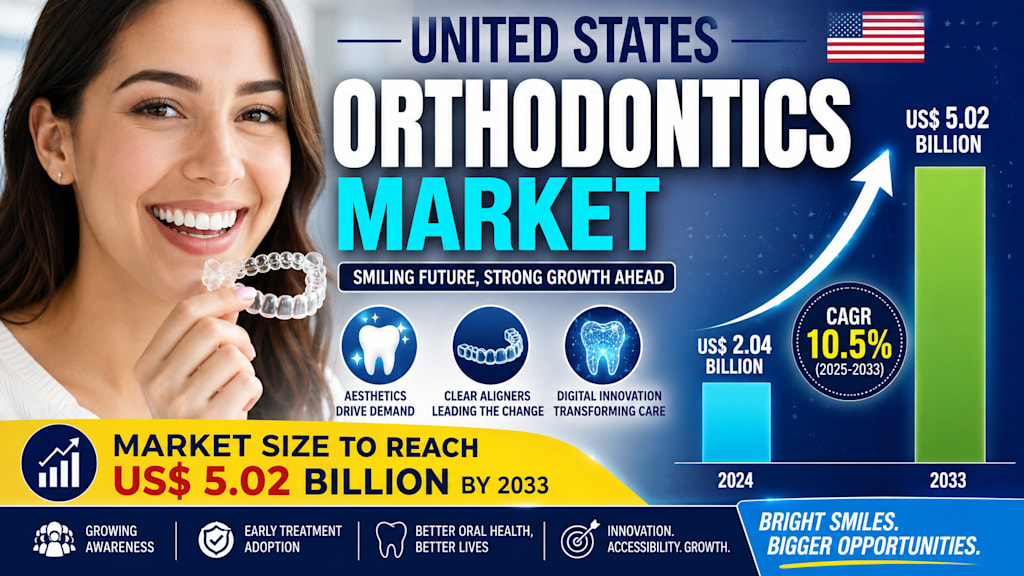
A confident smile has become one of the most valuable personal assets in modern society. In the United States, increasing awareness about dental aesthetics, oral health, and self-confidence is driving millions of people toward orthodontic treatment. Once considered a service primarily for teenagers, orthodontics has evolved into a rapidly expanding healthcare segment that now attracts adults, professionals, and even senior citizens seeking improved oral function and appearance.
According to Renub Research, the United States Orthodontics Market was valued at US$ 2.04 Billion in 2024 and is projected to reach US$ 5.02 Billion by 2033, growing at a remarkable CAGR of 10.5% during 2025–2033. This impressive growth reflects changing consumer preferences, technological advancements, and broader accessibility of orthodontic treatments across the country.
Understanding Orthodontics and Its Growing Importance
Orthodontics is a specialized branch of dentistry focused on diagnosing, preventing, and correcting irregularities in teeth and jaw alignment. Common conditions treated through orthodontics include crowded teeth, overbites, underbites, crossbites, spacing issues, and jaw misalignments.
The importance of orthodontic treatment extends far beyond cosmetic enhancement. Properly aligned teeth contribute to improved chewing function, better oral hygiene, reduced risk of gum disease, and enhanced speech development. As awareness of these benefits continues to grow, more Americans are seeking professional orthodontic care at earlier stages of life.
The rise of social media platforms, video conferencing, and digital communication has also amplified the importance of appearance, making orthodontic treatments increasingly desirable among consumers of all age groups.
Clear Aligners Are Revolutionizing Orthodontic Treatment
One of the most significant transformations within the orthodontics industry has been the emergence of clear aligners.
Traditional metal braces remain effective, but clear aligners offer several advantages that appeal to modern consumers. These removable, nearly invisible devices provide greater comfort, flexibility, and convenience during treatment.
Patients can remove aligners while eating, brushing, or attending important social and professional events. This freedom has significantly increased adoption among adults who previously avoided orthodontic treatment due to aesthetic concerns.
The popularity of brands such as Invisalign has reshaped consumer expectations and encouraged manufacturers to invest heavily in research and innovation. New aligner technologies are making treatments more precise, faster, and comfortable than ever before.
As competition increases, orthodontic companies continue introducing advanced solutions designed to improve treatment outcomes while enhancing patient experiences.
Digital Dentistry Is Creating a New Era of Orthodontics
The integration of digital technologies has dramatically changed how orthodontic treatments are planned and delivered.
Modern orthodontists now utilize:
3D imaging systems
Intraoral scanners
Computer-aided design (CAD)
Artificial intelligence-powered treatment planning
Digital treatment simulations
These technologies provide highly accurate diagnostic capabilities and customized treatment plans tailored to individual patients.
Digital scanning has largely replaced traditional dental impressions, eliminating discomfort while improving precision. Patients can also visualize projected treatment outcomes before beginning therapy, increasing confidence and treatment acceptance.
Artificial intelligence is further enhancing orthodontic workflows by predicting tooth movement patterns and helping practitioners optimize treatment strategies.
The combination of digital innovation and orthodontic expertise is creating faster, more predictable, and highly personalized treatment experiences.
Rising Demand for Cosmetic Dentistry Drives Market Expansion
Americans are increasingly investing in personal appearance and self-care. Cosmetic dentistry has emerged as a major component of this trend, with orthodontic treatment playing a central role.
A straight smile is often associated with confidence, professionalism, and attractiveness. As a result, many individuals pursue orthodontic treatments to improve both their appearance and social confidence.
Social media platforms have intensified this trend by increasing visibility of personal appearance. Influencers, celebrities, and public figures frequently showcase smile transformations, encouraging wider consumer adoption.
The growing popularity of smile-enhancement procedures continues to support strong demand for orthodontic products and services throughout the country.
Adult Orthodontics Emerges as a Major Growth Segment
Historically, orthodontic treatments were primarily associated with teenagers. Today, however, adults represent one of the fastest-growing patient populations.
Several factors are contributing to this shift:
Increased awareness of oral health
Availability of discreet treatment options
Flexible financing programs
Expanded dental insurance benefits
Remote monitoring technologies
Adults who missed orthodontic treatment during childhood are now pursuing corrective procedures to improve dental function and aesthetics.
Work-from-home arrangements and virtual consultations have also simplified access to orthodontic care. Patients can now begin and monitor treatments with fewer clinic visits, making orthodontics more convenient than ever before.
As adult participation continues rising, orthodontic providers are developing specialized services specifically tailored to mature patients.
Teen Orthodontics Continues to Dominate Treatment Volumes
Despite the rapid growth of adult orthodontics, teenagers remain the largest consumer group within the market.
Adolescence remains the ideal period for correcting alignment issues because the jaw and teeth are still developing. Early intervention often produces faster and more effective outcomes compared to treatment initiated later in life.
Parents continue to prioritize orthodontic care for their children due to growing awareness of long-term oral health benefits.
Schools, pediatric dentists, and healthcare providers also play important roles in promoting early diagnosis and treatment. Routine dental examinations frequently identify orthodontic concerns before they become severe, allowing timely intervention.
While traditional braces remain common among teenagers, clear aligners are rapidly gaining popularity due to their aesthetic appeal and comfort.
Dental Clinics Lead Orthodontic Service Delivery
Dental clinics represent the backbone of orthodontic service delivery throughout the United States.
These facilities offer:
Personalized treatment plans
Advanced diagnostic tools
Flexible payment options
Convenient appointment scheduling
Comprehensive patient education
Many clinics have embraced digital dentistry technologies, including 3D scanning and in-house aligner production systems, improving treatment efficiency and patient satisfaction.
Patient-centered care models have become increasingly important as clinics compete to attract and retain orthodontic patients.
Local outreach programs, educational initiatives, and enhanced customer experiences continue strengthening the role of dental clinics within the orthodontic ecosystem.
Hospitals Support Complex Orthodontic Cases
Hospitals also play an essential role within the orthodontics landscape, particularly when patients require multidisciplinary treatment approaches.
Complex jaw abnormalities, severe malocclusions, and surgical orthodontic procedures often necessitate hospital-based care.
Teaching hospitals contribute significantly to workforce development by training future orthodontists and supporting advanced clinical research.
Investments in hospital dental departments are enhancing access to sophisticated treatment capabilities while promoting integrated healthcare delivery models.
Market Challenges Continue to Impact Accessibility
Despite strong growth prospects, several challenges continue to affect market expansion.
High Treatment Costs
Orthodontic treatment remains expensive for many households.
Advanced solutions such as clear aligners often involve significant out-of-pocket expenses. While insurance coverage has improved, many plans still provide limited orthodontic benefits.
This financial burden can discourage treatment initiation, particularly among lower-income families.
Workforce Shortages in Rural Areas
Access to orthodontic care remains uneven across the country.
Urban centers generally offer abundant orthodontic specialists and advanced facilities. Rural communities, however, often face shortages of qualified providers.
Limited availability results in delayed diagnoses and treatment initiation, potentially increasing future treatment complexity and costs.
Addressing geographic disparities remains essential for ensuring equitable access to orthodontic services nationwide.
Innovation Continues to Shape Industry Competition
Manufacturers are aggressively investing in research, development, and product innovation.
Key areas of focus include:
Faster treatment solutions
Improved aligner materials
Enhanced patient comfort
AI-powered treatment planning
Remote monitoring platforms
Customized orthodontic appliances
The orthodontics industry is increasingly becoming a technology-driven healthcare segment where innovation serves as a major competitive differentiator.
Companies capable of delivering superior clinical outcomes while maintaining affordability are likely to capture significant market share over the coming decade.
10 Recent Developments from Leading Orthodontics Companies
1. Align Technology
Received FDA clearance for the Invisalign Palatal Expander System, expanding treatment options for younger patients.
2. LuxCreo
Introduced the 4D Bright Aligner, combining orthodontic correction with cosmetic teeth-whitening benefits.
3. Angelalign Technology
Expanded its customized clear aligner offerings into the United States market.
4. Biolux Technology
Launched the enhanced OrthoPulse orthodontic acceleration platform in the U.S.
5. 3M Company
Continued investment in advanced orthodontic bracket and adhesive technologies.
6. Envista Holdings Corporation
Expanded digital dentistry capabilities across orthodontic treatment solutions.
7. Dentsply Sirona
Enhanced digital workflow integration for orthodontic practices.
8. Henry Schein
Strengthened orthodontic product distribution and digital support services.
9. Rocky Mountain Orthodontics
Expanded precision orthodontic appliance manufacturing capabilities.
10. Dentaurum
Continued innovation in orthodontic materials and treatment systems for global markets.
Future Outlook: A Decade of Strong Growth Ahead
The future of the United States orthodontics market appears exceptionally promising.
Growing awareness of dental aesthetics, rising disposable incomes, technological innovation, and increasing adoption of clear aligners are expected to sustain long-term growth.
Digital orthodontics will continue improving treatment accuracy, efficiency, and patient satisfaction. Simultaneously, expanding adult participation will create new revenue opportunities for providers and manufacturers.
As healthcare consumers increasingly prioritize preventive care and personal appearance, orthodontic treatment will become a routine part of oral healthcare planning rather than a specialized luxury service.
Final Thoughts
The United States orthodontics industry is undergoing a remarkable transformation driven by technology, consumer awareness, and evolving patient expectations. From AI-powered treatment planning to next-generation clear aligners, innovation is redefining how orthodontic care is delivered and experienced.
With the market projected to grow from US$ 2.04 Billion in 2024 to US$ 5.02 Billion by 2033, the sector is positioned for sustained expansion. For patients, providers, and investors alike, orthodontics represents one of the most dynamic and promising segments within modern healthcare.
As accessibility improves and innovation accelerates, millions more Americans are expected to embrace orthodontic treatment, creating healthier smiles and stronger market opportunities throughout the decade ahead.
About the Creator
Enjoyed the story? Support the Creator.
Subscribe for free to receive all their stories in your feed.
Comments
There are no comments for this story
Be the first to respond and start the conversation.