
United States Neurology Devices Market Set for Strong Growth as Advanced Brain Health Technologies Transform Patient Care
Rising neurological disease prevalence, technological innovation, and expanding healthcare investments are expected to propel the U.S. Neurology Devices Market to US$ 6.32 Billion by 2033

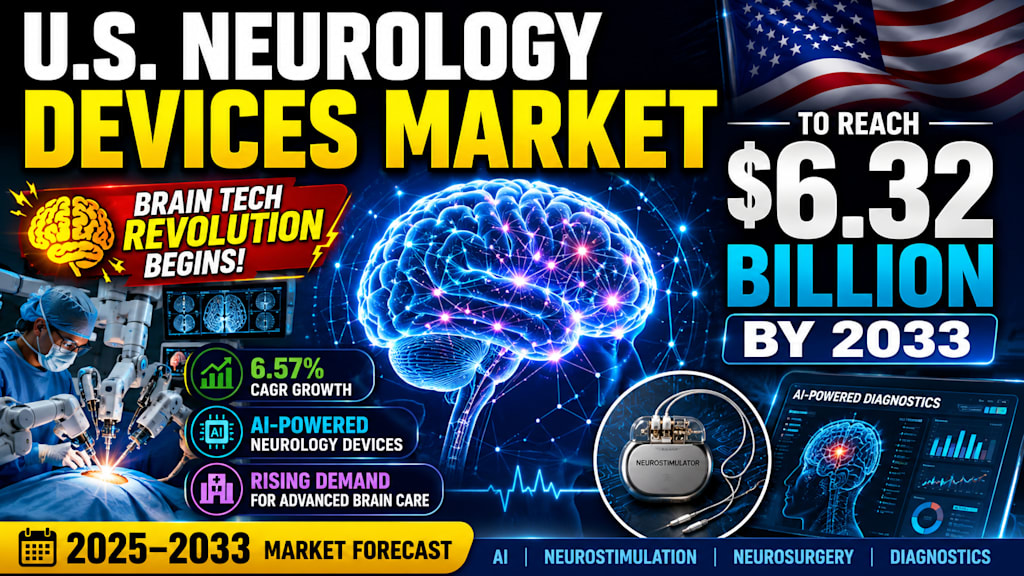
United States Neurology Devices Market Size and Forecast 2025–2033
The United States Neurology Devices Market is poised for substantial expansion over the coming decade, reflecting the growing importance of advanced neurological care in modern healthcare systems. According to Renub Research, the market is projected to increase from US$ 3.57 billion in 2024 to US$ 6.32 billion by 2033, registering a compound annual growth rate (CAGR) of 6.57% from 2025 to 2033.
As neurological disorders continue to affect millions of Americans, healthcare providers are increasingly relying on innovative devices for diagnosis, treatment, monitoring, and rehabilitation. From neurostimulation systems and neurosurgical tools to advanced neurodiagnostic equipment, technology is reshaping how neurological conditions are managed across hospitals, specialty clinics, and outpatient settings.
The combination of an aging population, rising disease burden, and continuous innovation is creating favorable conditions for sustained market growth throughout the forecast period.
Neurological Disorders Continue to Drive Market Demand
Neurological diseases represent one of the most pressing healthcare challenges in the United States. Conditions such as Alzheimer's disease, Parkinson's disease, epilepsy, multiple sclerosis, stroke, and traumatic brain injuries are becoming increasingly prevalent.
The aging population is a significant contributor to this trend. As life expectancy rises, age-related neurological disorders are becoming more common, creating a growing need for sophisticated diagnostic and therapeutic solutions.
Neurology devices have emerged as essential tools for healthcare professionals seeking to improve diagnosis accuracy, monitor disease progression, and deliver targeted treatments. Advanced technologies help physicians intervene earlier, reduce complications, and improve long-term patient outcomes.
The increasing awareness of neurological health among patients and caregivers is also encouraging more individuals to seek specialized care, further boosting demand for innovative neurological technologies.
Technological Innovation Is Transforming Neurological Care
Innovation remains one of the most influential factors shaping the U.S. neurology devices market. Medical device manufacturers are investing heavily in research and development to introduce next-generation technologies that enhance patient care and clinical efficiency.
Neurostimulation devices have become particularly important in treating chronic neurological conditions. These systems deliver targeted electrical impulses to specific regions of the nervous system, helping manage disorders such as Parkinson's disease, epilepsy, chronic pain, and movement disorders.
Meanwhile, advances in neuroimaging technologies are enabling physicians to visualize brain activity and neurological structures with unprecedented precision. Improved imaging capabilities support faster diagnosis and better treatment planning.
Another notable trend is the increasing adoption of minimally invasive neurosurgical technologies. These advanced systems allow surgeons to perform complex procedures with greater accuracy while minimizing tissue damage, reducing recovery times, and lowering complication rates.
Wearable neurological monitoring devices are also gaining popularity. These technologies provide continuous patient monitoring outside traditional healthcare settings, improving disease management and enabling more personalized care approaches.
Artificial Intelligence Expands Neurology Device Capabilities
Artificial intelligence (AI) is rapidly becoming a transformative force within the neurology devices industry.
AI-powered algorithms are helping healthcare professionals analyze large volumes of neurological data, identify subtle abnormalities, and predict disease progression more effectively. These capabilities are particularly valuable in conditions such as Alzheimer's disease and epilepsy, where early intervention can significantly improve outcomes.
Machine learning technologies are being integrated into neurodiagnostic devices to support faster and more accurate diagnoses. Real-time data analytics allow clinicians to monitor patients remotely and adjust treatment plans based on continuously evolving information.
The combination of AI, digital health platforms, and connected medical devices is creating a new era of precision neurology, where treatment decisions are increasingly guided by personalized patient data.
Expanding Healthcare Infrastructure Supports Market Growth
The growth of healthcare infrastructure across the United States is another major factor contributing to market expansion.
Hospitals, specialty neurology centers, ambulatory surgery facilities, and diagnostic clinics are investing in advanced neurological technologies to meet growing patient demand. These investments are enabling healthcare providers to offer more comprehensive neurological services while improving operational efficiency.
Government funding and private-sector investments are further accelerating innovation and adoption. Research grants, public health initiatives, and venture capital funding continue to support the development of new neurological technologies and treatment approaches.
Additionally, collaboration between healthcare providers, research institutions, and device manufacturers is facilitating faster commercialization of breakthrough innovations.
As healthcare systems prioritize neurological care, demand for sophisticated diagnostic and therapeutic devices is expected to remain strong throughout the forecast period.
Neurostimulation Devices Lead Product Innovation
Among various product categories, neurostimulation devices are emerging as one of the most dynamic segments of the neurology devices market.
These devices offer effective treatment options for patients suffering from chronic neurological conditions that may not respond adequately to pharmaceutical therapies. Deep brain stimulation, spinal cord stimulation, and vagus nerve stimulation technologies are increasingly being adopted across healthcare facilities.
The ability of neurostimulation devices to improve patient quality of life while reducing long-term healthcare costs is driving widespread clinical acceptance.
Manufacturers continue to enhance these systems through improvements in battery life, device miniaturization, wireless connectivity, and personalized programming capabilities.
As evidence supporting neurostimulation therapies continues to grow, this segment is expected to remain a key contributor to overall market growth.
Neurosurgical and Interventional Neurology Devices Gain Momentum
Neurosurgical devices represent another critical segment within the U.S. neurology devices market.
Advancements in robotic-assisted surgery, navigation systems, and minimally invasive surgical tools are improving precision and reducing risks associated with neurological procedures. These technologies are helping surgeons address complex brain and spinal disorders more effectively.
Interventional neurology devices are also experiencing increasing adoption. These solutions play an essential role in managing stroke and cerebrovascular disorders, enabling faster treatment and improved patient outcomes.
As hospitals continue investing in advanced surgical capabilities, demand for innovative neurosurgical and interventional devices is expected to rise significantly.
Market Challenges Remain Despite Strong Growth Prospects
Although the outlook for the U.S. neurology devices market remains highly positive, several challenges could impact growth.
High Device Costs and Reimbursement Issues
Advanced neurological devices often require substantial financial investment. Technologies such as implantable neurostimulators, robotic surgical systems, and sophisticated imaging equipment can be expensive for healthcare providers.
Smaller hospitals and rural healthcare facilities may face difficulties acquiring these technologies due to budget constraints.
In addition, reimbursement policies for neurological procedures vary across insurers, creating uncertainty for providers and patients alike. Limited reimbursement coverage can restrict access to advanced treatments and slow adoption rates.
Addressing affordability concerns and improving reimbursement frameworks will be essential for broader market penetration.
Regulatory Complexity
Neurology devices must undergo rigorous testing and clinical validation before receiving regulatory approval.
While these requirements are necessary to ensure patient safety, they can significantly increase development timelines and costs. Smaller companies often face challenges navigating complex regulatory pathways, limiting their ability to compete with larger industry players.
Long approval cycles may delay the introduction of innovative technologies to the market, potentially slowing overall industry growth.
However, industry stakeholders continue to advocate for streamlined regulatory processes that maintain safety standards while supporting innovation.
State-Level Market Analysis
California: Innovation Hub for Neurology Devices
California remains one of the leading markets for neurology devices in the United States. The state's combination of world-renowned research institutions, advanced healthcare facilities, and strong venture capital ecosystem creates an ideal environment for innovation.
Technology expertise from Silicon Valley is contributing to the development of AI-powered neurological solutions, wearable devices, and brain-computer interface technologies.
California's hospitals and research centers continue to serve as early adopters of cutting-edge neurological technologies.
Texas: Rapidly Emerging Growth Center
Texas is becoming a major destination for neurology device innovation and investment.
Healthcare hubs in Houston, Dallas, and Austin are driving research, development, and clinical adoption of advanced neurological technologies. Lower operating costs compared to other major markets make Texas attractive for medical device manufacturers and startups.
The state's expanding healthcare infrastructure further supports strong market growth.
New York: Clinical Research and Innovation Leadership
New York maintains a strong position in the neurology devices market due to its concentration of leading hospitals, academic institutions, and biotechnology companies.
The state plays a critical role in clinical trials and translational research, accelerating the development of innovative neurological technologies.
Strong collaboration between healthcare providers and medical device companies continues to foster breakthroughs in neuroimaging, neuromodulation, and minimally invasive surgery.
Florida: Growing Demand Driven by Aging Population
Florida's large senior population is creating significant demand for neurological care and related technologies.
Hospitals and research institutions across the state are increasingly adopting advanced diagnostic and therapeutic devices to address conditions such as Alzheimer's disease, stroke, and epilepsy.
Growing biotechnology clusters and supportive healthcare initiatives are strengthening Florida's position as an important regional market.
Competitive Landscape Intensifies
Competition within the U.S. neurology devices industry continues to intensify as established manufacturers and emerging innovators seek to capture market share.
Leading companies are focusing on product innovation, strategic partnerships, acquisitions, and geographic expansion to strengthen their competitive positions.
Major players operating in the market include:
Medtronic plc
B. Braun Melsungen AG
Boston Scientific Corporation
Stryker Corporation
Abbott Laboratories
Johnson & Johnson
Smith & Nephew
MicroPort Scientific Corporation
These companies continue investing heavily in innovation to meet the growing demand for neurological care solutions.
10 Recent Developments by Leading Companies
1. Medtronic plc
Expanded its deep brain stimulation portfolio with advanced programming capabilities designed to improve treatment personalization for Parkinson's disease patients.
2. Abbott Laboratories
Enhanced its neuromodulation technologies through software upgrades aimed at improving patient comfort and treatment effectiveness.
3. Boston Scientific Corporation
Advanced next-generation brain stimulation solutions focused on movement disorders and chronic neurological conditions.
4. Stryker Corporation
Strengthened its neurosurgical portfolio through investments in navigation and robotic-assisted surgical technologies.
5. Johnson & Johnson
Continued development of minimally invasive neurosurgical solutions to improve procedural precision and patient recovery outcomes.
6. B. Braun Melsungen AG
Expanded its neurosurgery product offerings with innovations supporting safer and more efficient surgical procedures.
7. Smith & Nephew
Increased focus on advanced surgical technologies and digital integration for neurological and complex surgical applications.
8. MicroPort Scientific Corporation
Accelerated investment in innovative neurological intervention devices targeting improved clinical outcomes.
9. Medtronic plc
Strengthened AI integration initiatives to support predictive analytics and remote neurological patient monitoring.
10. Abbott Laboratories
Expanded research collaborations with healthcare institutions to advance next-generation neurostimulation therapies.
Market Segmentation
By Product
Neurostimulation
Neurosurgery Devices
Interventional Neurology
CSF Management Devices
Others
By End User
Hospitals
Ambulatory Surgery Centers
Others
By State
California
Texas
New York
Florida
Illinois
Pennsylvania
Ohio
Georgia
New Jersey
Washington
North Carolina
Massachusetts
Virginia
Michigan
Maryland
Colorado
Tennessee
Indiana
Arizona
Minnesota
Wisconsin
Missouri
Connecticut
South Carolina
Oregon
Louisiana
Alabama
Kentucky
Rest of United States
Final Thoughts
The United States Neurology Devices Market is entering a period of sustained growth driven by increasing neurological disease prevalence, rapid technological advancement, and expanding healthcare investments. With the market projected to grow from US$ 3.57 billion in 2024 to US$ 6.32 billion by 2033, opportunities are emerging across neurostimulation, neurosurgery, neurodiagnostics, and digital neurology solutions.
As artificial intelligence, wearable technologies, and minimally invasive procedures continue transforming neurological care, device manufacturers are positioned to play a critical role in improving patient outcomes. While challenges related to reimbursement, regulatory approval, and device affordability remain, ongoing innovation and collaboration across the healthcare ecosystem are expected to support long-term market expansion. The future of neurological healthcare in the United States will increasingly depend on advanced devices that enable earlier diagnosis, more precise treatments, and personalized patient management.
About the Creator
Enjoyed the story? Support the Creator.
Subscribe for free to receive all their stories in your feed.
Comments
There are no comments for this story
Be the first to respond and start the conversation.